War’s Early Years

During much
of the spring of 1940 Wolff was involved in the infighting over Himmler’s
attempts to set up further armed fighting units of the Waffen SS. Gruppenfuhrer
Theodor Eicke, commander of the Totenkopf
division[i],
was prepared to beg borrow or steal equipment for his men. Eicke informed Wolff
that he planned to break into the Skoda works to arm the Totenkopf troops. In the alternative he suggested
that Wolff could ask Himmler to approve the creation of a heavy artillery
battalion for the division.
By March
Eicke was writing to Himmler complaining that none of the booty at the Skoda
works had been given to his men; instead it had been passed on to the Wehrmacht. Wolff was used by Himmler as an intermediary between Eicke and himself,
suggesting that Eicke did not escalate the fight over the weapons.
On 23rd
March Wolff contacted the Ministry of Justice informing them that
‘”The Fuhrer proposes to
postpone punishment of the so-called “decent poachers” and, provided they acquit
themselves well at the front, to guarantee them amnesty.”’[ii]
Wolff then
demanded a list of all poachers known to the ministry; 55 poachers were eventually
transferred to the Totenkopf division.
France

Dr Stumpfegger
On 12th
May[iii] Wolff, along with
Pieper, Professor Gebhardt[iv], and Dr Stumpfegger[v], joined Himmler on an inspection
tour of the new occupied territories and Waffen SS troops. The first night was
spent in Hasselt where the party was joined for dinner by the commander of the Der
Fuhrer standarte & his deputy.
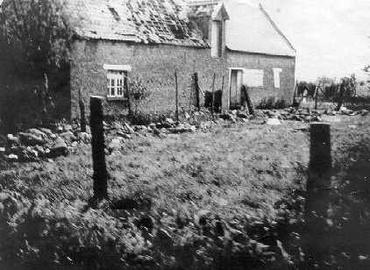
le Paradis
Fifteen days
later the Totenkopf division were responsible for the massacre at le Paradis[vi]. Himmler was furious with Eicke and
declared the matter a state secret. Wolff was well aware of the massacre as he
discussed it on the phone with Rudolf Brandt. On 31st May Himmler
gave Eicke one of his most trusted subordinates, Brigadefuhrer[vii] Kurt Knoblauch, as a
deputy; the paranoid Eicke was not impressed with what he believed was a spy
from HQ.
Mid-July saw
Wolff back on tour with Himmler in Burgundy; where Himmler burbled on about
creating an SS state within a state; Himmler would be Grand Master and his
Wolffchen[viii] the Chancellor. On 19th
July Wolff and Himmler flew back to Berlin to attend Hitler’s justification of
his aggression and an offer of peace to Britain;
‘"My
foreign policy had identical aims. My program was to abolish the Treaty of
Versailles. It is futile nonsense for the rest of the world to pretend today that I did not reveal this program until
1933 or 1935 or 1937. Instead of listening to the foolish chatter of émigrés,
these gentlemen would have been wiser to read what I have
written thousands of times.”’[ix]
The Intermediary
Erich von dem Bach Zelewski
Wolff always
claimed that he knew nothing of the Holocaust; but he was certainly aware that
the Jews were being mistreated. On 13th September Erich von dem Bach Zelewski[x] wrote to Wolff about his meeting
with Himmler two days earlier, discussing using Jews for hard labour in
Silesia.
During the
autumn Wolff was acting as an intermediary in the internecine brangling between
Eicke and Gottlob Berger head of the Waffen SS recruitment,
over replacement troops for the Totenkopf division. Eicke claimed that Berger
was sending him sub-standard troops; while Berger complained that Eicke was
placing the needs of the Totenkopf above the remainder of the Waffen SS. Eicke
also upset Hans Juttner[xi] who disbanded Eicke’s motorcycle
division.
Hans Juttner
Eicke asked
Wolff to complain to Himmler about Berger’s recruitment procedures; an action
Wolff was unwilling to undertake as Himmler was very enthusiastic about the
numbers of men, including Volksdeutsche[xii], that Berger was
recruiting to the Waffen SS[xiii]. Eicke was also
desperate to save one of his men arrested by Juttner’s orders for attempting to
remove military equipment from Dachau[xiv].

Dachau - SS barracks on right
By spring
1941, as the military build up for the invasion of Russia was underway, Wolff
was embroiled in a scandal at one of the Lebensborn homes under his control. The
conditions at the Kurmark Lebensborn home[xv] were provoking local
gossip. Himmler, worried about the reputation of the home as a brothel,
ordered;
‘The homes risk losing their
good reputation through such visits [from male friends of the inmates]. To avoid hardship a visitor’s hut will be
established……where there will be no opportunity for intimacy.’[xvi]
Preparing for the Invasion
Kurt Daleuge
Sometime in
March 1941 Wolff attended a meeting about the preparation for the invasion of
Germany’s ally Russia. Kurt Daluege[xvii], Berger, the Obergruppenfuhrers[xviii] and the Gruppenfuhrers
who were in charge of the Einsatzgruppen and were to be the SS leaders of the
conquered territories attended Himmler’s meeting at Wewelsburg[xix].

Richard Glucks
On 1st
March Wolff joined Himmler, IG
Farben executives, von dem Bach Zelewski, Richard Glucks[xx] and a number of other officials for
the first inspection of Auschwitz[xxi]. On this day Himmler ordered an
increase in the size of the camp from 10,000 to 30,000 prisoners who would be
used to build a factory for IG Farben. The same month Wolff was involved with
Himmler, Daluege and Heydrich in deciding the role of the police in the to-be conquered
lands in Russia.
It would
appear that Wolff had overreached himself financially, as the following month, having
admitted that he owed 150,000 Reichsmarks on his house on the Tegernsee, SS
negotiators reduced the debt to 21.500 Reichsmarks. FX Schwarz, the Nazi party treasurer, gave 1,500 Reichsmarks towards
paying off the loan. Later Himmler was to write to Schwarz giving his opinion
of Wolff; he would give Wolff 21,500 Reichsmarks partly as a gift and partly as
a loan from Freundeskreis RFSS funds.
On the 4th
May Wolff accompanied Himmler to listen to Hitler detail the results of the
campaign in the Balkans, thrust upon an unwilling Hitler[xxii] by Mussolini’s
overweening ambition to emulate Hitler’s successes in France. Hitler castigated
Churchill as the architect of the war,
claiming;
'He is the most bloodthirsty
or amateurish strategist in history'[xxiii]
On 9th May
Wolff joined Himmler on a trip to inspect the Leibstandarte Adolf Hitler[xxiv] in Larissa, Greece.
Friedrich Jeckeln
In mid-June
Wolff attended a three day meeting of Himmler and his senior staff at
Wewelsburg. Heydrich, von dem Bach-Zelewski, Friedrich Jeckeln[xxv], Daleuge, Oswald Pohl and Rudolf Brandt were among those attending. The future Higher SS and Police Fuhrers (HSSPF) were given copies of Heydrich’s
instructions to the Einsatzgruppen. It was expected that 30 million undesirables[xxvi] in the Soviet Union
would have to be killed.
The Killing Fields
In October,
after the invasion of Germany’s former ally Russia, Wolff joined Himmler on a
trip to the newly conquered territories. On 15th October Himmler,
accompanied by his faithful Wolffchen, addressed the men of Bach-Zelewski’s
einsatzgruppen in Minsk. There
had been complaints from the army about the einsatzgruppen killing methods.
Himmler
witnessed an 'execution' of partisans and Jews;
‘After the first salvo
Himmler came right up to me and looked personally into the ditch, remarking
that there was someone still alive. He said to me “Lieutenant, shoot that
one!”’[xxvii]
He told his
men that he and Hitler would answer to history for the necessary extermination
of the Jews as;
'”The carriers of world
Bolshevism.”’[xxviii]
According to
him this justified the harshest possible measures against the Jews.
Artur Nebe
In afternoon
Himmler visited mental hospital in Novinki, where Artur Nebe[xxix] was instructed to kill the inmates.
Himmler also found time to visit a POW camp, drive through the Minsk ghetto and
talk to Bach-Zelewski about killing methods. He also instructed Nebe to develop
less brutalizing methods of killing.
On 21st
October Heydrich wrote to Wolff complaining about the number of Jews being
claimed as indispensible to the work force; no doubt Heydrich and his men were
eager to murder them. Wolff must have been aware of the reports coming in from
Heydrich’s einsatzgruppen, in competition with each other, boasting about the
numbers of Jews and political commissars being killed.

Schwerin von Krosigk
In late
October 1941 Wolff accompanied Himmler to Joachim von Ribbentrop’s shooting
lodge at Schonhof, near Salzburg. Also present, at what Hitler intended to be a
reconciliation between Himmler and von Ribbentrop[xxx], was Galeazzo Ciano Italy’s foreign minister, Schwerin von Krosig[xxxi] and Himmler’s masseur Felix Kersten[xxxii]. Himmler told Kersten;
'”I would never have come to
this shooting party if the Fuhrer had not expressly wished me to come.”'[xxxiii]
The beaters
comprised 400 soldiers and the majority of the bag was taken by Ciano.
Bibliography
The
Architect of Genocide – Richard Breitman, Pimlico 1991
Master Race
– Catine Clay & Michael Leapman, BCA 1995
Nazi Conspiracy and
Aggression Volume V – International Military Tribunal, US Government Printing
Office 1946
Hitler –
Nemesis – Ian Kershaw, Penguin 2001
Top Nazi –
Jochen von Lang, Enigma Books 2005
Heinrich
Himmler – Peter Longerich, Oxford University Press 2012
Himmler –
Peter Padfield, Cassell & Co 2001
The Rise and
Fall of the Third Reich – William L Shirer, Book Club Associates 1985
The SS A New
History – Adrian Weale – Little Brown 2010
[i]
Originally formed from concentration camp personnel. Eicke had been the
inspector of the camps; a job which was then given to Richard Glucks
[ii]
The SS - Weale
[iii]
Two days after the commencement of the invasion of France
[iv]
Himmler’s boyhood friend and a doctor
[v]
Himmler’s doctor
[vi]
Soldiers of the Royal Norfolk Regiment were executed contrary to the rules of
war
[vii]
Equivalent of a Brigadier General
[viii]
Himmler’s pet name for Wolff, he often gave those around him nicknames
[ix]
Nazi Conspiracy and Aggression Volume V – International Military Tribunal
[x]
Leader of one of the Einsatzgruppen, responsible for the death of tens of
thousands of Russians and Jews; later SS head of Russland Mitte
[xi]
Head of the SS Fuhrungshauptamt and Berger’s alter-ego, responsible for
equipping and all other matters pertaining to the Waffen SS. He and Berger
reported direct to Himmler, while theoretically Eicke reported to Juttner. But
as an old SS man he had Himmler’s ear and was able to contact Himmler direct.
[xii]
People of German origin
[xiii]
In competition with the Wehrmacht
[xiv]
Not only a concentration camp but also SS barracks
[xv]
In Klosterheide near Lindow
[xvi]
Master Race – Clay & Leapman
[xviii]
Equivalent to a Lieutenant General
[xix]
Himmler’s castle, used for meetings of the senior SS officers and for training;
adapted by slave labour at enormous cost
[xx]
The concentration camps inspector
[xxi]
The land had been purchased the previous year and Rudolf Hoss had been
appointed commander of what had originally been intended as a transit camp
[xxii]
Hitler always claimed that having to pull the Italian eggs from the fire was
the principal cause of the disasters at the end of the year.
[xxiii]
The Rise and Fall of the Third Reich - Shirer
[xxv]
An HSSPF Bach-Zelewski had oversight of Einsatzgruppe B
[xxvi]
Including Jews and Communist party officials; presumably Wolff was out having a
cigarette when this forerunner of the Holocaust was mentioned
[xxvii]
Heinrich Himmler - Longerich
[xxviii]
Ibid
[xxix]
A police officer and head of Eisatzgruppe B and later one of the conspirators
attempting to kill Hitler
[xxx] The two former friends
had a falling out over the activities of the SD men placed in German embassies
around the world; Ribbentrop had the SD men thrown out of the embassies, much
to Himmler and Heydrich’s fury
[xxxi]
Minister of Finance
[xxxii]
A very ambiguous man who took credit for Himmler’s release of Jews in the last
months of the war
[xxxiii]
Himmler - Padfield


