Tuesday, 16 July 2013

The Apprenticeship of Peter the Great V


The Call of the West
Andrei Matveyev
Peter named Lefort[i] as head of the Great Embassy. One of Lefort’s two colleagues, Golovin, was a professional diplomat, to whom Peter entrusted conduct of foreign affairs. Voznitsyn also had previous diplomatic experience. Prominent among the noblemen and volunteers[ii] accompanying the embassy were Peter’s childhood friends Andrei Matveyev[iii] and Alexander Menshikov.

With them went Pyotr Mikhailov. To address the Czar as anything else, or to reveal that Peter was the Czar, or mention that he was accompanying the embassy was punishable by death.

To govern Russia in his absence Peter established a three man council, consisting of his uncle Lev Naryshkin, Prince Boris Galitzyne and Prince Peter Prozorovsky, the Czar’s treasurer. The man who actually ran the country, subordinate to these three, was Prince Fedor Rodomanovsky, the Governor General of Moscow.
Just before the embassy’s departure three men were arrested; Ivan Tsykler[iv], colonel of one of the Streltsy regiments, and two boyars. The three men had been fulminating against the Czar’s perceived desertion of his wife and the Kremlin and of his consorting with foreigners. Their grumbles had been made too publicly and Peter was furious. The news of the arrest was brought to the Czar dining with his friends in the German Suburb; in his diary Gordon noted

‘A merry night has been spoiled by an accident of discovering treason against his Majesty.’[v]
The three traitors were bloodily executed in Red Square, having touched a raw nerve in the Czar’s character.

A Czar Abroad
The embassy departed Moscow on 20th March 1697, leaving Russia via the Swedish province of Livonia[vi]. Peter studied the new Swedish fortress in Riga with great interest. The party then travelled through the Duchy of Courland[vii], where Peter was entertained lavishly by the reigning Duke, one of whose ministers wrote;

‘Open tables were kept everywhere with trumpets and music attended by feasting and excessive drinking as if his Tsarish Majesty had been another Bacchus. I have not yet seen such hard drinkers.’[viii]

Frederick of Brandenburg
 
The Russians were met by Frederick III[ix], the Elector of Brandenburg when they travelled on from Courland. Frederick was anxious to sign an alliance against the Swedes but Peter, still at war with the Ottoman Empire, was unwilling to provoke the Swedes at his back. Frederick and Peter eventually signed a mutual defence treaty.
Peter lingered in Brandenburg waiting to discover who was to be Poland’s next king[x]. The news that Augustus of Saxony had been elected king of Poland, in preference to the French Prince de Conti, arrived in mid-August. Relieved of his fear that the Poles, under a French king, would withdraw from the fight against the Ottomans, Peter planned his departure to the Netherlands by sea. These plans were thwarted by the presence of a French squadron in the Baltic and reluctantly Peter travelled by land across Germany.

Sophia of Hanover
He was ambushed by Sophia, the Electress of Hanover[xi] and her daughter at Koppenbrügge, both were desperate to meet Peter. He was persuaded to join them for dinner, which lasted for four hours; after dining Peter was persuaded to dance with the first Western women he had ever got close to. He was surprised by their corsets; he amused mother and daughter by his comment,
‘These German women have devilish hard bones.’[xii]
After the dinner Peter set out down the Rhine on the last leg of his journey to the Netherlands, leaving the remainder of his entourage to follow at a more normal pace.

In the Netherlands

Peter's House
On the 18th August Peter arrived in the small town of Zaandam, a town renowned for shipbuilding. In his impatience to arrive he bypassed Amsterdam. It was arranged that Peter would stay in the home[xiii] of a widow who lived next door to a Dutchman, Gerrit Kist, whom Peter had known in Moscow.
Peter signed on as a common workman in one of the shipyards; during the day he worked on the ships; in the evenings he visited the wives and parents of Dutch workers in Russia. He bought a boat, haggling over the price and took it sailing.

The news of his identity spread throughout the country and soon crowds were descending upon the town, eager to see the Czar of Russia. His longed for stay in Zaandam lasted one week. Instead the preternaturally shy Peter moved to Amsterdam; at the time the greatest port on earth and the wealthiest city in the world.
It was suggested that Peter work in the docks of the East India Company, whose shipyards were enclosed and barred to the public. To assist Peter’s shipbuilding education the company’s board ordered the laying of a keel for a new frigate and allocated Peter the use of the company’s master ropemaker’s house, within the shipyard walls. The ship was named the Apostles Peter and Paul.

Peter and ten of his volunteers started work immediately, while the remainder were allocated to jobs in rope making, sail making, mast turning, block and tackle construction and seamanship. Prince Alexander of Imeritia[xiv] was despatched to den Haag to study artillery.
In France the Duchesse d’Orléans wrote of Peter to her aunt, the Electress of Hanover;

‘If he should fall on hard times, he will never starve to death, for he knows fourteen crafts. The great man here[xv] made fun of him for working with a shipwright in Holland and helping to build ships.’[xvi]
Peter visited factories, sawmills, spinners, workshops, museums, botanical gardens and laboratories. He met with architects and sculptors and took drawing and sketching lessons. He attended dissections by a renowned professor of anatomy and met botanists and the inventor of the microscope. On his free days Peter wandered around Amsterdam, once stopping to interrogate an itinerant dentist, later practising on his servants. His curiosity was insatiable.

Peter’s ministers in Moscow were reluctant to act without their master’s authority and he was inundated with letters and requests. Now thousands of miles away from home, Peter began to show more interest in ruling his country than ever before. He attempted to deal with his correspondence every Friday.
Peter and William

William III
Peter was invited to meet King William III at Utrecht. Of all the European leaders William was Peter’s foremost hero. His Dutch, German and other foreign friends in the German Suburb had long admired the dauntless William. An aficionado of all things Dutch Peter was greatly moved by this meeting, informing his host;
‘I have accomplished my wish and I am sufficiently rewarded for my journey by having enjoyed your presence. It is your military genius that has inspired my sword, and the noble emulation of your exploits has aroused in my heart the first thoughts I ever had of enlarging my empire.’[xvii]
Peter’s proposal that he and William join in an anti-Turk alliance met no favour from a man committed to fighting French hegemony in Europe. The Great Embassy presented their proposals to the States General, but the focus of the Dutch politicians was on western not eastern Europe. Burdened with debt and the need to replenish their own navy; the Dutch refused the request to help the Russians build and arm seventy warships and more than one hundred galleys.

Cornelius Cruys
When he was not working in the shipyards, Peter travelled across the Netherlands. Early on in his visit Peter met Admiral Gilles Schey[xviii]. Schey organised a mock naval battle for Peter’s edification; held at Ij. Peter tried to lure Schey back to Russia; Schey refused the offer but suggested an alternative, Admiral Cornelius Cruys[xix]. A reluctant Cruys was persuaded by Schey and other Dutch prominente to accept the post, understanding that he would be in a position to influence Russian trade with the Netherlands.
Peter and William met on numerous occasions; the meetings between these two very private individuals were unrecorded. Peter had become dissatisfied with the way the Dutch built their ships; each shipwright having his own quirky ways. At a meeting with William, Peter expressed a wish to visit England to look at the way the English built their ships. He arrived in England on 10th January 1698

Peter in England
William sent an escort to ferry Peter across the channel; he travelled with Menshikov and a number of the volunteers, leaving Lefort and the Great Embassy in the Netherlands. He met William a number of times; observed a ball being held in honour of Princess Anne, the heir apparent and spent much of his free time roaming around London, visiting workshops and factories.

Peter discussed religion with the leaders of the established church and purchased a watch and learnt how to dismantle, repair and reassemble his new possession. His interests seemed boundless, but his main concentration was on the acquisition of shipbuilding skills. Once again he took to working in the shipyards, this time at Deptford.

Plan of Sayes Court
While working at Deptford Peter stayed at the diarist John Evelyn’s house, Sayes Court; the place was almost trashed by Peter and his servants. Evelyn’s servant despaired;
‘The Czar lies next your library, and dines in the parlour next your study.’[xx]
When Peter left Evelyn sent in a bill for £150[xxi] to repair and clean his house.

In London Peter visited the arsenal, the Royal Mint and the Royal Society; these visits were to help inspire his vision of a Russian state based on modern Western ideals. He also visited the theatre on numerous occasions and indulged himself in an affair with a Mrs Cross, an actress. He had his portrait painted by Godfrey Kneller and presented the painting to William.
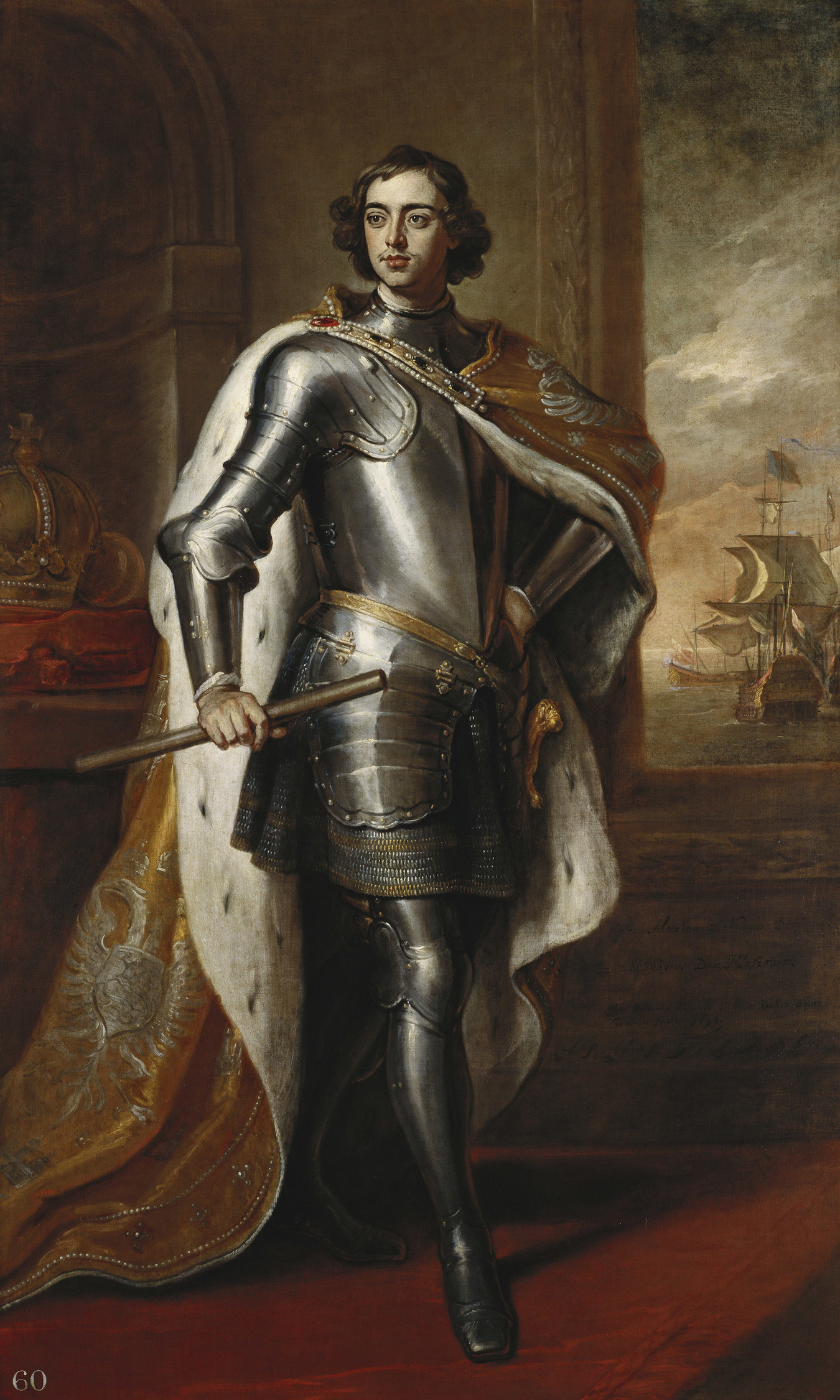
Peter the Great by Kneller
Peter left England on 23rd April 1698, giving William a ruby valued at £10,000[xxii], wrapped in a piece of brown paper. He returned to the Netherlands on the Royal Transport, a present from William[xxiii].

Bibliography
Natasha’s Dance – Orlando Figes, Penguin Books Ltd 2002

A Woman’s Life in the Court of the Sun King – translated Elborg Forster, The John Hopkins University Press 1984
Russia and the Russians – Geoffrey Hosking, The Penguin Press 2001

William and Mary – John van der Kiste, Sutton Publishing 2003
Peter the Great – Robert K Massie, Abacus 1992

William and Mary – Henri & Barbara van der Zee, History Book Club 1973
www.wikipedia.en


[i] By now also Governor-General of Novgarod
[ii] Those who had been chosen by Peter to learn shipbuilding in the west
[iii] Son of Artamon Matveyev murdered in front of Peter in the Streltsy uprising
[iv] Who had been expecting great things of his transfer of allegiance from Sophia, was angered by a posting to Azov
[v] Peter the Great - Massie
[vi] On the eastern shores of the Baltic
[vii] In western Latvia
[viii] Peter the Great - Massie
[ix] Later to be Frederick I of Prussia
[x] Jan Sobieski had died in June 1696
[xi] Her son became the first Hanoverian king of England, George I
[xii] Peter the Great - Massie
[xiii] Now a museum, Peter returned here several times
[xiv] Part of modern Georgia around the Rioni river
[xv] Louis XIV
[xvi] A Woman’s Life in the Court of the Sun King - Forster
[xvii] William and Mary – Henri & Barbara van der Zee
[xviii] A pupil of the great de Ruyter
[xix] Who was to become the commander of the Russian Baltic fleet
[xx] William and Mary – Henri & Barbara van der Zee
[xxi] In 2010 worth £15,300.00 using the retail price index £287,000.00 using average earnings www.measuringworth.com
[xxii] In 2010 worth £1,020,000.00 using the retail price index or £19,100,000.00 using average earnings www.measuringworth.com
[xxiii] Presented on 2nd March 1698

Tuesday, 9 July 2013

The Apprenticeship of Peter the Great IV


The Orthodox Church
Bust of General Gordon
Instead of capitalising on his coup Peter now returned to his adolescent games at Preobrazhenskoe and Lake Plaschev. Natalya and her advisers ruled in Ivan and Peter’s names. But Natalya and her friends lacked Sophia’s drive and determination. The Ukraine was not defended from Tartar attack, law and order decayed in the countryside and corruption was rampant. In addition Eudoxia’s relatives descended on Moscow to take advantage of her position. And contrary to the course the younger Czar was taking, the Patriarch encouraged hatred of foreigners.

Joachim was unable to control Peter, who spent much of his time in the German Suburb with his foreign friends. On 10th March 1690 Peter invited General Gordon to dine at court, in honour of Czarevitch Alexis’ birth. Joachim protested vehemently and Peter withdrew the invitation. His opinion of the Patriarch was made clear by his actions the following day, when he dined at his country house with Gordon and then rode back to Moscow beside him.

On 17th March the hostile Joachim died suddenly. He left a testament demanding that Peter appoint no foreigners to state or military positions[i]. Peter’s immediate response was to order a new set of German clothes and to dine with General Gordon in the German Suburb.

Patriarch Adrian
Peter backed the more westward leaning Marcellus, a scholarly churchman for the post of Patriarch. His mother and her advisers (and the majority of the faithful) backed the more conservative Adrian. After a contest lasting several months Natalya’s choice of candidate was given the post. Peter was disgusted by the appointment, telling foreign visitors some years later
When the Patriarch in Moscow was dead, he [Peter] designed to fill that place with a learned man, who had travelled, who spoke Latin, Italian and French….the Russians petitioned him in a tumultuous manner not to set such a man over them, alleging three reasons: first, because he spoke barbarous languages; second, because his beard was not big enough for a Patriarch; and third, because his coachman sat upon the coach seat and not on the horses as was usual.’[ii]

Peter’s Friends and Advisers
Anna Mons house in the German Suburb
In 1690 Peter made friends with François Lefort[iii] who, with General Gordon, was to become most closely associated with Peter. At Lefort’s home Peter was to meet the woman who was to become his mistress, Anna Mons[iv]. Anna was an ambitious woman and was to remain Peter’s mistress for twelve years; she had hopes of replacing Eudoxia, who Peter could not bear.
Peter had numerous friends in the German Suburb, but he also continued his friendships with the boys from his Preobrazhenskoe days. He also attracted the company of elder men, eager to work for the anointed Czar. Much of his time was spent on his war games, which became ever more elaborate.  It was through these war games that Peter was taught the art of war by his foreign friends; nor did he neglect his passion for boats during this period.

Archangel
Archangel was the only seaport the Russians possessed and it was Peter’s enthusiasm for the idea of sea power that drew Peter.

‘’I then decided to see the open sea, and began often to beg the  permission of my mother to go to Archangel. She forbade me such a dangerous journey, but, seeing my great desire and unchangeable longing, allowed it in spite of herself.’[v]
On 11th July 1693 Peter, Lefort and many of his foreign friends departed Moscow in a party of over one hundred on a trip to Archangel; by road and river a journey of one thousand miles.

Peter was fascinated by the sea and was greeted by a yacht, the St Peter, which had been constructed for him. He took the yacht out to sea in a convoy of English and Dutch ships leaving for Europe. Peter accompanied them to where the White Sea meets the Arctic and then he reluctantly turned back. Before his return to Moscow Peter laid the keel of a vessel larger than his little St Peter and ordered a Dutch built frigate from Amsterdam.
Change
Natalya died suddenly on 4th February 1694, aged forty two, only a few weeks after Peter’s recovery from a fever that laid him low from November 1693 to January 1694[vi]. His mother’s death filled Peter with grief. He did not attend her funeral, only visiting her grave to pray alone.

Czarevna Natalya
Peter now transferred his love to his younger sister Natalya, but she was to be unable to temper his enthusiasms. All the brakes on his behaviour were now gone. Less than three months after his mother’s death Peter took part in the great court Easter procession. It was the last time he would ever be involved in Kremlin ceremonials.
Peter returned to Archangel that summer, returning reluctantly to Moscow in early September to oversee the last of his great military peacetime manoeuvres. It was during this period of his life that Peter’s fits[vii] commenced. They made him seriously shy, concerned that strangers would see him.

A Campaign in Tartary
During the winter of 1695 Peter became obsessed with the idea of travelling. He announced another campaign against the Tartars; the objective was the fortress of Azov. This decision was made partly in view of Jan Sobieski’s threat to make peace with the Ottomans; a peace which would ignore Russia’s needs.

Two armies were formed to make separate attacks; one was led by Gordon and Lefort, which was to move down the Don and attack Azov. The other army, under Russian command, was to travel down the Dnieper and attack Oshakov and Kazikerman. For fourteen weeks Gordon’s army pounded Azov and the siege was eventually raised on October 12th.
The retreat was a disaster, costing lives and equipment. Peter attempted to mask the disaster by staging a triumphal march through Moscow. Like Galitzyne’s attempts if fooled no-one. There were harsh words uttered against the foreigners influencing the Czar; compounded by the relative success of the Russian army, who had taken their objectives. Peter determined to make another attempt on Azov; starting over winter a shipyard was built at Vorozneh on the Don, to build a massive fleet to attack Azov in the summer.

On February 8th 1696 Czar Ivan died. Peter immediately offered his protection to his brother’s wife and her daughters; thereby gaining Czarina Praskovia’s allegiance for the rest of her life. Peter was now the sole Autocrat of the Russian state.
Return to Azov

The siege of Azov
In late May the Russian army encamped around the fortress of Azov. Possibly suffering from hubris the Turks had not removed the previous year’s earthworks, and on June 8th the Russians opened fire, after the Turkish Pasha in charge of the fortress refused an offer for surrender. When Natalya begged Peter not to go near the fighting he replied;
‘It is not I who go near to cannon balls and bullets, but they come near to me. Send orders to them to stop it.’[viii]
On July 27th two thousand Cossacks, fed up with digging and carrying earth, stormed part of the walls of the fortress. The following day a general assault was ordered to capitalise on the Cossacks’ gains. Before it could commence the Turks surrendered.

Peter ordered the building of a fort and harbour to shelter his new fleet, intended to dominate the Black Sea. Taganrog was to become the first Russian naval base.
The Muscovites were stunned by this first Russian victory since the days of Czar Alexis. Peter did not head the parade, but walked with other galley captains behind the carriage of Admiral and General Lefort. This giant of a man, towering over the other marchers, was easily recognised as their eccentric Czar.

Forming a Navy
Peter summonsed his council of boyars and informed them of his plans to colonise Azov and Taganrog and his determination to construct a navy. Three thousand peasants and their families and three thousand Streltsy and their families were to be uprooted and despatched to Azov as military colonisers. In addition twenty thousand Ukrainian labourers were sent to Taganrog to build Peter’s new harbour.

The church, landowners and merchants would join the state in paying the costs of Peter’s new navy. All the ships were to be constructed, equipped and armed within a period of eighteen months. The timber would be provided by the state. The order was harshly enforced. When merchants complained of having to provide twelve ships the number was increased to fourteen.
On 22nd November 1696 Peter announced that he was sending more than fifty Russians to Western Europe to study seamanship, navigation and shipbuilding. No-one was to return without a certificate signed by a foreign master attesting to the student’s proficiency and they were to travel at their own expense.

Fedor Golovin
Two weeks later the Foreign Ministry announced that Lefort, General Fedor Golovin and Councillor Prokofy Voznitzyn were to travel to Western Europe, visiting England, Rome, Venice, the Netherlands and Denmark in what was to become known as the Grand Embassy. What was not announced was that the Czar was to travel with them. Peter was hoping to expand the alliance[ix] against the Turks.
Peter’s alias, Bombardier Peter Mikhailov, was to protect him against being caught up in ceremonial duties. But he was quick to take offence if he was not treated with suitable dignity. The one place Peter was not going to visit was France, whose desire for hegemony over Europe was at odds with Peter’s plans to oppose the expansion of Turkish influence in Eastern Europe.

Bibliography
Natasha’s Dance – Orlando Figes, Penguin Books Ltd 2002

Russia and the Russians – Geoffrey Hosking, The Penguin Press 2001
William and Mary – John van der Kiste, Sutton Publishing 2003

Peter the Great – Robert K Massie, Abacus 1992
William and Mary – Henri & Barbara van der Zee, History Book Club 1973

www.wikipedia.en


[i] To avoid the faithful being given orders by heretics
[ii] Peter the Great - Massie
[iii] Who married a cousin of General Gordon’s
[iv] She had already slept with Lefort
[v] Peter the Great - Massie
[vi] Peter was seriously ill and it was believed that he would die.
[vii] Possibly epileptic seizures induced by his fever the previous winter
[viii] Peter the Great - Massie
[ix] Weakened by the death of Jan Sobieski

Tuesday, 2 July 2013

The Apprenticeship of Peter the Great III


A Son and Heir
Eudoxia Lokupina
By the end of 1688 Natalya was determined to marry her son off to a suitable Russian noble lady. Sophia did not object, the Romanovs had only Peter to produce the next Czar Ivan was producing only daughters. Natalya was frustrated by Peter’s insistence on surrounding himself with foreigners. Particularly as, when he went away for long periods Peter was out of her control.

Peter was married to Eudoxia Lokupina in 1689. Eudoxia bore the Czarevitch Alexei Petrovich in February 1690, the following year in October she gave birth to Alexander Petrovich[i] and in 1693 Pavel Petrovich was born[ii].

The End of the Regency

Prince Galitzyne was unpopular with the masses as the man who was trying to force foreign ways on Russia. The charades of the two failed campaigns in the Crimea only added to the dislike with which he was viewed by the Boyars and the people. The old nobility began to gather around Peter and Natalya at Preobrazhenskoe. It was this group of nobles, inimical to Sophia and her lover, who had insisted that Galitzyne command the second Crimean campaign. 
Sophia did nothing to restrain her half brother during her years as regent. In January 1689 Peter was allowed to attend the Council of Boyars; he found it boring and did not often attend thereafter. Sophia was trying to arrange for a continuation of her rule, even after Ivan and Peter reached adulthood.

In 1686 Sophia had assumed the title of Autocrat[iii], marking her as an equal to Ivan and Peter. In the summer of 1687 Sophia investigated the possibility of being crowned with the support of the Streltsy. Alas, her plans foundered on the very conservatism of the Streltsy, that had forced Ivan into sharing the throne with Peter. The Streltsy disapproved of this innovation and the matter was quietly dropped.
Sophia had a portrait of herself painted wearing the Czar’s regalia. To the opposition this and the usurpation of the title of Autocrat was unacceptable. It was feared that Sophia would marry Galitzyne[iv] and depose Ivan and Peter or dispose of Peter. One of Sophia’s advisers, Fedor Shaklivity urged Sophia to crush the Naryshkin family and their allies before Peter came of age, killing Peter’s supporters and his mother. Sophia was now struggling to maintain her influence. Galitzyne refused to politic against an anointed Czar, but Shaklovity was openly denouncing the leaders of Peter’s party.

On 3rd July, General Gordon noted in his diary
‘The heat and the bitterness are ever greater and greater and it appears that they must break out soon.’[v]
A Crisis in Sophia’s Affairs

Donskoy Monastery
The crisis came to a head on 17th August 1689. Sophia had formed the habit of walking to various monasteries in Moscow, to pay her devotions. She notified the Streltsy that she required a regiment of Streltsy to accompany her to the Donskoy Monastery[vi] on the morrow. An anonymous letter appeared[vii] claiming that Peter was going to have Sophia and Ivan murdered.
A large number of Streltsy were garrisoned in the Kremlin overnight and the gates of the palace were shut. A close watch was kept on the road to Preobrazhenskoe, from whence the regicides were expected to come. The Streltsy were concerned that they would be ordered to murder Peter, their anointed Czar. The carrier of a routine despatch from Peter was dragged off his horse and beaten. He was taken to see Shaklovity.

Peter’s supporters at Preobrazhenskoe were warned of this outrage by one of seven Streltsy suborned by Prince Boris Galitzyne[viii], one of Peter’s supporters. On arrival of the news Peter was awakened and he fled on horseback to the Troitsky Monastery[ix]. The frightened seventeen year old Peter had been afraid of being hunted down, ever since he had witnessed the murder of his mother’s adviser as a ten year old.
At the Troitsky Monastery

Troitsky in the 1890s
Peter informed the Abbot that his sister intended to kill him and his family; he then fell into an exhausted sleep. During the night he was joined by his wife and mother, accompanied by Peter’s play regiments. During the following day the entire Sukharov Streltsy regiment arrived from Moscow. 
Far from being a panicked response to the actions of Sophia’s supporters; this arrival at Troitsky was part of a pre-arranged plan. This heavily fortified monastery was renowned throughout Russia as the traditional place of sanctuary of the royal family in times of danger. Peter’s advisers had chosen their bolt-hole carefully. The mere arrival of the Czar at Troitsky would send alarm bells ringing throughout the country and the Streltsy would not march against the Troitsky. And to his people Peter’s arrival there indicated that his life was in danger.

Peter’s advisers sent to Sophia querying the number of Streltsy that had been staying overnight in the Kremlin the previous night. The answer that the thousands of men were merely required to walk the Regent to a monastery two miles from the Kremlin was considered risible.
The colonel of the elite Stremyani regiment was ordered to the Troitsky with fifty of his men. Colonel Ivan Tsykler was one of the leaders of the 1682 revolt and one of Sophia’s most devoted adherents. Sophia was concerned about the summons and she had reason to be. Tsykler attended Peter and the Troitsky and told him and his advisers all he knew about the plans to suppress Peter’s supporters. Tsykler was a weather vane and switched sides to the coming man, only requiring the protection of a royal command.

Sophia Weakens
Peter spurned an embassy from Sophia and wrote to the colonels of all the Streltsy regiments commanding their attendance at the Troitsky. In person Sophia ordered the colonels not to obey the Czar’s order on the pain of beheading. The following day Peter informed Sophia and Ivan that he had ordered the colonels to attend him at his current residence.

Patriarch Joachim
Peter asked Sophia as Regent to ensure that his orders were obeyed. Sophia sent another embassy begging for a reconciliation. They returned to inform Sophia that Peter’s party were confident and growing rapidly in numbers. The Streltsy were starting to leave Moscow. Sophia sent the Patriarch Joachim to see Peter and once there the Patriarch declared his allegiance to Peter. Now  new supplicants arriving at Troitsky were met by Joachim and Peter.
On 27th August Peter wrote again to the colonels of the Streltsy commanding that they and ten soldiers from each regiment attend him at the Troitsky. A similar order was sent to the leading citizens of Moscow. A mass of Streltsy led by five colonels set out from Moscow to submit to the Czar. 

Sophia decided that the only choice she had left was to go to confront Peter herself. She travelled with Vasily Galitzyne, Shaklovity and an escort of Streltsy. Eight miles from the monastery, the party was met by armed men ready to fire and ordered to proceed no further. Sophia was further ordered to return to Moscow. On 11th September Sophia spoke to her supporters
‘They almost shot me at Vozdvizhenskoe. Many people rode out after me with muskets and bows. It was difficulty that I got away and hastened to Moscow in five hours. The Naryshkins and Lopukhins are making a plot to kill the Tsar Ivan Alexeivich and are even aiming at my head.’[x]
On her return Sophia received a letter from Peter claiming that Shaklovity and a monk named Sylvester Medvedev[xi] were colluding in a plot to kill Peter and demanded that they be turned over to him for judgement. Sophia attempted to rouse her supporters with a series of speeches; to the Streltsy, to the leading citizens of Moscow and to a large crowd of Muscovites including the foreign officers in the Russian army[xii]. Sophia commanded Ivan to serve vodka to the Streltsy, Muscovites and the foreigners.

On the 14th September Peter sent a written order to the German suburb, where the foreigners lived, commanding all foreign officers to Troitsky, fully armed and on horseback. That night a long cavalcade of officers left Moscow on the Troitsky road. Peter had won and the Streltsy remaining in the city knew it. They demanded that Sophia hand over the traitor Shaklovity. When she refused they threatened another revolt. Shaklovity was taken in chains to the Troitsky. t
Now it was Prince Vasily Galitzyne’s turn to appear before the Troitsky walls. Interrogation of Shaklovity proved Galitzyne’s innocence in the plot to murder Peter. Following intercession from Prince Vasily’s cousin Boris, Peter agreed to send Galitzyne into exile[xiii].

Peter then wrote to Ivan pointing out that the two of them were the anointed Czars and that Sophia should in future be excluded from ruling. He asked permission to appoint officials without specific approval from Ivan, promising that he would always defer to his half brother as the senior Czar.
‘I shall be ready to honour you as I would my father.’[xiv]

Novodevichy Convent
Ivan did not have much choice but to defer to the will of his younger more energetic brother. Sophia was ordered into the Novodevichy convent on the outskirts of Moscow. She resisted the removal from the Kremlin for a week, but was finally escorted to where she was to live for the last fifteen years of her life. She was not required to become a nun and had a comfortable suite of rooms available to her. In later years Peter was to describe her as
‘A princess endowed with all the accomplishments of body and mind to perfection, had it not been for her boundless ambition and insatiable desire for governing.’[xv]
Peter re-entered Moscow on 16th October on a road lined by kneeling Streltsy begging the Czar’s pardon. In the Uspensky Cathedral, within the Kremlin walls, Peter embraced his brother Ivan.

Bibliography
Natasha’s Dance – Orlando Figes, Penguin Books Ltd 2002

Russia and the Russians – Geoffrey Hosking, The Penguin Press 2001
Peter the Great – Robert K Massie, Abacus 1992


[i] Alexander died in May the following year
[ii] Pavel died the same year
[iii] An appellation allowed only for the Czar
[iv] Who was married
[v] Peter the Great - Massie
[vi] About two miles from the Kremlin
[vii] Possibly authored by Shaklovity
[viii] A cousin of Vasily Galitzyne
[ix] 45 miles north east of Moscow
[x] Peter the Great - Massie
[xi] One of Sophia’s supporters heavily involved in trying to reduce the power of the Patriarch
[xii] Who had been forbidden to leave Moscow
[xiii] He lived for 25 years in the Arctic north, dying at the age of 71
[xiv] Peter the Great - Massie
[xv] Ibid