The Howards of Norfolk
The fourth
Duke of Norfolk, Thomas Howard, was executed on the 2nd
June 1572; his crime? To get caught in the web of a spider, whose stupidity was
to eventually bring her too to the block as well as her intended fourth
husband; Mary Stuart, the deposed Queen of Scotland. Her
execution was delayed until February 1587, for continued plots against her captor, Elizabeth, Queen of England. 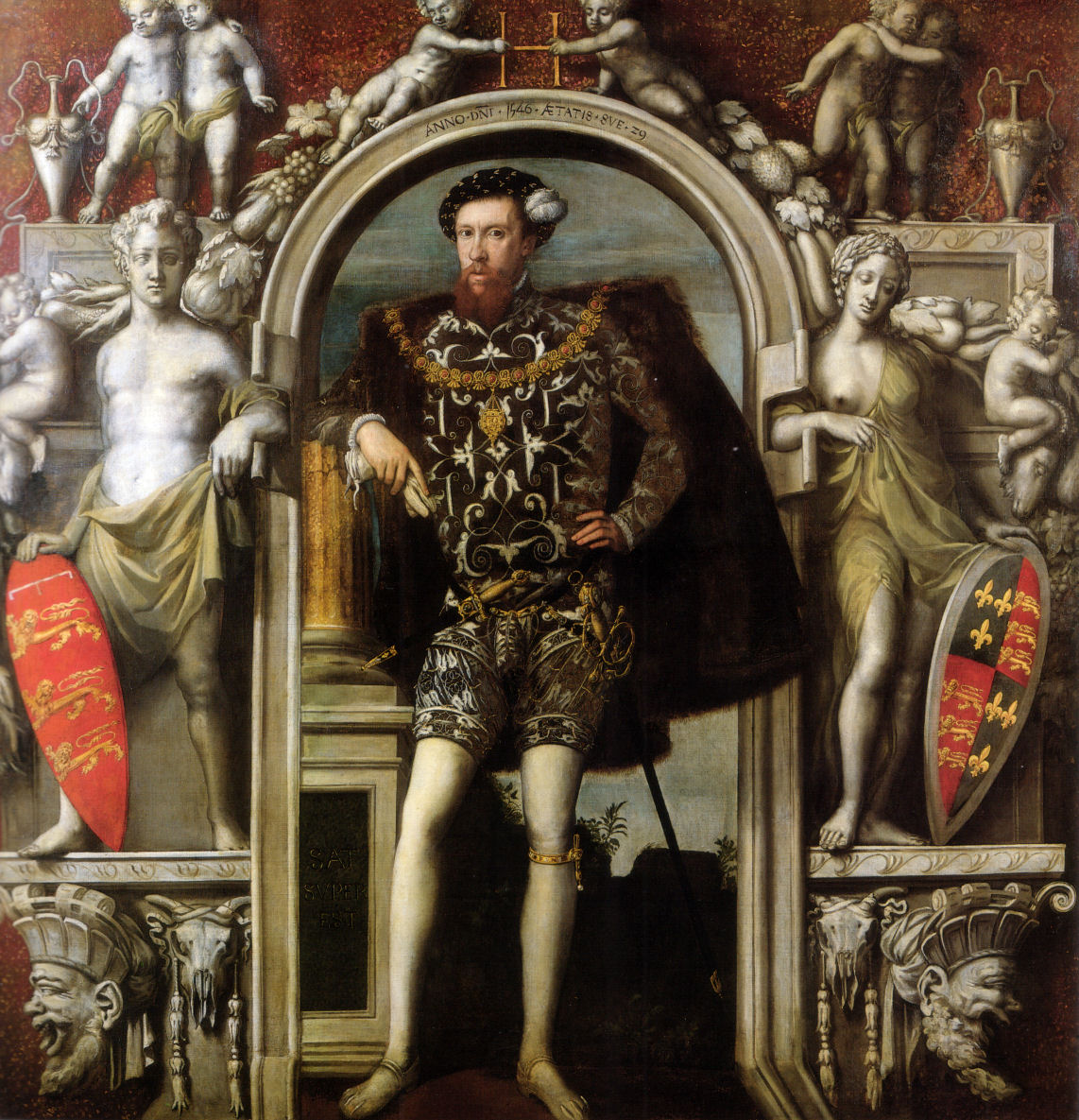 |
| Henry Howard, Earl of Surrey |
Born on 10th
March 1536, Thomas was the oldest son of Henry Howard, the Earl of Surrey[i], a poet of some merit, and
his wife Frances de Vere[ii]. Thomas[iii] was one of five children
and was brought up in the Protestant religion, although the family did have
Catholic leanings[iv].
Thomas was
born at his grandfather’s house; Kenninghall Palace was the home of Thomas Howard the third Duke of Norfolk. The elder
Thomas Howard was resident in the palace at the time of his grandson’s birth
and on 14th March he wrote to Thomas Cromwell, asking him to inform the king, Henry VIII, of the birth of the younger Thomas.
‘It hath pleased Almighty
God to send me so good a fortune that my daughter of Surrey is brought to bed of
a son………God be thanks, the child is as lusty a boy as needeth to be of that
age.’[v]

Frances Howard, Countess of Surrey
The elder
Thomas was the second most senior noble in the land and a schemer of the
highest order; it was as a result of his machinations that his niece Catherine Howard had married the king as his fifth wife. Norfolk
had not attempted to save her when she was accused of adultery, being more
concerned with saving himself.
‘The abominable deeds done
by two of my nieces against your Highness, hath brought me into the greatest
perplexity that ever poor wretch was in; hearing that Your Majesty……..might not
only conceive a displeasure in your heart against me.’[vi]
Norfolk had
already presided over the trial of another niece, Anne Boleyn, and had Thomas Cromwell arrested for high treason. Cromwell
had charged Norfolk with disloyalty during an argument over Cardinal Wolsey[vii] and Norfolk took his revenge on 10th
June 1540. Cromwell was executed on 28th July.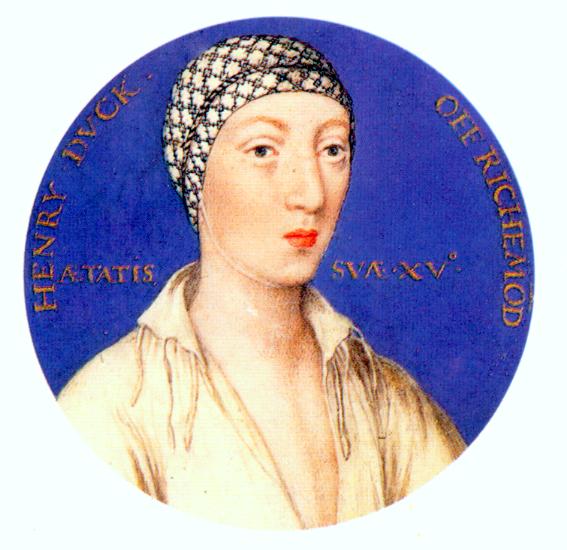
Henry Fitzroy, Duke of Richmond
The younger Thomas’s
father was a close friend of Henry Fitzroy, Duke of Richmond and Somerset, an
illegitimate son of King Henry. The two boys had grown up together, and Fitzroy
married Henry’s sister Mary. But Fitzroy died a few months after
the birth of Thomas, leaving no legitimate heirs.
Surrey’s
daughter Jane was born in the summer of 1532; his
second daughter Katherine was born in 1539 and Henry in February 1540. His last child
Margaret was born in January 1543. The children spent most of their time at
Kenninghall Palace; but they also resided at other Howard holdings throughout
East Anglia.
The Duke was
having his palace in Norwich rebuilt of stone from an abbey sequestered during
the Reformation. While the Earl of Surrey was
building Mount Surrey on the site of a former priory.
Childhood and EducationThe Howard children were taught riding, hawking, hunting and archery as well as more academic subjects. The young Thomas enjoyed hare coursing and in later life wrote a treatise[viii] on the subject. Thomas as future master of the estates was also given lessons in ruling a great household.
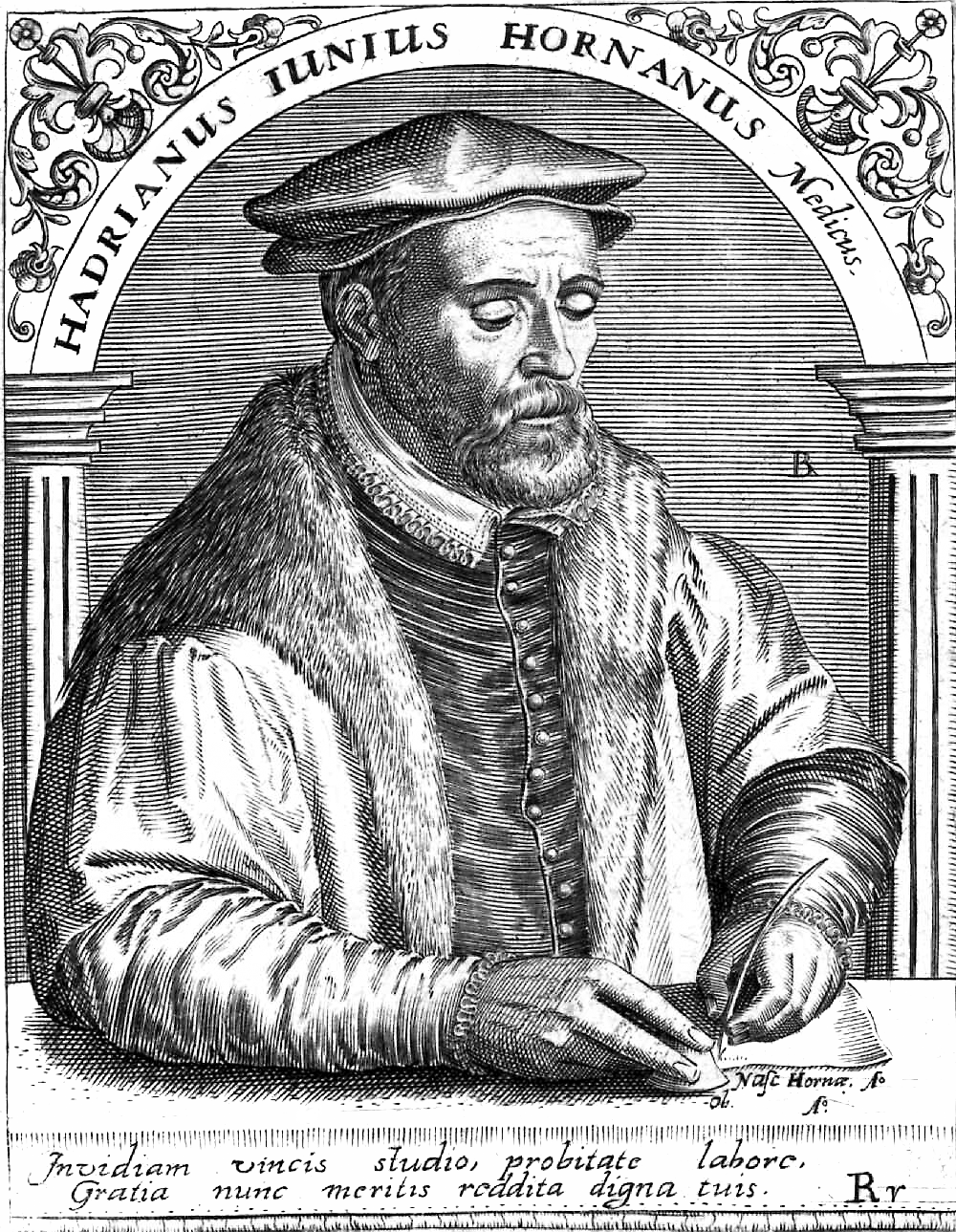
Hadrianus Junius
The Earl of
Surrey was a scholar of distinction nearest and dearest the children were
taught by a scholar of European renown; Hadrianus Junius[ix]. Jane and Henry were to benefit most
from their education. In later years Thomas was unable to talk Latin
sufficiently well to trust himself to discuss matters of state with the Spanish
ambassador.
‘Because his own Latin
tongue was not ready.’[x]
The Foolishness of the Earl of Surrey
The Howards
were old nobility and, even more than his father, Surrey despised new men. At
the same time he was not sufficiently able a courtier to hide his distaste from
such self-made men as Cromwell. Surrey was described as
‘The most foolish proud boy
that is in England.’[xi]
Surrey was
given Cromwell’s place as a Knight of the Garter following his fall from favour. Surrey was skilled at
jousting, thereby gaining the favour of the king. Nevertheless this did not
stop him finding himself in prison on a number of occasions, or being confined
in Windsor Castle.
On 1st
April 1543 Surrey was called before the Privy Council, charged with breaking the peace and
was sent to the Fleet for a second time. During his stay there he wrote A
Satire Against the Citizens of London.
‘London! Hast thou accused
me
Of breach of laws? the root
of strife!
Within whose breach did burn
to see,
So fervent hot, thy
dissolute life……’[xii]
When
released Surrey returned to Norwich and spent time that summer with his
children. By October he was back at court and joined a military expedition
aiding Emperor Charles V against François I. The following year Surrey fought in France and was made
Lieutenant General of the English forces based in Boulogne. He returned it
England in July 1545, asking the king for permission to have his family join
him in France; his request was refused.
Norfolk was
already planning dynastic marriages for his grandchildren;
‘Whereas my son of Surrey
has a son and divers daughters that a cross marriage might be made between the
Lord Great Chamberlain [Edward Seymour][xiii]
and them.’[xiv]
The scheme
came to nothing, but Surrey was plotting to have his widowed sister[xv] become her
father-in-law’s mistress. She refused to consider the matter for one moment.
A Nest of Traitors

Henry VIII
The king was
seriously ill and it was clear to those close to the king that Seymour’s star
was in the ascendant. Men who had previously courted the Howards now turned
their attentions and fawning upon the future Lord Protector. The Privy Council
started meeting at Seymour’s house and after 1st November 1546,
fearing for his safety, Norfolk stopped attending.
In early
December a Norfolk MP, whose loyalties changed with the wind, stood up in
council to proclaim that
‘He knew certain things
about the Earl [of Surrey] that touched his fidelity to the King.’[xvi]
Norfolk, who
had retired to Kenninghall, was sent for and interned in the Tower, upon his
arrival in London on 12th December.The draft articles against Surrey
and his father accused him of changing his armorial quarterings; illegal use of
an old ‘coat of the Crown’; attempting to prostitute family members to the king
in an attempt to rule him.
‘If a man say these words:
‘If the King die, who should have the rule of the Prince[xvii]
but my father and I?’; what it importeth.
The depraving of the King’s
Council.’[xviii]
Surrey was
found guilty of treason on 13th January and was executed on 19th
January 1547. Norfolk’s execution was set for 30th January, but was
forestalled by the death of the king the previous day.
A Breath of Fresh Air
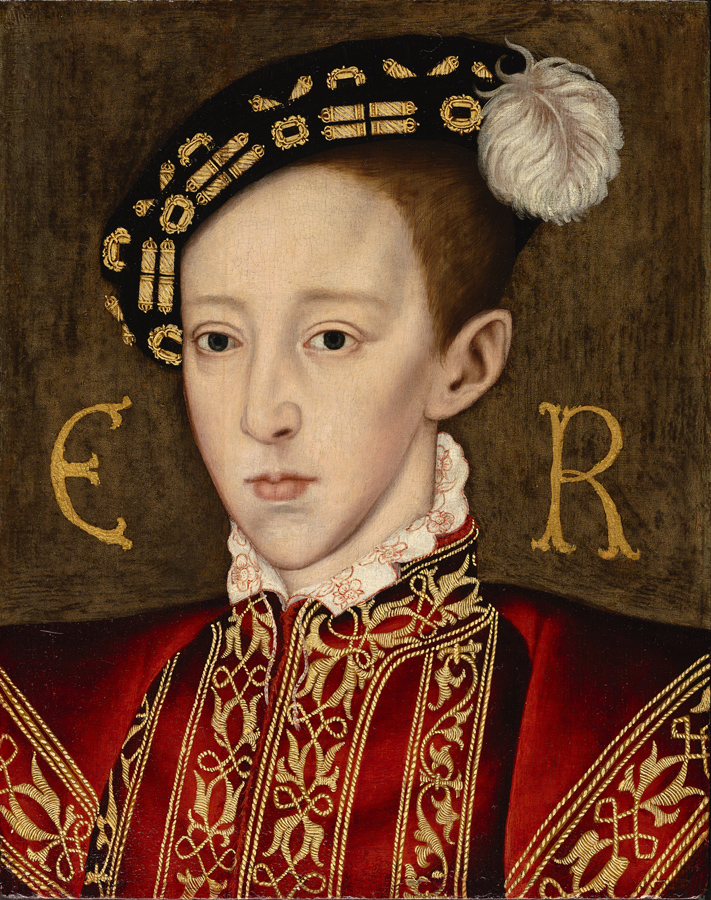
Edward VI
The young Edward VI was now king. The nine year old boy
had sixteen executors supplemented by twelve men of counsel. Originally Henry’s
will provided for a Regency Council but by the 4th February the
king’s uncle, Edward Seymour had been appointed Lord Protector of the king. He
was also made the king’s Governor and the Duke of Somerset.

Edward Seymour, Duke of Somerset
The Duke of Norfolk
was to remain in the Tower throughout Edward’s reign, his lands redistributed
among Somerset’s supporters, with a large portion being given to Somerset himself.
He also abrogated to himself Norfolk’s posts as Lord Treasurer and Earl Marshal. Somerset’s brother Thomas
secretly married the king’s widow Katherine Parr. Thomas
hoped to win over the young king as well, in an attempt to offset his brother’s
power.
The young
Edward was a fanatical Protestant, having been educated by Richard Cox, Bishop of Eley and John Cheke, and received some tuition from Roger Ascham. For the king being Protestant was a spiritual matter, not a
political one as it had been for his father.
It was under
Edward that Thomas Cranmer introduced far ranging reform to the
Church of England’s doctrinal and liturgical structures. He also wrote the Book
of Common Prayer[xix].
His reforming zeal as Archbishop of Canterbury had been kept in check during
Henry’s reign; but now many of the changes, that differentiated the Church of
England from the Church in Rome, were established[xx].
Looking After the Children
Mary Howard, Duchess of Richmond
Following
their father’s execution the children were initially separated, but the
following year they were placed under the guardianship of their Aunt Mary. They
lived at Reigate Castle for five years, joined by their cousin Charles[xxi]. The Duchess of Richmond, an ardent
Protestant, hired John Foxe[xxii] to teach her nephews and nieces.

John Foxe
In 1549 Ket’s Rebellion broke out in the former Howard stronghold of Norfolk, a
protest movement against enclosure of land. For six weeks Ket and his followers
held the city of Norwich, until stamped out by an army under the leadership of
the Earl of Warwick on 27th August. The
farmers and their supporters were crushed by soldiers including German
mercenaries.
Meanwhile
the children saw nothing of their grandfather who was kept immured in the Tower.
Norfolk was allowed a new feather bed and accoutrements in 1548 and the
following year the exchequer allowed him £80[xxiii] per annum spending
money. The Lieutenant of the Tower treated Norfolk with rather more leniency
than the Duke of Somerset was led to believe.
By the
autumn of 1549 Somerset’s rule, as Lord Protector, was under siege. Somerset
took Edward to Windsor and issued a call for assistance. The remainder of the
Privy Council meanwhile issued a statement of Somerset’s mismanagement of his
responsibilities. A series of wars had brought the kingdom almost to financial
ruin. On 11th October Somerset was arrested and Edward brought to
Richmond. Somerset was replaced by Warwick[xxiv], who instituted much
needed reforms.
On 6th
July 1553 the young king died. Edward had been ill since the January and
rumours abounded that the Duke of Northumberland or the Catholics had poisoned
the king. His Catholic sister Mary was to attempt to overset her father and
brother’s inculcation of the Protestant religion in England. Mary was as
fanatical a Catholic as her brother had been Protestant.
Bibliography
Elizabeth and
Mary – Jane Dunn, Harper Perennial 2003
Walsingham –
Alan Haynes, Sutton Publishing 2004
The Boy King
– Diarmaid MacCullough, Palgrave 2001
Lady Jane
Grey – Alison Plowden, Sutton Publishing 2006
Mary Tudor –
HFM Prescott, Phoenix 2003
Elizabeth I
– Anne Somerset, Fontana 1992
Elizabeth –
David Starkey, Vintage Books 2001
Rivals in
Power – ed. David Starkey, Macmillan London Ltd 1990
A Tudor
Tragedy – Neville Williams, Barrie and Rockcliff 1964
[i]
Henry was the eldest son of the third Duke of Norfolk
[ii]
Daughter of the 15th Earl of Oxford, she outlived her son by five
years.
[iii]
Named after his grandfather
[iv]
The Howard family are now the premier Catholic nobility in the country
[v]
A Tudor Tragedy - Williams
[vi]
Rivals in Power - Starkey
[vii]
Cromwell had worked for Wolsey, who had promoted him. Cromwell came out of the
shadow of his former master after the cardinal’s fall following his failure to
obtain a divorce for the king from his first wife, Katherine of Aragon.
[viii]
A seminal work which was reprinted as recently as the 19th century
[ix]
Whose salary of 50 angels a year was twice the sum paid by the king to Roger
Ascham, tutor to the Princess Elizabeth
[x]
A Tudor Tragedy - Williams
[xi]
Ibid
[xii]
Ibid
[xiii]
Earl of Hertford and later Duke of Somerset
[xiv]
A Tudor Tragedy - Williams
[xv]
The marriage between her and Henry Fitzroy had not been consummated
[xvi]
A Tudor Tragedy - Williams
[xvii]
The future Edward VI
[xviii]
Rivals in Power - Starkey
[xix]
An updated version of which is still in use today throughout the world
[xx]
Including abolishing celibacy of the clergy
[xxi]
Also known as Howard of Effingham; an admiral who fought against the Armada.
Later first earl of Nottingham
[xxii]
Later writing a book about the sufferings of Protestants under Mary Tudor and
in 1552 ‘Tables of Grammar’
[xxiii]
£30,000.00 using the retail price index or £375,000.00
average earnings www.measuringworth.com
[xxiv]
Made Duke of Northumberland in 1551