Wednesday, 14 January 2015

Tudor England - The Importance of Being Thomas II


Maximilian I
Changing Circumstances
Thomas was one of the knights who took part in a great tournament in February 1511, to celebrate the birth of the Prince of Wales. A few weeks later he was honoured to be bearing the coffin at the baby’s funeral. By now Thomas figured prominently in Henry’s circle of intimates.

In May1512 Thomas undertook an embassy to Maximilian, the Holy Roman Emperor, alongside were Sir Richard Wingfield and John Young. The following Spring took Thomas and Sir Edward Poynings to Rome, where they concluded a treaty on 5th April 1513 with Pope Julius II[i]. This was despite a diplomatic incident when Thomas’s dog bit the Pope’s toe which Thomas then refused to kiss, as was the custom at the time, as his spaniel had defiled it. Henry VIII was now joined in an anti-French Holy League[ii] with Pope Julius, the Archduchess Margaret of Austria, Regent of the Netherlands and Maximilian.
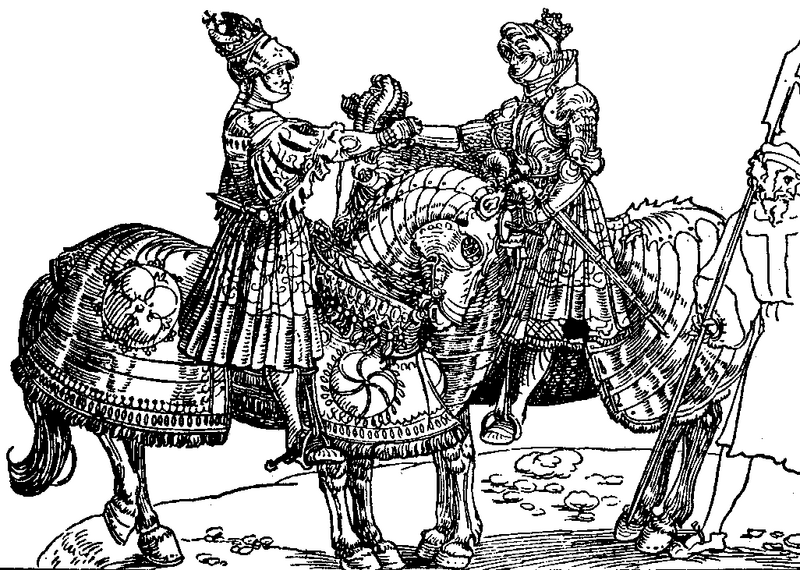
Henry & Maximilian meet at the siege of Therouanne
Thomas returned home in June and when Henry VIII invaded France later in the summer, Thomas led a company of a hundred men and took part in the siege of Thérouanne and the Battle of the Spurs.
Thomas’s father-in-law meanwhile had recovered the family dukedom, being made Duke of Norfolk in 1514 alongside the king’s great friend Charles Brandon who became the Duke of Suffolk;
‘The King being at Lambeth, were create these estates following: that is to say, the Earl of Surrey, Sir Thomas Howard senior, Earl Marshal and Treasurer of England, create Duke of Norfolk; the Viscount Lisle, Sir Charles Brandon, late Marshal of the king’s army, was create Duke of Suffolk; the Lord Howard, Sir Thomas Howard the younger, Lord Admiral of England, was create Earl of Surrey.’[iii]

Foreign Policy
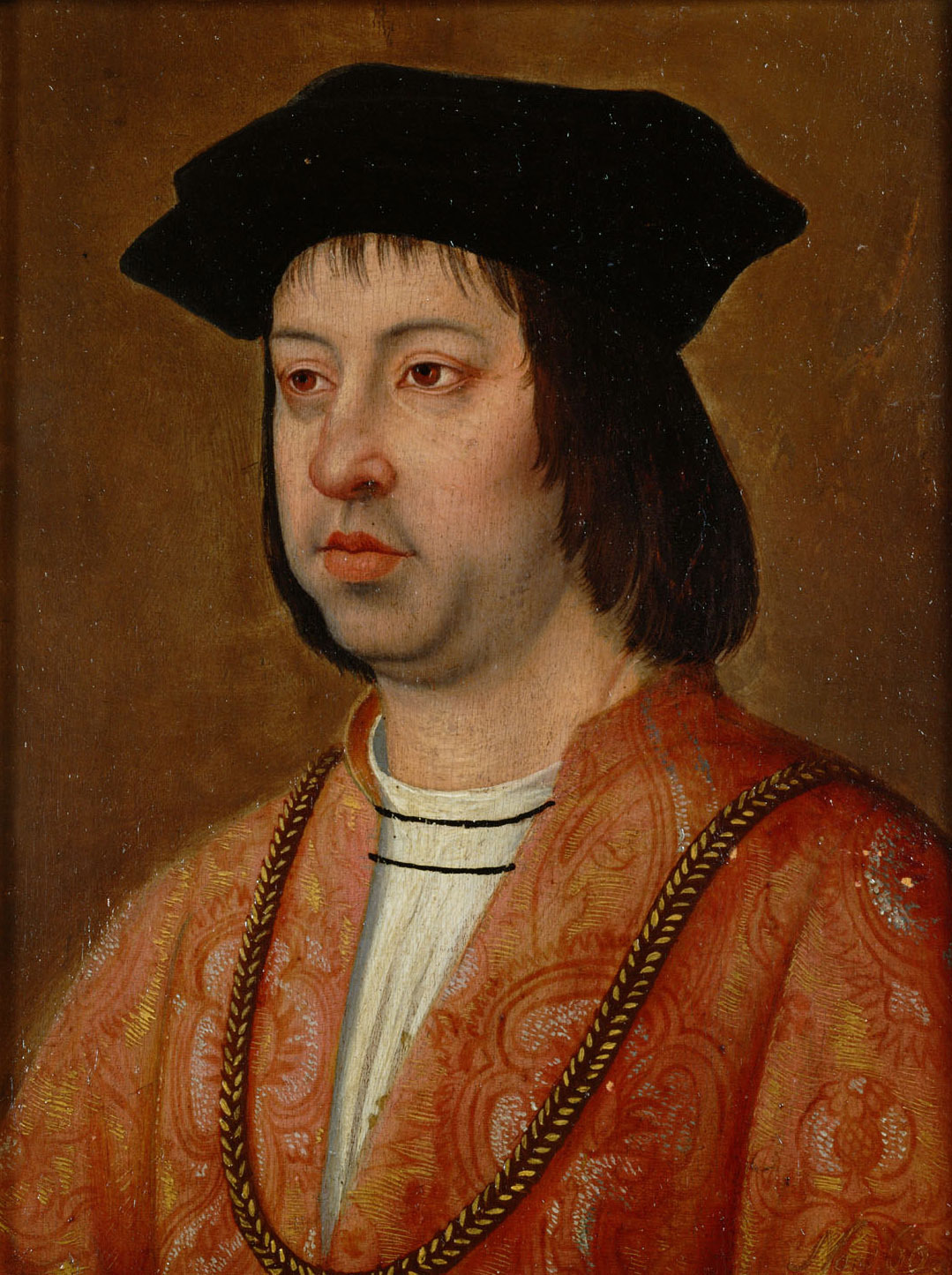
Ferdinand of Aragon
In June 1514 Henry fell out with Katherine’s father and spat out complaints about her. There had already been problems between the two kings, when Ferdinand had failed to support an English expedition to take Bayonne[iv]; instead he’d sent his troops into Navarre, leaving the English to mutiny and return home. A mortified Henry had to accept his father-in-law’s caustic comments on English reliability.
 In the following year Ferdinand made peace with Louis XII, just as Henry was about to attack France. But in 1514, under the guiding hand of Henry’s new adviser Thomas Wolsey, English policy changed. Henry made his peace with France, turning the tables on Ferdinand and Maximilian, both of whom had used Henry’s naivety about foreign affairs to extend their power bases at the expense of the English.
Wolsey was able to negotiate possession of Tournai, a large amount of gold and the marriage between Henry’s sister Mary and Louis[v]. Henry now felt able to tell the Spanish ambassador some home truths, the poor man even complained that he was;
‘A bull, at whom everyone throws darts.’[vi]
And although Katherine was again pregnant, there was talk of a divorce. As a result of Wolsey’s diplomacy England was recognised once again as a power to be taken into consideration. Henry wrote to Pope Leo X requesting a cardinal’s hat for Wolsey;
‘Such are his merits that I esteem him above my dearest friends, and can do nothing of importance without him.’[vii]
The request was refused.
A Tudor Courtly Education
Margaret of Austria
Anne at least of the Boleyn girls had a relatively broad education for a girl. Both girls were trained for a life at court and marriage. The composer Richard Davy was Thomas’s chaplain from 1506-15 and may have taught the two girls music; Anne was an excellent musician, singer and dancer, a skilled needlewoman as well as being competent at poetry. The poet Thomas Wyatt lived at nearby Allington.
All the Boleyn children were taught to speak fluent French, a language with which Anne apparently struggled, unlike her father, and it was living in the courts of France and Brussels that gave her some proficiency. The children of the nobility were also taught to ride, hunt and hawk; a skill that Thomas excelled in.
On an embassy to Archduchess Margaret at her court in Mechelen Thomas ingratiated himself with Margaret. He extolled the virtues of Anne and Margaret offered her a place at her court as one of her eighteen maids of honour. Returning home in the spring of 1513 Thomas immediately despatched Anne to Mechelen in the care of a knight named Broughton.
Margaret was delighted with her new maid, writing to Thomas;
‘A present more than welcome in my sight. I hope to treat her in such a way that you shall be quite satisfied with me.…….I am more beholden to you for sending her than you can be to me for receiving her.’[viii]
The French Marriage
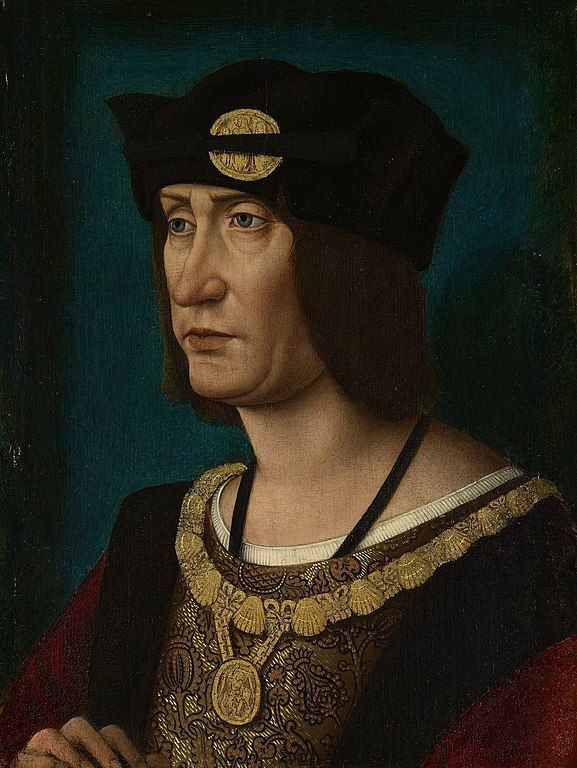
Louis XII
In the autumn of 1514 the 18 year old Princess Mary was chosen, as the victim of her brother’s new foreign policy, to marry the 52 year old Louis of France, to be his third wife[ix],. For the sake of peace with France Henry had jettisoned the proposed marriage between Princess Mary to Margaret’s nephew Charles[x].
Mary needed ladies who could speak French and one of those chosen to go with her to France was Mary. Anne was also to go at the special request of Princess Mary, as Thomas wrote to Margaret;
‘To this request I could not, nor did I know how to refuse.’[xi]
That Thomas had two daughters as ladies of Mary’s court was an indication of just how high he had climbed.
Anne wrote to her father;
‘I understand by your letter that you desire that I shall be a worthy woman when I come into the court, and you inform me that the Queen will take the trouble to converse with me………..this will make me have the greater desire to speak French.’[xii]
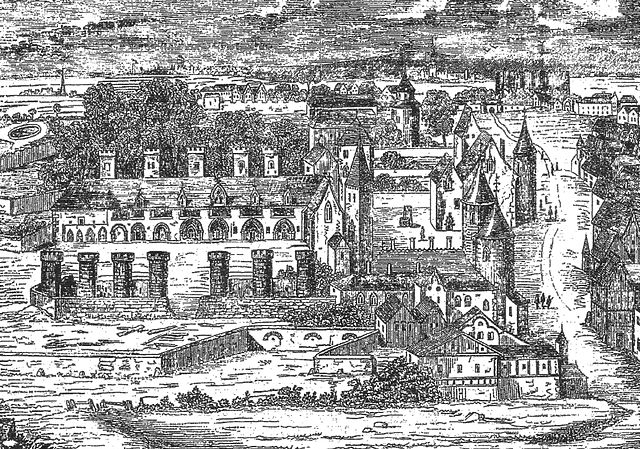
Hotel des Tournelles
Louis and Mary were married by proxy on 14th August at Greenwich Palace and then again on 9th October at Abbeville. Mary was one of the queen’s ‘Chamberers’, serving in the queen’s private suite doing the menial tasks that were above the dignity of the ladies-in-waiting. Lady Guildford[xiii] was the queen’s Lady of Honour and had charge of the maids-of-honour.
Louis was suffering from leprosy and his ravaged face must have been a shock to the young queen. After the wedding the Duke of Norfolk visited Queen Mary to discuss which of her English ladies would be sent home. But this meeting was pre-empted by Louis who dismissed Lady Guildford and most of Mary’s servants, causing much distress to his young wife. Mary was one of those retained, probably due to the intervention of her grandfather.
Following the wedding a series of jousts and tourneys were held at which the new Duke of Suffolk, Charles Brandon, excelled. The tournaments were organised by Louis’ heir and cousin François. Christmas was celebrated at the Hôtel de Tournelles. François showed a clear interest in his new queen, although this did not seem to bother Louis.
The Royal Widow
Louise de Savoie
Anne rejoined the queen and her ladies sometime after Christmas. By the time she arrived Mary was a widow; Louis died on 1st January 1515 during a fit of vomiting. Mary and her ladies were sent to the Hôtel de Cluny at the order of Louise de Savoie[xiv] for the prescribed 40 days of mourning, where Mary could be scrutinised to ensure that she was not pregnant with Louis’ child.
Mary’s letters home to her brother became more and more frantic as she received the unwelcome attentions of the new French king. François indicated that he would be happy to divorce his wife Claude, his intimations were not well received. François dismissed Mary’s English ladies, replacing them with French maids of honour. He was hoping to organise a second marriage for Mary that would be advantageous for France, knowing that Henry was once again looking for an alliance with the Hapsburgs.
Henry had promised Mary that she could choose her second husband for herself, but had every intention of breaking this promise. Henry decided to reinstate his plans for Mary to marry Katherine’s nephew Charles, plans that horrified Mary who, thinking him the ugliest man in Europe, declared;
‘I would rather be torn to pieces.’[xv]
Mary took advantage of Suffolk’s presence in France and, with the possible encouragement of François[xvi], the couple were secretly married on 5th March 1515. Henry was enraged and it took much work on the part of Thomas Wolsey before the king’s wrath was assuaged[xvii]. Mary and Brandon were remarried on 13th May at Greenwich.

Bibliography
Cardinal Wolsey – Mandell Creighton, McMillan & Co 1891
Henry VIII – Robert Lacey, George Weidenfeld & Nicholson & Book Club Associates 1992
The Earlier Tudors – JD Mackie, Oxford University Press 1992
Rivals in Power – David Starkey (ed), Toucan Books 1990
The Six Wives of Henry VIII – Alison Weir, Pimlico 1992
Mary Boleyn – Alison Weir, AudioGO Ltd 2012
The Hapsburgs – Andrew Wheatcroft


[i] Known as the Warrior Pope for his aggressive policy and patron of Michelangelo
[ii] The latest in a series of leagues set up by Julius; this aim of this one was to throw the French (Julius’ pervious allies against the Venetians) out of Italy
[iii] Rivals in Power - Starkey
[iv] In south-west France
[v] She was his third wife
[vi] Henry VIII - Lacey
[vii] Cardinal Wolsey - Creighton
[viii] The Six Wives of Hnery VIII - Weir
[ix] His second wife had died in the January and it was known that he was looking out for a young wife
[x] Later Charles V, Holy Roman Emperor, father of Philip II of Spain, who was to marry Henry’s daughter Mary
[xi] Mary Boleyn - Weir
[xii] Ibid
[xiii] Widow of Sir Richard Guildford, one of Henry’s courtiers who had helped put down the Cornish rebellion
[xiv] François’ mother
[xv] Henry VIII - Lacey
[xvi] Hoping to forestall Henry’s planned alliance with the Holy Roman Emperor
[xvii] Henry was eventually persuaded by Wolsey to fine the couple an enormous amount of money, eliminating Brandon as one of the king’s advisers and leaving Wolsey as Henry’s sole confidant
Wednesday, 7 January 2015

Tudor England - The Importance of Being Thomas[i]


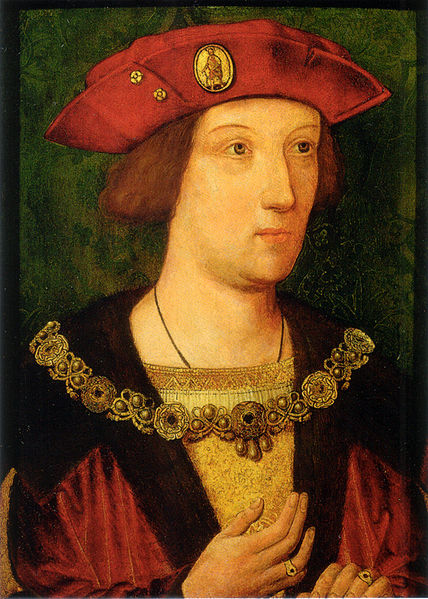
Arthur, Prince of Wales
The King
It was on 2nd April 1502 that the young Prince Henry’s fortune changed dramatically, the day his elder brother Arthur died and Henry inherited not only Arthur’s future but also Arthur’s wife. A Spanish infanta, Katherine was six years older than her second husband. Henry’s father Henry VII was unwilling to return Catherine and her generous dowry (of which only half had been paid) to Spain.

In April 1509 Henry became king and now freed from his father’s parsimony the young Henry set out to enjoy his inheritance. And so a marriage between the younger Henry and Catherine finally took place on 11th June 1509; Henry wrote to Katherine’s father Ferdinand of Aragon;
‘As for that entire love that we bear to [Catherine] ….even if we were still free, it is she…..we should choose for our wife before all other.’[ii]
Catherine of Aragon
Katherine had loved Arthur and she certainly loved the glamorous and attractive young Henry whose desire for an heir she gratified with the birth of Henry of Cornwall on 1st January 1511, a year after the birth of a stillborn daughter. But the young boy lived less than two months. On 18th February 1516 Catherine gave birth to another child, Mary. Mary was initially much loved by both her parents, but Henry started brooding about the lack of a male heir.
‘We are both young. If it was a daughter this time, by the grace of God the sons will follow.’[iii]
Upward Mobility
It was Geoffrey Boleyn[iv], a merchant, who had amassed the wealth necessary to attract the attention of the mighty Howard family. Geoffrey cunningly married Anne Hoo, daughter of Thomas Hoo[v]. Anne was co-heiress of the Hoo estate, bringing Geoffrey lands and a whiff of nobility. In 1452 Geoffrey purchased Blickling[vi] from his friend Sir John Falstof and two years later was attempting to marry one of his daughters to Falstof’s ward Thomas;
‘I am credibly informed that Geoffrey Boleyn makes great labour for the marriage of the said child [Thomas Falstof] to one of his daughters.’[vii]
In 1462 Geoffrey purchased Hever Castle from Sir Thomas Cobham and started to convert the castle into a moated manor house. Geoffrey died the following year and was buried at the church of St Lawrence Jewry in London. Nine years later Geoffrey’s heir Thomas died and was buried alongside his father.
Butler family arms
Geoffrey’s second son William inherited the Boleyn estates. William was lucky enough to support the Duke of York during the Wars of the Roses and as a result was made a Knight of the Bath at Richard III’s coronation. He also became a Justice of the Peace and married Margaret Butler, daughter and co-heiress of Thomas Butler, 7th Earl of Ormond[viii]. Chronically short of money before entering into his inheritance of £20,000[ix] in 1477, Butler was kept afloat financially by Geoffrey Boleyn and the reward was Margaret as William’s wife.
Margaret and William had eleven children, of whom only four survived. Thomas Boleyn was the eldest son born in 1477. Anne was his older sister[x], born in 1475; his younger sister Alice was born circa 1487[xi].
With the death of the king at the Battle of Bosworth the Boleyns immediately turned to support the new Henry VII. In 1490 William was appointed Sheriff of Kent and in 1501 Sheriff of Norfolk. By 1502 William was one of the four Barons of the Exchequer, who sat as judges in the Court of the Exchequer[xii].
The Rise of Thomas
Thomas Howard, 2nd Duke of Norfolk
Thomas and his father fought for Henry VII against the rebellious Cornish[xiii] in 1497 fighting against increases in income tax. Thomas himself was a gifted linguist, the most fluent French speaker at court. He was also an expert jouster; a talent that attracted the attention of the young king Henry VIII, who adored jousting.
About the turn of the century Thomas Boleyn married Lady Elizabeth Howard, daughter of Thomas Howard[xiv]. The marriage was a brilliant match for Thomas Boleyn; he would never have been allowed to marry a scion of the great Howard family if they had not suffered the reverse of supporting the wrong side at the Battle of Bosworth, where John Howard, Duke of Norfolk was killed fighting for Richard.
John’s son was thrown into the Tower by Henry VII in 1484 for three years. His son, Thomas Howard, then the Earl of Surrey, had been engaged to marry the new Queen Elizabeth’s sister Anne; after his return to favour in 1489 the earldom of Surrey was returned to him. Thomas Howard renewed his suit to Anne and the couple were married on 4th February 1495. Thomas Boleyn was now brother-in-law to the queen’s brother-in-law. And his sister-in-law Anne Tempest, his brother Edward[xv]’s wife, was one of Katherine’s ladies in waiting.
The Newly Weds
Elizabeth Howard was Thomas Howard’s eldest daughter. She was pretty and the court poet John Skelton dedicated some verses to her, the Garland of the Laurel. Elizabeth was compared to;
‘Goodly Cressida, fairer than Polyxena,

For to envy Pandarus’ appetite:

Troilus, I vow, if that he had you seen,

In you he would have set his whole delight.’[xvi]
It is unlikely that Elizabeth came with a large dowry; her father had to expend much money buying back his lands from the king. Elizabeth was rarely seen at court, save for the major celebrations.
Margaret Tudor, Queen of Scotland
The couple had five children, Mary Boleyn was born sometime between 1499-1500; her exact date of birth is unknown. Her sister Anne was probably born the following year in 1501. Two more children died young, the fifth child was George Boleyn, born sometime between 1503-4. The children were born at Blickling Hall in Norfolk. Thomas later complained that, at the time, the young couple had a mere £50 per annum[xvii] to live on.
‘When I married I had only £50 to live on for me and my wife, as long as my father lived, and yet she brought me every year a child.’[xviii]
Thomas had to pay the Bishop of Norwich the sum of 3 shillings and 6 pence[xix] every 30 weeks for castle guard for Blickling.
Thomas was present at the marriage of Prince Arthur and Princess Catherine and in August 1503 was one of those chosen to escort Princess Margaret north to marry James IV of Scotland.
Inheritance
Hever Castle
Thomas’s financial problems were solved in October 1505 by the death of his father and the family moved to Hever in the following February. Thomas was given royal licence to take possession of his father’s estates in February 1506. Thomas inherited a number of other properties in Norfolk, Hertfordshire and Kent. Geoffrey’s will required Thomas to pay his mother 200 marks per annum.
Hever was more convenient for London and the court. Thomas made over Blickling to his brother James and started improving Hever, adding mullioned windows, an entrance hall, a staircase gallery and a long gallery.
By 1507 Thomas held the post of Yeoman of the Crown at King’s Lynn. He was one of the Esquires of the Body at Henry VII’s funeral on 11th May 1509. Thomas was dubbed a Knight of the Bath at the new king’s coronation on 23rd June 1509. Elizabeth attended the ceremony and had a new gown for the occasion.
Shortly thereafter her husband was also dubbed a Knight of the Body[xx]. This new post meant that Thomas spent far more time away from his family, leaving Lady Elizabeth looking after the children. Thomas purchased New Inn without Temple Bar as a home from court.
Thomas was a diplomat and a statesman, holding Henry’s regard to the end. Indeed Henry believed that no-one was more skilled at negotiating than Thomas. Thomas’s vices were selfishness and avarice;
‘He could not resist the temptation of money.’[xxi]
Thomas could also be affable, dispassionate, brusque and insolent.
Bibliography
Cardinal Wolsey – Mandell Creighton, McMillan & Co 1891
Henry VIII – Robert Lacey, George Weidenfeld & Nicholson & Book Club Associates 1992
The Earlier Tudors – JD Mackie, Oxford University Press 1992
Henry – David Starkey, Harper Perennial 2009
Rivals in Power – David Starkey (ed), Toucan Books 1990
Illustrated Letters of the Paston Family – Robert Virgoe (ed), MacMillan London Ltd 1989
The Six Wives of Henry VIII – Alison Weir, Pimlico 1992
Mary Boleyn – Alison Weir, AudioGO Ltd 2012
www.wikipedia.en


[i] With apologies to my mother, who always wanted to write a book, about Henry VIII’s counsellors, with this title
[ii] Henry - Starkey
[iii] Henry VIII - Lacey
[v] Courtier and Knight of the Garter.
[vi] The present house is built on the remains of the Boleyn property
[vii] Illustrated Letters of the Paston Family - Virgoe
[viii] One of the country’s richest noblemen, Butler had a fortune of £40,000; In 2013 the relative: historic standard of living value of that income or wealth is £29,440,000.00 economic status value of that income or wealth is £858,800,000.00 economic power value of that income or wealth is £13,540,000,000.00 www.measuringworth.com
[ix] In 2013 the relative: historic standard of living value of that income or wealth is £13,900,000.00 economic status value of that income or wealth is £447,600,000.00 economic power value of that income or wealth is £6,812,000,000.00 www.measuringworth.com
[x] Marrying the courtier Sir John Shelton
[xi] Marrying Sir Robert Clere
[xii] Between 1501 and 1546 the appointment of the heads of the Howard family as Lord High Treasurer saw a diminution in the importance of this court.
[xiii] A response to Henry’s war taxes to pay for the Scottish border incursions, inspired by Perkin Warbeck’s claims to the throne
[xiv] The family title of Duke of Norfolk was given back to the Howards in 1514 following Thomas Howard’s defeat of the King of the Scots at Branxton (Flodden) in Northumberland
[xv] Edward was about 19 years Thomas’s junior
[xvi] Mary Boleyn - Weir
[xvii] In 2013 the relative: historic standard of living value of that income or wealth is £36,320.00 economic status value of that income or wealth is £1,017,000.00 economic power value of that income or wealth is £14,480,000.00 www.measuringworth.com
[xviii] Mary Boleyn - Weir
[xix] In 2013 the relative: real price of that commodity is £118.70 labour value of that commodity is £1,133.00 income value of that commodity is £3,299.00 www.measuringworth.com
[xx] A post requiring Thomas to serve as a bodyguard to the king, sleeping on a pallet outside his door
[xxi] Mary Boleyn - Weir