_-_Pope_Clement_VII_-_Google_Art_Project.jpg/495px-Sebastiano_del_Piombo_(Italian)_-_Pope_Clement_VII_-_Google_Art_Project.jpg) |
| Clement VII |
Freedom
In 1529, in part
thanks to his mother’s foreign policy while he was imprisoned François was able
to forge a new anti-Hapsburg alliance with those who felt that Charles V was
becoming too powerful; joining the alliance was the pope Clement VII[i], the Republic of Venice, the Duke of Ferrara and de’ Medici ruler[ii] of Florence. Last but not least was the newly
reinstated Duke of Milan, Francesco II Sforza[iii] who was wary of Charles’ ambitions
in Italy[iv].
Henry VIII was also becoming wary of Charles and was not best pleased that the
emperor had turned down the offer of his daughter Mary in marriage[v].
While the
king of France and the Holy Roman Emperor were locked in increasing
intransigence Louise of Savoy and Charles aunt’ Margaret of Austria[vi] were able to negotiate the Treaty of Cambrai, signed in August 1529. The treaty
gave Charles two million écus[vii]
in exchange for the return for the two French princes.
 |
| Louise of Savoy |
Louise of
Savoy sent her usher to visit François and Henri to inform them they were
coming home. Monsieur Bodin arrived at Pedraza in September 1529 and was
horrified to find the two boys in a small dark cell, with one small window high
up in the walls and two straw mattresses for furnishings. According to the
guards the only pleasure the boys had was two small dogs[viii].
The guards also informed Bodin;
‘You see how the sons of the
king your master are treated, with no company but that of the soldiers….and
neither exercise nor education[ix].’[x]
Short of
money François had to raise his sons’ ransom from his richer subjects. He
charged Anne de Montmorency, Grand Master of France, with the task of handing over the
gold and bringing his sons back to France.
Back Home
 |
| Mont de Marsan |
François’
new queen accompanied his sons return to their homeland. Henri’s treatment in
Spain led to him to hate both his father and more particularly Charles V, the
controller of his and François’ deteriorating imprisonment in Spain. Father and
sons met on 6th July 1530[xi]
at Mont de Marsan.
Their
imprisonment had changed the two boys; François returned more Spanish than
French, wearing only sombre colours, speaking very little and drinking only
water. Henri returned, changed from a bright intelligent child to an awkward,
taciturn, morose and unsociable boy rarely heard laughing. This change was to
last the rest of his life, François was displeased in the change in his sons
and was unable to hide his displeasure. Never one to put himself out he
commented that;
‘He did not care for dreamy,
sullen, sleepy children’[xii]
 |
| Anne de Pisseleu |
And
henceforth bestowed his affection solely on his youngest son Charles. Henri
vented his frustration in a frenzy of hunting, tilting, wrestling and other
wild exercise. He threw himself into becoming an excellent Real Tennis player. He gathered round him a tight-knit band of friends
including Jacques d’Albon[xiii] and François de Guise[xiv]. Henri was to idolise the older
Jacques for the rest of his life.
Henri also
found much to admire in the prince’s new head of household Anne de Montmorency.
The estrangement with his father led to Henri becoming devoted to Montmorency
who carried with him the aura of a successful soldier as well as being a
chivalrous and learned man.
The Dauphin
and Henri were reunited with their siblings at Amboise and in March 1531 Henri
was involved in the coronation of his stepmother at St Denis. François had no interest in his
wife and failed to hide his feelings for his latest mistress Anne de Pisseleu, Duchesse d’Étampes[xv]. He publically indulged in sexual
behaviour with Anne, embarrassing Eleanor. During the summer the court went on
a progress around the country to thank the French for their efforts in
obtaining the return from durance vile of the two older princes.
An Arranged Marriage
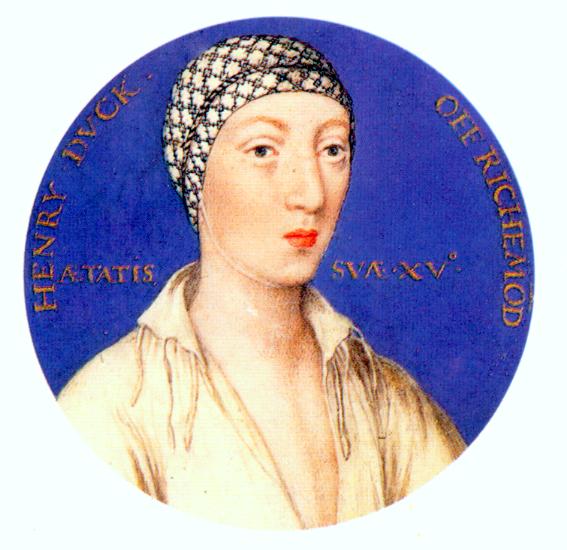 |
| Henry Fitzroy |
François
came of age in 1532 and was now old enough to come into his inheritance, from
his mother, as Duke of Brittany. His father had administered the duchy since the death of
Queen Claude. At the same time King Henry VIII was attempting to browbeat the
pope into granting him a divorce from his queen to marry his new love Anne Boleyn. Unfortunately for Henry his wife’s nephew was Charles V.
In late 1532
Henry VIII met with François in Calais and the two men agreed that François
would try and persuade Clement VII to grant Henry his divorce. In the meantime
Henry sent his bastard son Henry Fitzroy to François’ court[xvi],
along with Henry Howard, the son and heir of the Duke of Norfolk, to gain some French polish. The two
boys got on well with the French princes, being as sports mad as Henri and
Charles.
As a Son of
France Henri was never going to be able to choose his own wife and so it was
that the pope had a niece to dispose of; Catherine de’ Medici[xvii]. Clement offered Catherine as a bride
for Henri to cement the alliance between the papacy and France[xviii].
The young couple had something in common as Catherine had also been a prisoner
of the Hapsburgs.
 |
| Catherine and Henri's wedding |
In January
1533 Clement agreed to meet with François to discuss the matter of a marriage between
the two young people and confirmed Thomas Cranmer[xix] as Archbishop of Canterbury. By the time the two men met to
discuss Henri’s marriage to Catherine, Henry VIII had lost patience and had
Cranmer declare him divorced and married Anne. Clement tried, unsuccessfully,
to force Henry to give up his new wife and return to the staid and aging former
queen. Despite pressure from Henry François refused to bully the pope, afraid
that if he did so Clement would turn to Charles V for support and weaken the
League against the emperor.
Catherine
sailed from la Spezia with the papal fleet on 1st
September and the fleet collected Clement from Villefranche, arriving in Marseille on 11th October. François prostrated himself before Clement
the following day and Catherine and Henri were wed on 28th.
Catherine’s dowry[xx]
was 130,000 gold eçus[xxi];
she also had jewellery to the value of 27,900 gold eçus. From her new father-in-law
Catherine was to receive an annual income of 10,000 livres[xxii].
As a memento the pope apparently gave François a unicorn’s horn[xxiii]
‘Pope Clement VII gave him
[François] a gift of a unicorn’s horn, which expels poisons, to make him
understand that he should keep his kingdom safe from heresy.’[xxiv]
Bibliography
Martyrs and
Murderers – Stuart Carroll, Oxford University Press 2009
Catherine de
Medici – Leonie Frieda, a Phoenix Paperback 2003
Charles V –
Harald Kleinschmidt, Sutton Publishing 2004
French
Renaissance Monarchy – RJ Knecht, Longman Group 1996
The Rise and
Fall of Renaissance France – RJ Knecht, Fontana Press 1996
Catherine
de’ Medici – RJ Knecht, Pearson Education Ltd 1998
A History of
France – David Potter, The MacMillan Press 1995
Prince of
the Renaissance – Desmond Seward, MacMillan Publishing 1973
Emperor
Charles V – James D Tracey, Cambridge University Press 2010
Henri II – H
Noel Williams, Methuen and Co 1910 (reprint 2016)
www.wikipedia.en
[i]
Who had been taken prisoner by the emperor during the sack of Rome in
1527; he escaped to Orvieto
in December 1528
[ii]
Cousin of the pope
[iii]
Upon payment of 900,000 ducats; in 2015 the relative: historic standard of living value of that income or wealth is £500,300,000.00 labour earnings of that income or wealth is £6,033,000,000.00 economic status value of that income or wealth is £16,790,000,000.00 economic power value of that income or wealth is £238,700,000,000.00 www.measuringworth.com
[v]
Charles was to marry his cousin Isabella of Portugal;
the close and continual intermarriages of the Hapsburg family were to end with
the unhappy Carlos
II, while Mary was to marry Charles’ son Philip
[vii]
In 2015 the relative: historic standard of
living
value of that income or wealth is £1,112,000,000.00 labour earnings of that income or wealth is
£13,410,000,000.00 economic status value of that income or wealth is £37,310,000,000.00 economic power value of that income or
wealth is £530,400,000,000.00 www.measuringworth.com
[viii]
The dwarf seems to have been sent away (or died) by this time
[ix]
This is not the only time that Charles V has been accused of ill-treatment of
prisoners by neglect; he treated his mother similarly see http://wolfgang20.blogspot.co.uk/2015/11/reanaissance-europe-juana-la-loca-v.html
[x]
Catherine de Medici - Frieda
[xi]
Much of the intervening time had been spent raising the ransom and then raising
the deficit after some of the treasury officials charged with gathering the
monies, clipped
the coins which were found to be under value
[xii]
Henri II - Williams
[xiii]
Son of his governor
[xv]
The king’s sister informed the Duke of Norfolk that François could not bear to
share Eleanor’s bed
[xvi]
See Henry Howard III
[xviii]
François saw the marriage as a route back into winning back Milan
[xix]
Architect of the royal divorce
[xx]
30,000 eçus of which was in
exchange for her rights to the Medici patrimony
[xxi]
In 2015 the relative: historic standard of
living
value of that income or wealth is £71,240,000.00 labour earnings of that income or wealth is
£790,800,000.00 economic status value of that income or wealth is £2,391,000,000.00 economic power value of that income or
wealth is £32,640,000,000.00 www.measuringworth.com
[xxii]
In 2015 the relative: historic standard of
living
value of that income or wealth is £5,480,000.00 labour earnings of that income or wealth is
£60,830,000.00 economic status value of that income or wealth is £183,900,000.00 economic power value of that income or
wealth is £2,511,000,000.00 www.measuringworth.com
[xxiv]
Catherine de’ Medici - Knecht

_-_Google_Art_Project.jpg/430px-Barend_van_Orley_-_Portrait_of_Charles_V_(1519)_-_Google_Art_Project.jpg)


