Wednesday, 15 January 2014

Peter the Great - What Peter Did Next III


Rising to Dizzy Heights
Catherine
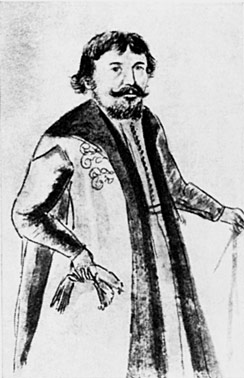
The two people who were to become most important to Peter came to the fore during the early stages of the Great North War; Prince Menshikov, a former stable hand[i] and Martha Skavronskaya, who was to become Peter’s mistress and later his wife. Menshikov had been discovered by Lefort and quickly attracted Peter’s attention. He joined the play army of Peter’s youth and gradually climbed the ranks.
Menshikov then fought with Peter at Azov; by 1700 he was in charge of the Czar’s wardrobe. The start of the war saw Menshikov return to soldiering and he was involved in the founding of St Petersburg and in 1703 he was given responsibility for building one of the great bastions of the Peter and Paul fortress. The same year Menshikov was also made Governor of Ingria, Karelia and Estonia. But most important was his role as Peter’s friend, following the death of Lefort. Peter wrote of his friend.

‘He does what he likes without asking my opinion….but I for my part never decide anything without asking him his.’[ii]
The orphan Martha Skavronskaya was befriended by a Lutheran minister, taken into his Marienburg household where she was expected to make herself useful. As the Swedes withdrew from Marienburg, Martha’s employer fell into the hands of Sheremetev’s victorious Russian army; by whom he was used as a translator. Martha herself was taken into Sheremetev’s household as a domestic servant.

By the time Martha entered Menshikov’s household, she had joined the Orthodox church and taken the name of Catherine. In the autumn of 1703 Menshikov took Catherine to Moscow; although it is not known if the pair became lovers, they did however become inseparable friends.
Peter’s relationship with Anna Mons was breaking up[iii] and Peter was attracted to Catherine and she became his mistress. She continued to live at Menshikov’s house, along with Menshikov’s future wife Darya Arseneev and her sister[iv]. Darya and Catherine travelled together to join Menshikov and Peter where the Russian armies were encamped.

In the winter of 1704 Catherine gave birth to Peter’s son Pyotr[v]; another two children were born before her secret marriage to Peter in November 1707. The marriage was kept secret until March 1711 when Peter informed his family of this second marriage. In February 1712 Peter remarried Catherine, the only person who could deal with his convulsive fits, in a public ceremony. Prior to the ceremony Catherine was accepted publicly into the Orthodox church with her stepson, the Czarevitch Alexis, acting as her Godfather.
In 1717 she was described by a German diplomat as;

‘In the prime of life and showed no signs of having possessed beauty. She was tall and strong, exceedingly dark, and would have seemed darker but for the rouge and whitening with which she covered her face. There was nothing unpleasant about her manners, and anyone who remembered the Princess’s origins would have been disposed to think them good……..She had a great desire to do well.’[vi]
Changes
 
Peter was not a man to stay still and, even when not with his armies, he rarely stayed in one place for more than three months, criss-crossing the broad expanses of his country. He visited the shipyards, inspected new building works and military installations. Peter wrote laws and decrees, often on brown pieces of paper, usually on the move or in an inn en route to his next destination. The Russian people were not used to a mobile Czar; normally seen as figureheads sat in Moscow. Never before had so many ordinary people across Russia seen their ruler.

Fedor Apraxin
In 1706 Golovin died and his job as General-Admiral and Foreign Minister was divided among three men. Fedor Apraxin became General-Admiral, Gavril Golovkin became Foreign Minister and Peter Sharifov[vii] was made his deputy. New departments were created; the Department of the Navy, a Department of Artillery and a Department of the Mines.
Peter discovered that the old Boyar council, now renamed the Privy Council, was being blamed for its decisions by members who claimed they had not been present when decisions, criticised by Peter, were made. To stop this Peter ordered that every member present at a meeting would have to sign off on decisions and the originals would be forwarded to the Czar wherever he was by courier.

To deal with all the paperwork pouring in from all parts of the country, for the Czar’s attention, a mobile personal chancellery, headed by Alexis Makarov, accompanied Peter everywhere.
Rebellion

Peter’s wars and buildings projects exerted hardships on the Russian people unable to pay the taxes demanded and resentful of being pressed into labour gangs for the buildings works. To escape they melted away into the forests and thence, for many of them, down to the south and Ukraine.

17th century Astrakhan
Peter ordered the return of these runaway serfs and the Cossacks, after deliberation, refused. Astrakhan harboured remnants of the Streltsy and Peter’s increased taxes and pressure to introduce foreign ways help to foment rebellion. The rumour mills went on overtime.
In 1705 the rumour that Peter had forbidden Russian men to marry for seven years so that Russian women could be married off to foreigners lit the spark. On 30th July 1705 one hundred women in Astrakhan were married off to Russian men in a mass wedding; a bid to avoid the purported decree.

Onlookers then rushed to the local government offices; beheaded the governor and elected a new government, claiming
‘The governor and other officers practised all kinds of idol worship[viii] and wished to compel us to it. But we have not allowed this to happen. We have taken the idols out of the house of the officials.’[ix]
The rebels wrote to other towns on the Volga and to the Don Cossacks, inviting them to join the rebellion. Peter, in Courland besieging Mittau[x], sent Sheremetev to put down the rebellion[xi]. Peter invited the rebel leaders to come to Moscow and discuss their problems with Golovin, who was impressed by their complaints.

‘I have talked for some time with them and they seem faithful and honest people. Deign, sir, even to force yourself to show them mercy. Even we are not without rascals.’[xii]
Peter offered an amnesty if the city submitted, but his leniency only encouraged the rebels, who ignored the offer, believing they could overpower Sheremetev’s troops. They were wrong, the amnesty was withdrawn after they attacked the soldiers and hundreds of rebels were sent to Moscow or broken on the wheel.

The same year unhappiness spread through the nomadic Bashkirs[xiii]; they were being squeezed by Russian settlers and, in their wake, Russian tax collectors. By early 1708 the tribes were in open revolt, burning new villages and their fighters were within twenty miles of Kazan. Peter sent troops and the western Bashkirs submitted; those in the east continued to devastate the countryside until put down by the Kalmucks, called in by Peter to deal with the rebellion; his regular troops had been required to fight the Swedes in the west.
Rebellion Number Three
Peter was determined to round up the army deserters and serfs who had fled to join the Don Cossacks. This determination led to the most dangerous of the rebellions, against Peter’s rule, during this period. In September 1707 Prince Yuri Dolgoruky arrived on the Don with 1,200 soldiers to enforce Peter’s decree. The Don Cossacks continued in their refusal to return the deserting soldiers and runaway serfs.

On the night of 9th October 1707 the Ataman of Bakhut, Konradty Bulavin, attacked the Russian camp and killed all the Russians. Bulavin called upon all Cossacks;
‘To defend the house of God’s Holy Mother and the Christian Church against the heathen and Hellenic teachings which the boyars and Germans wish to introduce.’[xiv]
He promised to free the serfs at Azov and Taganrog and further promised a march on Moscow in the spring.

Fearing Peter’s wrath would descend on the region, a fellow Ataman Maximov, attacked Bulavin, who managed to escape. In the spring of 1708 he and his troops were attacked by a joint force of Maximov’s men and Russian troops. On the 9th April Bulavin defeated this army and the rebellion spread like wildfire. Peter now sent Vasily Dolgoruky[xv] with a force of 10,000 troops to the Don. In the interim Bulavin had executed Maximov and then attacked Azov.

Prince Vasily Dolgoruky
Dolgoruky’s orders were to
‘To extinguish this fire for once and all. This rabble cannot be treated other than with cruelty.’[xvi]
Bolstered by a successful attack on one of Azov’s suburbs[xvii] Bulavin inexplicably divided his army into three and these mini armies were picked off individually. After the second defeat on 1st July 1708 many of Bulavin’s men petitioned the Czar for forgiveness. The Cossack elders turned on Bulavin, who was still heroically resisting the Russians.

Bulavin killed himself and the insurgency gradually faded; finally dying when the remainder of Bulavin’s troops were defeated by Dolgoruky’s men.
Bibliography

Natasha’s Dance – Orlando Figes, Penguin Books Ltd 2002
Russia and the Russians – Geoffrey Hosking, The Penguin Press 2001

Peter the Great – Robert K Massie, Abacus 1992
The History of Charles XII of Sweden – Mr de Voltaire, C Davis & A Lyon 1732


[i] At Preobrazhenskoe
[ii] Peter the Great - Massie
[iii] Her ambition to become his Czarita foiled
[iv] Friends of Peter’s sister Natalya
[v] The child died in 1707. The couple had twelve children, all but two of whom died in childhood
[vi] Peter the Great - Massie
[vii] Golovin and Shafirov fell out after a while but were forced to continue working together by Peter, who felt he needed both men
[viii] These idols were wig stands for the new European style wigs Peter and his officials were now wearing
[ix] Peter the Great - Massie
[x] Now Jelgava
[xi] Letters from Moscow were stopped to avoid the spread of news
[xii] Peter the Great - Massie
[xiii] Muslim tribes living n the steppe between the Volga and the Urals
[xiv] Peter the Great - Massie
[xv] Brother of Yuri
[xvi] Peter the Great - Massie
[xvii] Later beaten off by the garrison

Wednesday, 8 January 2014

Peter the Great - What Peter Did Next II

After Narva

Narva Castle
Peter was stunned by the news of the loss at Narva. Two weeks after the battle he wrote to Sheremetev
‘We must not lose our heads in misfortune. I order the work we have undertaken to go on. We do not lack men; the rivers and marshes are frozen. I will hear no excuses.’[i]
The beaten army straggled into Novgorod and Peter used troops who had not been mustered in time and the re-organised survivors of Narva, plus 10,000 Cossacks, to form a new army of 44,000 men. Peter also ordered Prince Boris Galitzyne to raise ten new regiments of 1,000 men each. Command of this new army was given to Boris Sheremetev.

Peter ordered the construction of fortifications at Novgorod, Pskov and the Pescherk monastery near the town; Peter himself laboured on the Novgorod fortifications. Even with the new army raised Peter realised that proper training was required and a permanent professional army would be needed for his dreams of expansion.
Self portrait - Andrew Vinius
Andrew Vinius, the director of the Post Office, was required to re-equip the new army with artillery; he was given the new title of Inspector of Artillery. Given the losses before Narva, Vinius had to start from scratch. With no time to mine and refine metals Peter ordered
‘From the whole of Tsardom, in leading towns, from churches and monasteries, a proportion of the bells are to be collected for guns and mortars.’[ii]
By June 1701 a quarter of all church bells in Russia had been melted down and recast as cannon. Despite problems with foundry workers, Vinius had twenty cannon delivered to Novgorod, with a further seventy-six following shortly thereafter.

Augustus of Poland
Looking for assistance to mediate with Sweden, Peter sent ambassadors abroad; but the rulers of Europe were too engrossed in what was to become known as the War of the Spanish Succession. Peter now turned to his, by now very nervous, ally Augustus. In ten days of meetings the two renewed their alliance.
‘The King of Poland had engaged to furnish the Czar with fifty thousand German troops, which they were to hire of several Princes, and the Czar was to pay for. And he on the other hand was to send fifty thousand Moscovites, into Poland, to be trained up in discipline.’[iii]
What Charles Did Next

Charles XII of Sweden
Charles XII now thought seriously about invading Russia; buoyed up by his own victories in Zealand and at Narva, he was beginning to ignore advice. In December an officer of the King’s Guards wrote
‘I believe that if he [Charles] had only eight hundred men left, he would invade Russia with them, without the slightest thought as to what they would live on. And if one of our men is shot, he cares no more about it than he would for a louse.’[iv]

16th century Livonia
The Swedish army was suffering from hunger and disease; Peter’s soldiers had already plundered Livonia for food and supplies from Sweden could not arrive until the Baltic thawed. The cavalry horses were eating bark from the trees.
Charles finally agreed to go into winter quarters, but by the spring his contempt for the Russian military had increased. He thought that another victory over the Russians would not be appreciated by the courts of Europe as much as a victory over Augustus’s disciplined Saxon troops. In any event an attack into Russia could not be considered while Saxon armies ranged freely in his rear.

In July 1701 Charles’s army defeated a joint Russo-Saxon army on the banks of the Dvina, near Riga; the defeated Saxons reached the safety of Poland. Four Russian regiments, held in reserve, panicked and fled; thus increasing Charles’ contempt. The victory reinforced Charles’ decision to attack Augustus first.
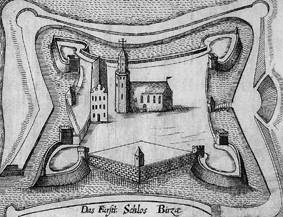
Birzen castle

‘It was in this place [Birzen[v]] that he laid the design of dethroning the King of Poland by the hands of the Poles themselves.’[vi]
Charles was refused permission to enter Poland in pursuit of the Saxon army. The Catholic Primate of Poland insisted that Augustus had made war on Sweden in his role as Elector of Saxony and without the consent of the Polish nobility. Charles replied that in that case Augustus had forfeited the crown of Poland and that the nobility should dethrone Augustus. The answer to Charles letter took some moths to come but when it did it transpired that the Poles were not prepared to do Charles’ dirty work for him.

In the spring of 1702 Charles invaded Poland and on 9th July defeated Augustus near Klissow.
‘The two Kings met….in a large plain near Clissau between Warsaw and Cracow. Augustus had near four and twenty thousand men, and Charles XII not above twelve thousand.’[vii]
The battle was inconclusive as the majority of Augustus’s army escaped yet again. The time spent by Charles on the campaign in Poland had given Peter a breathing space, in which the army gained some morale boosting small victories.

On Land and Sea
Sheremetev attacked the mobile Swedish force left in Livonia in January; the Russians defeated the Swedes and Sheremetev was promoted to Field Marshall. In July Sheremetev attacked this mobile force[viii] again and was again victorious[ix]; the self-confidence of his men grew. The result of the battle at Hummelshof meant that there was no mobile Swedish force in Livonia, only the static troops guarding Riga, Pernau and Dorpat

Lake Ladoga
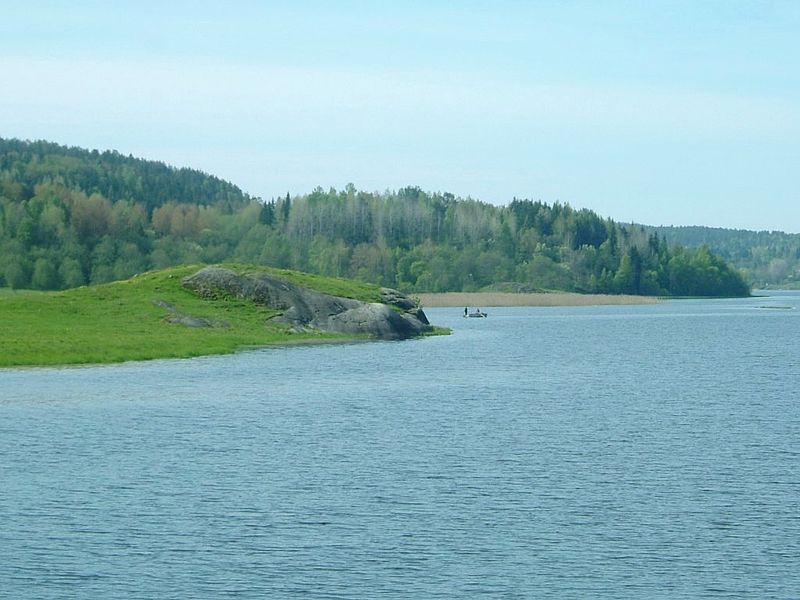
Peter decided that to attack the Swedish naval control of the Baltic he would require large numbers of smaller more manoeuvrable ships. On 20th June 1702 a little of flotilla of 18 Russian boats on Lake Ladoga caught a Swedish squadron anchored and attacking a village. The flagship was damaged and the Swedes retreated. The same squadron was attacked again on September 7th by thirty Russian boats and this time the squadron sailed out of Lake Ladoga. The withdrawal of all the Swedish ships from the Ladoga, down the Neva, gave the Russians unchallenged passage across the lake.

Narva River basin
The same tactics were taken on Lake Peipus, south of Narva, and again ended with the Swedes withdrawing their ships to safer waters. They returned in strength to reclaim the lake in 1703 but the tables were irreversibly turned in 1704. The Swedish flotilla was caught up river at Dorpat[x]. The Russians threw a boom across the mouth of the river and brought up artillery. Beyond the boom 200 Russian ships waited. The current pulled the hapless Swedish ships onto the boom where they were blown to pieces by the artillery.
Matveyev received information that the Swedes were intending to attack Archangel, Russia’s only port. Peter and Czarevitch Alexei set out in April 1702, accompanied by 4,000 men. On his arrival the defences were put in good order and the Russians waited for the Swedish attack. In August the annual Anglo-Dutch merchant fleet sailed into port with the news that the Swedes had dismissed ideas of attacking Archangel.
St Petersburg

Noteberg
Peter immediately took his guard and ordered Sheremetev and Peter Apraxin[xi], who had been harassing the Swedes in Ingria, to join him in capturing the Swedish fortress of Noteberg[xii]. Within ten days of the artillery assault the fortress surrendered.
‘In truth, this nut was very hard, but, thank God, it has been happily cracked. Our artillery did its work magnificently.’[xiii]
As an ecstatic Peter wrote to Vinius[xiv]. He renamed the fortress Schlüsselburg and made Alexander Menshikov[xv] the governor.

In the spring of 1703, determined to expand Russian influence in the Baltic, Peter had an army of 20,000 men, under Sheremetev, march down from Noteberg to the Baltic. Peter followed with a flotilla of sixty ships from Lake Ladoga.
On 11th May, after being subject to a barrage of artillery fire, the small Swedish settlement of Nyenskans surrendered. Two vessels from a Swedish fleet in the gulf were captured in a river battle on 18th May, after their detachment to ascertain the safety of Nyenskans.

Peter decided to build a fortress to guard the mouth of the Neva, the fort’s first sod was turned on 16th May and by October the construction was well underway. The fort was necessary as Peter was aware that the Swedes could not allow the Russians access to the Baltic, from whence they could challenge the Swedish mastery of the sea.
In the summer of 1703 a Swedish army of 4,000, camping on the north side of the Neva, was defeated by Peter’s men. On 7th July Peter personally led his soldiers and the defeated Swedes retreated. Throughout the summer the Swedes kept nine ships on standby at the mouth of the Neva, blocking Russian access to the Baltic.

Towards the end of the year the cold weather forced the withdrawal of the Swedish ships and Peter took his first trip on the Baltic in a Russian ship. He noted a small island at the mouth of the Neva and immediately ordered the building of a fort. By spring a small fort protected a channel from the Neva and the building work proceeding on the island.
Peter intended that his new settlement would also be a port and encouraged ships from western Europe to sail to St Petersburg to trade. To strengthen his grip on his new foothold Peter ordered more ships from the Lake Ladoga shipyard. Peter wrote to Menshikov on 23rd September 1704.

‘Here, thanks be to God, all goes fairly well. Tomorrow and the day after, three frigates, four snows, a packet-boat and a galliot will be launched.’[xvi]
To avoid the treacherous waters of Lake Ladoga Peter decided to move the main shipyard to St Petersburg.

The Swedes returned to attack the new settlement regularly and were driven off each time. Peter’s ambitions for St Petersburg gradually expanded and in early 1703 an Italian architect arrived in Russia, Domenico Trezzini, heavily influenced by Dutch northern baroque. On the 1sr April he signed a contract to become the Czar’s Master of Building, Construction and Fortification.
For nine years Trezzini directed the building of the city, which entailed a huge cost in human lives, estimates range from 25,000 to 100,000 workers losing their lives to scurvy, dysentery malaria and other assorted diseases. Workplace conditions were appalling; the ground was marshy and all materials had to be imported; every vessel, carriage and cart had to bring a quota of stone or rock before being allowed entrance to St Petersburg. In 1713 Trezzini began the building of the St Peter and St Paul Cathedral.
St Peter and St Paul Cathedral
 
To populate his city Peter invited his sister and half-sisters, the Czarevnas, the dowager Czaritas and hundreds of noblemen, officials and wealthy merchants. No-one was allowed to excuse themselves; traders and shopkeepers followed, lured by the exorbitant prices they could charge for goods.
Many of the labourers stayed, unable to walk the long distance home and were used the build the homes of the private citizens. The style of building and materials were laid down by decree. Many of the buildings were made of wood and fire was a constant danger, as was flooding in the winter.

Bibliography
Natasha’s Dance – Orlando Figes, Penguin Books Ltd 2002

Russia and the Russians – Geoffrey Hosking, The Penguin Press 2001
Peter the Great – Robert K Massie, Abacus 1992

The History of Charles XII of Sweden – Mr de Voltaire, C Davis & A Lyon 1732
www.wikipedia.en


[i] Peter the Great - Massie
[ii] Ibid
[iii] The History of Charles XII - Voltaire
[iv] Peter the Great - Massie
[v] In northern Lithuania
[vi] The History of Charles XII - Voltaire
[vii] Ibid
[viii] Now severely depleted
[ix] Among the prisoners was the woman who would eventually become Peter’s second wife
[x] Now know as Tartu
[xi] Brother of Admiral Feodor Apraxin, brother-in-law of Peter’s half-brother Feodor III
[xii] Standing at the point where Lake Ladoga empties into the Neva River, controlling all trade passing into Russia; now called Shlisselberg
[xiii] Peter the Great - Massie
[xiv] Inspector of Artillery and an old friend from the German Suburb
[xv] One of Peter’s major confidants
[xvi] Peter the Great - Massie

Wednesday, 1 January 2014

Peter the Great - What Peter Did Next


A Weakened Empire
Peter the Great
Encouraged by Augustus of Poland Czar Peter turned covetous eyes on the Baltic states[i], currently under Swedish dominion. Sweden was at the height of its imperial power but now, under the rule of an inexperienced adolescent, Sweden’s rivals sensed her vulnerabilities. The empire was over-extended and her Baltic provinces blocked Peter’s desired expansion to the Baltic. To Peter the lands bordering the Baltic’s eastern shores were Russian[ii], Karelia[iii] and Ingria[iv] had once come under Russian dominion.
Charles XI of Sweden and his ministers had been determined to crack down on their new province of Livonia[v] and in doing so created a bête noir; Johann Reinhold von Patkul was a Livonian noble, having pleaded with the Swedish King in vain

‘You have spoken like an honest man for your fatherland. I thank you.’[vi]
With the death of Charles on 5th April 1697 Patkul determined to remove Livonia from the claws of Sweden. In October 1698 he arrived in Warsaw in an attempt to persuade Augustus to join an anti-Swedish alliance.

Johann Patkul
Patkul had already met with Frederick IV, King of Denmark, who was willing to join the fray[vii]. Augustus hoped to turn his position of elected King of Poland into a hereditary position. To that end he wanted to take back Livonia from the Swedes, as a bribe to the Polish nobility. Patkul suggested that Austria, France, England and the Netherlands would do little more than protest; telling Augustus that conquering Livonia would be easy, he passed over details of the fortifications of Riga.
A joint offensive treaty between Poland and Denmark was signed. Denmark was to clear Schleswig and Holstein of Swedish troops, before mounting an attack on Scania. By January or February 1700 Augustus was to be ready to attack Riga. At this point Patkul suggested involving the Russians, who could attack Ingria, providing further distractions for the Swedes. Patkul accompanied an embassy from Augustus to Russia.

The Swedish king Charles XII sent a rival embassy to Russia; Peter met with both embassies and agreed with the Swedes to confirm treaties of peace between the two countries. Three days after the Swedish embassy’s departure Peter agreed to make war on Sweden, but only after the signing of a Russo-Turkish amnesty or peace treaty.
The War in the North
To meet his promises to Augustus Peter had to mobilise, train and equip an army within three months. A decree was issued to all clerical and civil landowners[viii] and volunteers were called for. Peter deeply felt the loss of General Gordon[ix], who died in November 1699. This was the second death of an old friend; Lefort had died in the previous March. Peter placed himself in charge of the training. In charge of the army he placed three Russians[x] all the regimental commanders were foreigners.

In February 1700 war was launched on Sweden without any formal declaration; 14,000 Saxon troops invaded Livonia and laid siege to Riga. The commanding general was killed; Peter, in Voronezh preparing for a possible further outbreak of war with the Turks, was disgusted with his ally.
‘The King…..should have been Livonia leading his troops himself instead of “diverting himself with women” in Saxony.’[xi]
Frederick of Denmark
In March Frederick of Denmark attacked Holstein[xii], besieging Tönning. His allies wanted Peter to attack Ingria, but as Peter said
‘It is a pity, but there is nothing to be done. I have not heard from Constantinople.’[xiii]
The rumours that the Turks were preparing for war again led Peter to rekindle good relations with Sweden. Throughout the spring these rumours proliferated, but on 8th August the news was finally received in Moscow; the Sublime Porte had signed a thirty year armistice on 3rd July. The following day Peter declared war on Sweden.

The Alliance of Poland, Denmark and Russia
Charles XII of Sweden, although young was determined to rid his empire of the invaders;

‘It is curious that both my cousins, Frederick and Augustus, wish to make war on me. So be it. But King Augustus has broken his word. Our cause then, is just, and God will help us.’[xiv]
Sweden was a powerful military power, but her enemies viewed Charles’ youth as a major weakness. Charles was not distracted by having two opponents in the first instance. His strategy was to deal with one and then the other.

Charles XII was supported by the major Protestant sea powers in Europe, England and the Netherlands; King William was implacably opposed to any change in the European status quo that might advantage Louis XIV of France. He also did not want his fellow sovereigns to be distracted by a war in northern Europe.
‘This reason has long engaged the English and Dutch, as much as possible, to hold the balance even between the Princes of the north. They joined themselves to the young King of Sweden, who seemed ready to be swallowed up by so many enemies.’[xv]
The Swedish navy of 38 ships and 12 frigates controlled the Baltic; but the open seas were controlled by the Danish-Norwegian navy. To gain access to the North Sea and the Atlantic Ocean required a joint action by the Swedes and the Anglo-Dutch squadron sent by William.

By June the combined allied navy of sixty ships were ready to meet the forty strong Danish-Norwegian navy. The Danes were unwilling to risk their navy with these odds and Charles was free to ferry his army across to Zealand and attack the Danes on their home ground.
In early July a force of 4,000 Swedes were landed on the island and within a further ten days a force of 10,000 were established. The outnumbered Danish forces withdrew into Copenhagen. Frederick IV hurried back from Holstein to find himself forced to come to terms.

‘The King of Sweden would not suffer the artifice of the ministers to draw out the negotiations into any length; he would have the treaty finished with as much rapidity as he made his descent into Zealand.’[xvi]
Narva

The Treaty of Travendal was signed on 18th August 1700; the Danes were required to leave the anti-Swedish alliance and return Holstein to its duke. Charles was now free to turn his attentions on the Poles in Latavia.
Peter’s attack on the Baltic provinces focussed on Ingria and Karelia. The news of his proposed line of attack was not received with pleasure by his allies.
‘We found him [Peter] so stubborn that we feared to touch anymore on such a delicate subject and must be satisfied with the Tsar’s break in the hope that in time Narva will be in our hands.’[xvii]
By mid-September the governor of Novgorod had received orders to march on Narva and invest it with a force of 8,000 men. Command of the army was given to Golovin[xviii]; by 4th October his troops before Narva totalled 35,000 men. The army suffered from supply problems, being over one hundred miles from the nearest Russian town.

Golovin
By the end of November the artillery bombardment of the town was temporarily ceased for lack of ammunition. Augustus had gone into winter quarters and news arrived in the Russian camp that Charles XII had landed Swedish troops on the coast, 150 miles from Narva.
Charles had withdrawn his troops from Zealand; the protection of the Anglo-Dutch squadron had been withdrawn. The hazardous trip across the Baltic was enlivened by a storm that crippled ships and cavalry horses. Nevertheless Charles had his army en route for Narva by 13th November.

Eighteen miles west of Narva General Sheremetev waited with 5,000 horse. Charles positioned his artillery and charged. Sheremetev’s men, lacking artillery retreated, under orders from Peter not to engage with the Swedish army.
Sheremetev’s troops pursued a scorched land policy in their planned retreat. Overnight on 17th-18th November Peter passed command of his army to the Duc du Croy[xix], and with Golovin left for Novgorod to speed up reinforcements and demand of Augustus why he was not prosecuting the fight during the winter[xx]. Peter, used to the leisurely speed that Russian armies conducted war, did not believe that Charles would act precipitately.

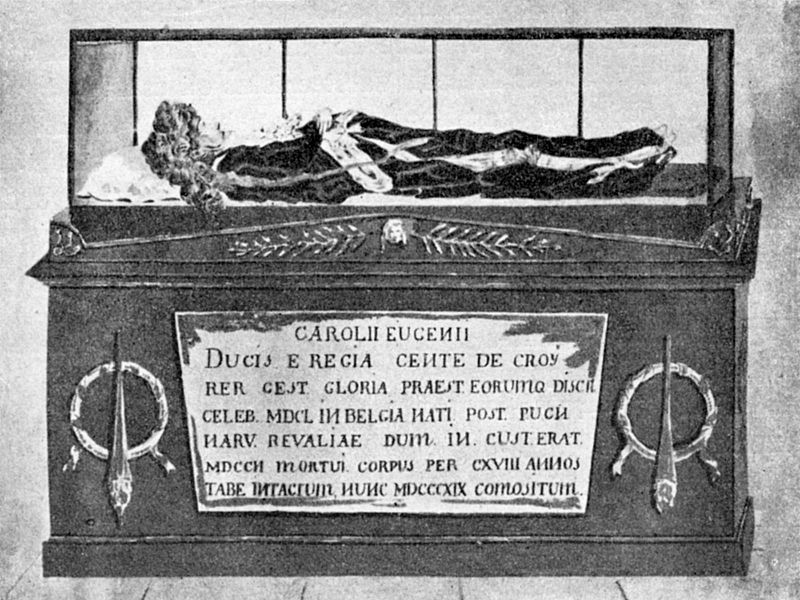
Tomb of the Duc du Croy
But Charles was a man with a mission, to save Narva. Du Croy was in an unfortunate position; he did not speak Russian and he did not know the disposition of the troops. On 20th November Charles took advantage of a storm that blew up; snow was blowing into the Russian lines. He attacked against an enemy blinded by the snow. The Russian lines before Narva fell like ninepins; all save six Russian battalions, including the Preobrahensky and the Semyonovsky guards.
Most of the foreign officers, including du Croy, surrendered and were sent to Reval along with Peter’s personal physician and Peter Lefort, the nephew of Peter’s old friend. They were to remain there for a very long time[xxi].

‘But at last their generals Dolhorouky, Gollouin, and Fedorwitz surrendered themselves to the King, and laid their arms at his majesty’s feet. And in the instant they were offering them, came up the Duke of Croy the general of the army, to surrender himself with thirty officers.’[xxii]
The small exhausted Swedish army had defeated an army much greater in size than their own. For Peter it was a huge disgrace. Charles struck a medallion showing his enemy running away from the battle, which caused much amusement across Europe. The battle instilled in Charles a belief in himself and his invincibility and an undeserved contempt for Peter that was to be the cause of his undoing.

Bibliography
Natasha’s Dance – Orlando Figes, Penguin Books Ltd 2002

Russia and the Russians – Geoffrey Hosking, The Penguin Press 2001
Peter the Great – Robert K Massie, Abacus 1992

The History of Charles XII of Sweden – Mr de Voltaire, C Davis & A Lyon 1732
www.wikipedia.en


[i] Now Estonia, Latvia and Lithuania
[ii] Russian hero Alexander Nevsky had beaten the Swedes at the Neva river in 1240.
[iii] North of Lake Ladoga
[iv] At the eastern end of the Gulf of Finland
[v] The Protestants of Livonia had been subject to the domination of Catholic Poland and in 1660 Livonia had transferred to Sweden. The new king now demanded the return of lands parcelled out to the nobility (reduction), in an attempt to centralise power in the hands of the monarchy. Despite a prior promise to the Livonians that the policy of reduction would not apply to them, the Livonian nobility were now to be dispossessed
[vi] Peter the Great - Massie
[vii] The Danes had never accepted the loss of land inflicted upon them by Gustavus Adolphus
[viii] One serf per 50 households for civil landowners and one serf per 25 households for clerical landowners
[ix] Peter had sat beside his friend as he died
[x] Golovin, Weide and Repnin
[xi] Peter the Great - Massie
[xii] Ruled by the King of Sweden’s brother-in-law
[xiii] Peter the Great - Massie
[xiv] Ibid
[xv] The History of Charles XII - Voltaire
[xvi] Ibid
[xvii] Peter the Great - Massie
[xviii] One of the ambassadors on the Great Embassy
[xix] An observer for King Augustus
[xx] Not normally a season for fighting
[xxi] Du Croy died in captivity, and due to the fact that he was in debt, his creditors would not allow him to be buried.
[xxii] The History of Charles XII - Voltaire