Wednesday, 16 April 2014

Emily Eden 3


The Terrible Dénouement
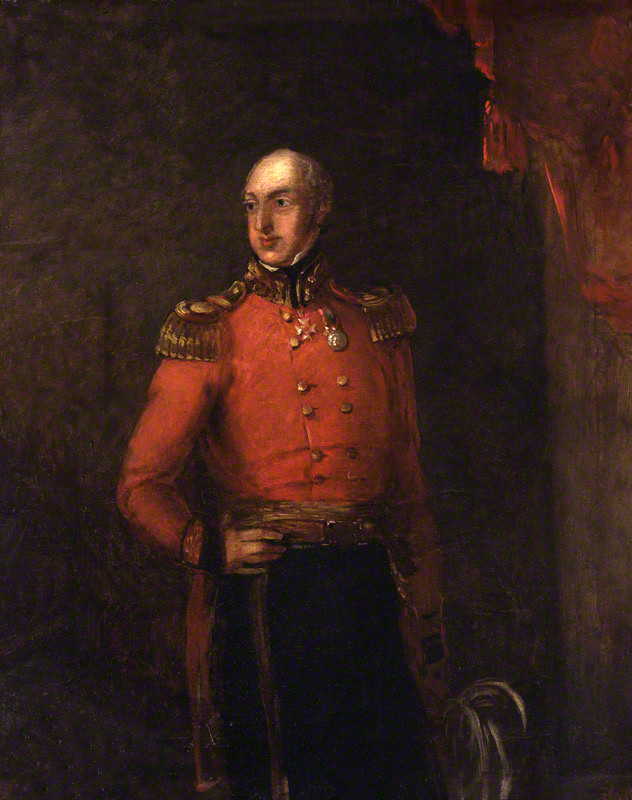
General Elphinstone
In November 1841 Macnaghten was due to leave Kabul to take up the post as Governor of Bombay. His successor Sir Alexander Burnes was murdered by a mob; there was no retribution and the rebels were not dispersed.
The appalling winter weather kept the British force at Kandahar from marching to Kabul. At the beginning of December, with supplies running low, Macnaghten and Elphinstone agreed with the rebel chiefs that they would leave Afghanistan and release Dost Mohammed.

Before the retreat commenced Macnaghten, suspecting the good faith of the groups he’d treated with, opened negotiations with a rival Afghan faction, who betrayed him to Dost Mohammed’s son Akbar Khan and was assassinated on 23rd December.
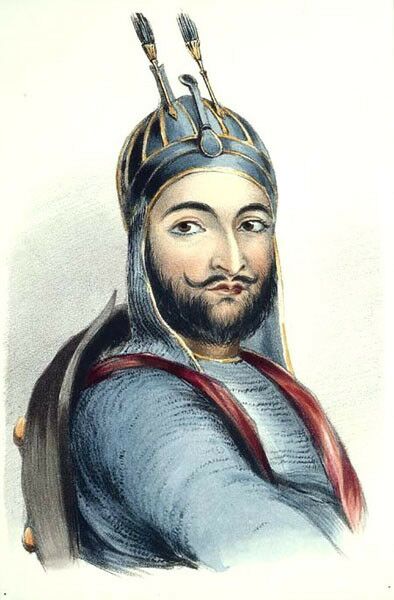
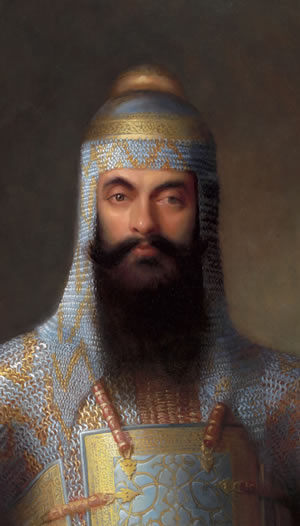
Akbar Khan
On the 15th December 1841 Emily wrote to a friend;
‘We go on very quietly with little scraps of news from Peshawur, which is on the frontier, and the last place with which we have any sure communication. Inasmuch as things are not worse they are better, as the snow, which was beginning to fall, would affect the unhoused assailants more than our troops in their lines. To-day General Sale forwarded a short French note from General , begging for help and ending with 'Nous sommes dans un péril extrême.'[i]
Elphinstone refused to seize the citadel and hold out until reinforcements could arrive; nor would he agree to fight through to Jallalabad. The evacuation of Kabul started on 6th January 1842; the weather was bitter and the majority of the stores and guns were left behind. The women and children and some of the officers, including Elphinstone, were given up as hostages and the troops made their last stand in the pass of Jagdallak.

The Return of Dr Brydon
By the 13th January, of the 4,500 troops and 12,000 camp followers, only 120 prisoners, some sepoys and Dr Brydon were left alive, victims of the bitter cold and the insurrectionists. Brydon arrived alone in Jallalabad to bring the news of the worst defeat the British Army had ever suffered.
On 29th January Emily wrote home;

‘The accounts from Cabul are more distressing and incomprehensible every day. One of Lady 's simple good letters have come to hand. She talks with bitter disgust of the cowardice of the whole proceeding, and says the retreat was to begin the next day, and her son-in-law, Lieutenant , who was wounded the other day, adds a note to the same purpose and says, 'God may help us, for we are not allowed to help ourselves.'[ii]
The First Afghan War cost the British much prestige in India and George’s reputation is coloured by the tragedy.

Return to England
Lord Ellenborough
George wanted to withdraw from Afghanistan, but it was now down to his replacement, Lord Ellenborough[iii] to decide on the appropriate actions; a relieving force marched through the Khyber Pass to find that the garrison at Jallalabad had defeated its besiegers and that the soldiers at Kandahar were also holding out.
George’s tour of duty ended on 28th February 1842 and the Edens left Calcutta on March 12th after a somewhat harried search for a vessel.

‘We went to the Fort Church this morning; and in the evening George and I went on board the 'Bucephalus' to see 's cabin and 's. The probability is that we shall go home in one of these country ships, as no Queen's ship seems to be forthcoming; and they are, in fact, nearly as comfortable.’[iv]
The unexpected early arrival of Lord Ellenborough went off better than expected,

‘Lord Ellenborough arrived twelve days ago, and we are all living together and are excessively fond of each other……..He startles people so very much by the extraordinary activity of his English notions; the climate will settle a great many of them, and in the meantime he really is so good-natured and hospitable we are quite touched by it.’ [v]

The journey home took four months on a ship that Emily claimed housed 80,000 cockroaches.
Home At Last

Upon their return to England Emily, Fanny and George set up home at Eden Lodge, in Kensington Gore, where Emily returned to her task as a political hostess. In 1844 Emily published a portfolio of 24 lithographs entitled Portraits of the Princes and People of India.
Robert Eden
Emily was bereft when her beloved George died unexpectedly on 1st January 1849 aged 64; he was in his third posting as First Lord of the Admiralty. The Earldom became extinct and brother Robert took the title that had been his father’s and George’s before him; Baron Auckland.
Robert was two years younger than Emily and had been consecrated Bishop of Sodor and Man in 1847[vi]. He was married with eight children and had been chaplain to William IV and Victoria.

Fanny died in April of 1849; Emily stayed at Eden Lodge, entertaining friends, corresponding with friends and writing.
The Author
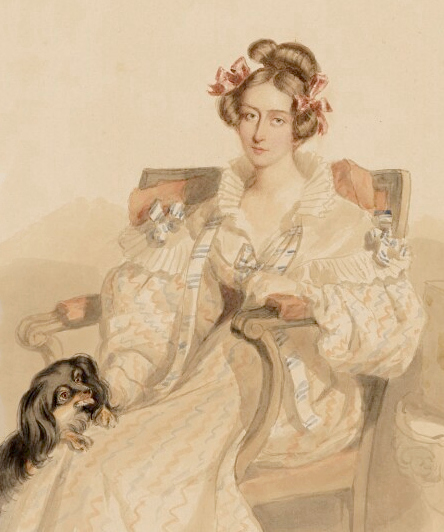
Emily Eden
In 1859 the second of Emily’s novels; the Semi-Detached House was published anonymously having been edited by Lady Teresa Lewis, a friend of Emily’s. Lewis negotiated a fee of £300[vii].
The Semi-Detached House tells the story of how the spoilt and pregnant Blanche gets on with her new socially inferior neighbours, when forced to live in a semi-detached property while her new husband is away on diplomatic duties in Berlin. Blanche’s travails while awaiting her husband’s return are intertwined with three romances.

The lives of all the local inhabitants are somewhat blighted by news in the local rag;
‘Rumours of all sorts are rife – a foreign court and a villa not one hundred miles from London are the scenes of several piquant anecdotes. Whether the last is tenanted by his Lordship’s wife, or his chére amie we forbear to say.’[viii]
which causes much misunderstandings between the various parties; the untangling of which Emily skilfully sorted so that Blanche and her husband and the three romantic couples all end happily.

Five years after Semi was published Anthony Trollope, in his book The Way We Live Now[ix], , echoed one of Emily’s themes. Trollope’s main character a Jewish banker called Augustus Melmotte bears several similarities to Emily’s Baron Sampson; being a Jewish banker, having a daughter who does not fall in love in compliance with her father’s wishes and a fall from grace as the result of dubious financial practises;
‘”And the rascal [Baron Sampson] is actually gone – went off while the dancing was going on….he got into a steamer, and has not been heard of since.”’[x]
But Trollope’s main character suffers a more violent end;

‘Drunk as he had been – more drunk as he probably became during the night – still he was able to deliver himself from the indignities and penalties to which the law might have subjected him by a dose of prussic acid.’[xi]
Emily was pleased with the success of ‘Semi’;

Semi has had more success than I require, and considerably more than I expected.’[xii]
Following the success of the Semi-Detached House the Semi-Attached Couple was published in 1860 after some re-writing;

‘When I wrote it. I thought it I thought it a tolerably faithful representation of modern society; but some young friends………..have read it with the indulgence of happy youth, condescendingly that it is amusing, inasmuch as it is a curious picture of old fashioned society.’[xiii]
Both books were acclaimed for ‘their lively wit and sharp observation’; the similarity to the novels of Jane Austen being no drawback. Following a period in obscurity the two novels were reprinted in 1927 by Elkin Matthews, with an introduction by Anthony Eden.

Emily’s letters to Mary from India were published in 1867 following the success of the novels. The book was entitled Up The Country. Further letters were published in 1869 three years after Emily’s death. More of Emily’s letters were published by Violet Dickinson[xiv] in 1919 under the title Miss Eden’s Letters.
Emily died in 1869, living in Richmond; she was seventy two, having outlived those she loved best by 20 years. She was buried at Beckenham.

Bibliography
The Last Mughal – William Dalrymple, Bloomsbury 2006

The Semi-attached Couple and the Semi-detached House – Emily Eden, Virago 1988
Up the Country – Emily Eden, Virago 1983

Heaven’s Command – James Morris[xv], Penguin 1979
The Way We Live Now – Anthony Trollope, Folio Society 1992

The Age of Reform – Sir Llewellyn Woodward FBA, Oxford University Press 1997
www.wikipedia.en


[ii] Ibid
[iii] Once again there had been a change of ministry and the leader of the Conservative Party Robert Peel was now Prime Minister
[v] Ibid
[vi] Robert was to be made Bishop of Bath and Wells in 1854
[vii] Worth in 2011 £24,700.00 using the retail price index or £187,000.00 using average earnings www.measuringworth.com
[viii] The Semi-detached House – Eden
[ix] First published in 1874
[x] Ibid
[xi] The Way We Live Now - Trollope
[xii] The Semi-attached Couple and the Semi-detached House – Eden
[xiii] Preface to The Semi-attached Couple - Eden
[xiv] A close friend of Virginia Woolf
[xv] This edition predates Jan Morris’s change of gender from James

Wednesday, 9 April 2014

Emily Eden 2


In India
George Eden
In September 1835 George was appointed Governor-General of India[i]. It was from her firm sense of duty, and of course her love for this favourite of her siblings, that Emily elected to accompany her brother. George, Emily and Fanny arrived, along with their nephew William Godolphin Osborne, who was to be George’s military secretary, in Calcutta in March 1836 after a five month voyage. They landed on Emily’s birthday, she was thirty-nine.
George had as his private secretary John Colvin. George’s staff also included William Mcnaghten as his political secretary and his assistant Henry Torrens.

The first 20 months of George’s appointment the Edens spent in Calcutta; during the week at Government House and at the weekends at Barrackpore House[ii]. Emily hated the very formal life in Calcutta; the rigorous social obligations that had to be met, no matter how ill the climate made one feel. According to her the society was ‘second rate’ and there were very few topics of conversation.
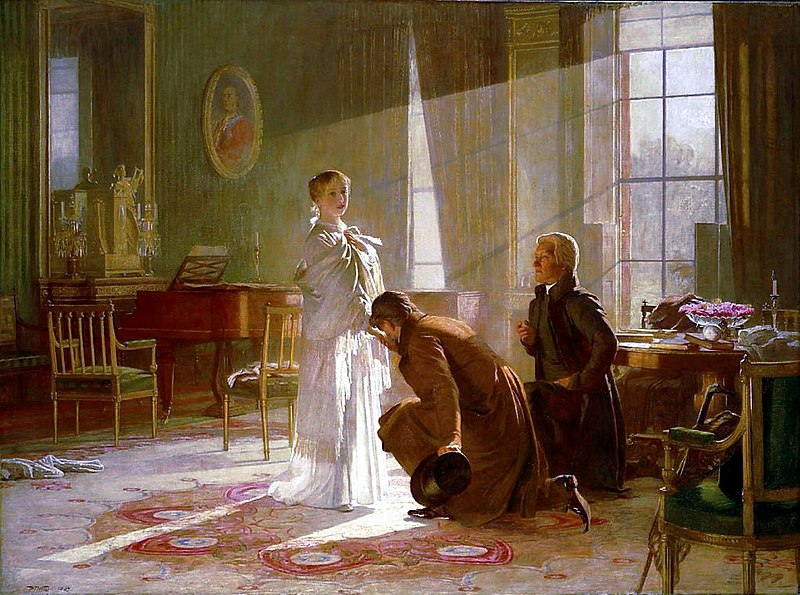
On 20th June 1837 the old king died and in his place his young niece, Victoria, came to the throne. The inexperienced young queen was to become very dependent on her fatherly and urbane Prime Minister Lord Melbourne. It was not until 30th October that Emily, by then 200 miles distant from Calcutta, learnt of the passing of an age;
‘I think the young Queen a charming invention, and I can fancy the degree of enthusiasm she must excite. Even here we feel it. The account of her proroguing Parliament gave me a lump in my throat.’[iii]
Up Country

In the autumn of 1837 Emily accompanied George on an official progress ‘up-country’ and it is her letters to her sister Mary Drummond that give us details of the travels of the Governor-General in colonial India. George intended to familiarise himself with the East India Company territory stretching from Calcutta to the River Sutlej in the north. George also wished to consolidate the 1831 treaty of friendship between Britain and the Maharajah of the Punjab[iv], Ranjit Singh.
The Sunderbunds
The party left Calcutta on the 21st October 1837 by steamer for the first 3 ½ weeks through the Sunderbunds and up the Ganges. On 15th November the Governor and his entourage camped at Benares. By the end of November the party were travelling overland to Simla, using 850 camels, 140 elephants and hundreds of horses and bullocks.
Nawab of Oudh
There were 12,000 people travelling in the governor’s wake and it could take three days for the ten mile long caravan to cross a river. The Nawab of Oudh sent his chef to cook for the Governor General; much affronting St Cloup, George’s own chef, who had previously worked for the Prince of Orange. The Edens were accompanied by George’s staff and their families[v].
At their halts the Edens and their entourage met with the British living in the vicinity, but of course society morality still prevailed;
‘There was a lady yesterday in perfect ecstasies with the music. I believe she was the wife of an indigo planter in the neighbourhood, and I was longing to go and speak to her, as she had probably not met a countrywoman for many months; but then, you know, she might not have been his wife, or anybody’s wife.’[vi]
Cawnpore from the Ganges
Emily, George and Fanny were distressed by the hunger they came across in Cawnpore;
‘You cannot conceive the horrible sights we see, particularly children; perfect skeletons in many cases, their bones through their skin, without a rag of clothing, and utterly unlike human creatures.’[vii]
The Edens began distributing food, but their attempts were minimal compared to the problems; one of the party saw three villagers drop dead of starvation. Three days after the first distribution of supplies they came across worse deprivation; 700 people were fed but the violence that erupted required policing.
Victoria was crowned on the 28th June 1838, but, so very unlike later Victorians, Emily makes no mention of the event in her letter of that date; instead she mentioned;
‘We had a musical dinner yesterday; a borrowed pianoforte and singing, and two couples who accompany each other. The flute couple I think a failure, but they are reckoned in this country perfectly wonderful……the other couple are beautiful musicians.’[viii]
A Successful Expedition

Lord Palmerston
George was, like Palmerston[ix], an anti-Russian politician and this led him to dabble in affairs in Afghanistan with disastrous consequences[x]. George listened to advisers whose proposals he believed would secure the north-west frontier. The plan of action involved going over the Khyber Pass, at the same time marching the army through Sind in violation of an 1832 treaty[xi], using the Persians siege of Herat as an excuse.
Ranjit Singh had ensured that the British would take the lead in restoring Shah Shuja to his throne. The Commander in Chief of British forces in India disapproved of the plan and Wellington, who had served in India, thought it would mean

‘A perennial march into Afghanistan.’[xii]
Palmerston thought that the expedition would;

‘Place the Dardanelles more securely out of the grasp of Russia.’[xiii]
On 1st October 1838, while staying at Simla, George dethroned Dost Mohammed[xiv] as a preliminary to the campaign. On 24th October Emily wrote;

‘News had arrived yesterday that the Persians had abandoned the siege of Herât, and so the
--s fancied that the Cabul business would be now so easy.’[xv]
9,500 Crown and East India Company troops formed the core of the invasion force, backed up by 6,000 local troops under the command of Shah Shuja[xvi], George’s choice for leader of Afghanistan. George and Emily attended a ceremonial parade of the troops on 3rd December before they departed.

‘For Runjeet, instead of being satisfied with a general view of the line, insisted on riding down the whole of it, about three miles, and inspecting every man….……in front there was the army marching by. First the 16th Hussars, then a body of native cavalry, then the Queen’s Buffs, then a train of artillery drawn by camels, then Colonel Skinner[xvii]’s wild native horsemen.’[xviii]

Ghazni
Shah Shuja entered Kandahar on the 25th April 1839 and Ghazni was taken by storm on 2rd July. The invasion itself was a success in that on 6th August 1839, following the flight of Dost Mohammed, Shah Shuja regained his throne; the trick would be to keep him there. For his part in the success George was made Earl of Auckland.
The Disastrous Expedition

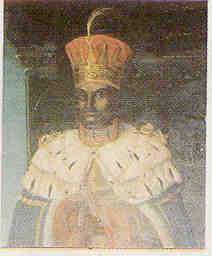
Ranjit Singh
Emily recorded Rajhit Singh’s death on 27th June
‘We heard of dear old Runjeet’s death……It is rather fine, because so unusual in the East, that even to the last moment, his slightest signs, for he had long lost his speech, were obeyed.’[xix]
The government in India was concerned that Ranjit’s death could endanger the British lines of communication with Kabul. The Edens returned to Calcutta on the 1st March 1840.

Dost Mohammed
Unpopular with the Afghans, the incapable Shah Shuja was unable to secure his position in Afghanistan without the support of the British forces and George was determined that the army would return to India. Dost Mohammed surrendered on 3rd November 1840 and was given sanctuary in British India; Emily drew his portrait during September 1841.
‘I was so active this morning. The Dost and his family all set off to-day for the Upper Provinces, and I have done a sketch of him and his two sons – merely their heads – and wanted his nephew, who is a beautiful specimen of a Jewish Afghan, to fill up the sheet; so Mr. C abstracted him out of the steamer early this morning and brought him to my room before breakfast.’[xx]
In April 1841 George appointed Major General Elphinstone as head of the British forces in Afghanistan, against the wishes of the Commander in Chief of all British forces in India[xxi]. George and Macnaghten, described disparagingly by Wellington as

‘”The gentlemen employed to command the army.”’[xxii]
believed they could withdraw the troops supporting Shah Shuja at a leisurely pace. George had refused to allow proper fortifications to be built for the garrison of Kabul[xxiii]. As an economy measure he also reduced the subsidies given to local chiefs to keep the passes open.

Bibliography
The Last Mughal – William Dalrymple, Bloomsbury 2006

Up the Country – Emily Eden, Virago 1983
Heaven’s Command – James Morris[xxiv], Penguin 1979

The Age of Reform – Sir Llewellyn Woodward FBA, Oxford University Press 1997
www.wikipedia.en


[i] Lord Heytesbury had been chosen by Robert Peel for the post before the change of ministry
[ii] 14 miles up the Hooghly River
[iii] Up the Country - Eden
[iv] Leader of the Sikhs
[v] The trip was due to last eighteen months
[vi] Up the Country - Eden
[vii] Ibid
[viii] Ibid
[ix] Currently Foreign Secretary
[x] George had instructions to forestall Russian encroachment towards British India
[xi] Opening the Indus to trade provided that no munitions of war were carried on the river
[xii] The Age of Reform - Woodward
[xiii] Ibid
[xiv] Emir of Kabul
[xv] Up the Country - Eden
[xvi] The former ruler of Kabul; Shuja’s troops were under the command of Macnaghten, the Political Officer
[xvii] Of the East India Company; leader of Skinner’s Horse
[xviii] Up the Country - Eden
[xix] Ibid
[xxi] Elphinstone had no experience of fighting in the east and was ill
[xxii] The Age of Reform - Woodward
[xxiii] Shah Shuja had taken the citadel for his seraglio
[xxiv] This edition predates Jan Morris’s change of gender from James