|
| Mehmet |
Back in the Balkans
Mehmet had
decided to leave Vlad Dracul alone in Wallachia as long as his tribute was paid.
But in 1461 Dracul formed an anti-Ottoman alliance with King Matthias Corvinus[i], the new king of Hungary. Mehmet
sent an envoy to lure Dracul to Istanbul, along with his arrears of tribute.
But Dracul’s men put the envoy’s escort flight and had the envoy and the
commander of his escort impaled on pikes.
Dracul then
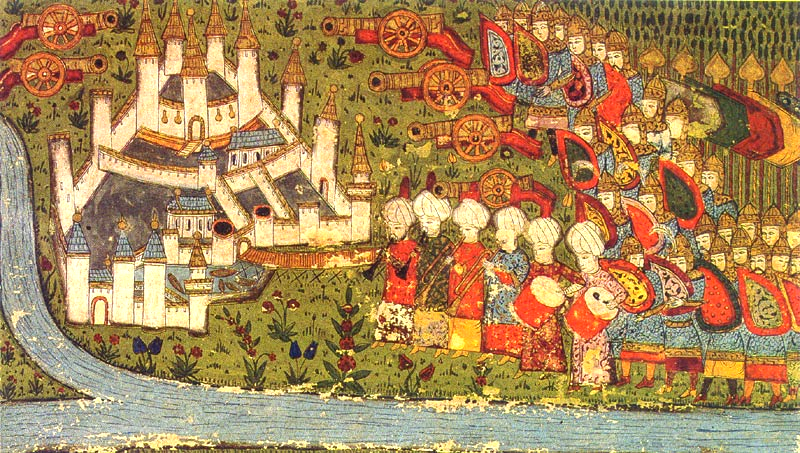
led an army into Bulgaria and ravaged Ottoman territory. In response Mehmet led
an army of about 80,000 men into Wallachia where they found a forest of 20,000
corpses; Bulgarians and Ottomans impaled on stakes and crucified. Soon after
crossing the Danube Mehmet’s army fought with Dracul and his men.
Dracul was
driven into exile in Moldavia where his former ally imprisoned him. Matthias
Corvinus later released Dracul, giving him one of Matthias’ cousins as a bride.
Dracul was replaced as Voyvoda of Wallachia by his brother Radu, a former page of Mehmet’s. Mehmet returned to Adrianople in
mid July 1462. Two years later Radu was expelled from his country by Stephen of Moldavia.
Naval Matters
.jpg/800px-Walls_of_Troy_(1).jpg) |
| Walls of Troy |
The summer
of 1462 was spent campaigning in Myteline, where Niccolo Gattilusio[ii], Lord of Lesbos, surrendered his
fortress after a siege of fifteen days; one third of the citizens were taken
into slavery[iii].
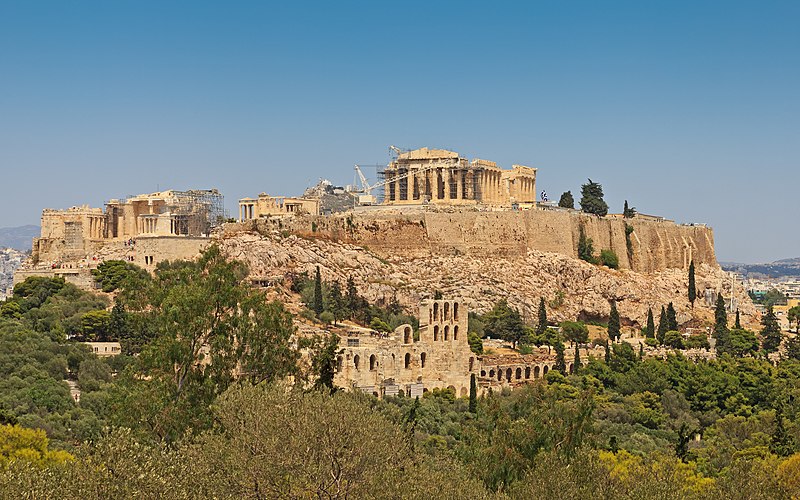
At the beginning of the campaign Mehmet visited the site of Troy, enquiring about the tombs of Ajax and Achilles. This campaign convinced
Mehmet of the need for a strong navy;
‘He gave orders that, in
addition to the existing ships, a large number of others should be speedily
built and many sailors selected……and set aside for this work alone. He did this
because he saw that sea power was a great thing.’[iv]
He also
decided to build a pair of fortresses guarding the maritime approach to Istanbul
from the Aegean. The project was managed by Yakup Pasha, admiral and governor
of Gelibolu. Kiht ül-Bahirye on the European
shore and Kalei Sultaniye[v] were constructed along
with a larger harbour at Gelibolu to accommodate the ships being built at the Tersâne[vi] on the Golden Horn.
Interlude in Bosnia
 |
| Steven Tomasevic |
Along with
Mahmut Pasha Mehmet led an army into Bosnia in 1463 where King Stephen VII Tomasević had refused to pay tribute. Stephen
believed that his alliance with Hungary, facilitated by the Pope, would protect
him from the Ottomans’ wrath. Stephen’s letter to the Pope claimed that Mehmet
posed a threat to Christianity;
‘His [Mehmet] insatiable
lust for power knows no bounds. After me he will attack Hungary and the
Venetian province of Dalmatia. By
way of Krain[vii] and
Istria he
will go to Italy, which he wishes to subjugate. He often speaks of Rome and
longs to go there.’[viii]
The winter
of 1463-4 saw Mehmet crippled with gout, something which was to plague him for
the rest of his life. His Jewish physician Maestro Iacopo managed to alleviate
the condition sufficiently that Mehmet was able to lead his troops back into
Bosnia.
King Stephen
fled from town to town before the passage of the Ottoman army, finally landing
in Jajce where he was brought before Mehmet.
Stephen was beheaded as the Ottoman army rolled on, taking most of Hercegovina, whilst its duke Stephen Vučkić fled to Hungary.
.jpg/372px-Portrait_of_Doge_Cristoforo_Moro_(1390-1471).jpg)
Venetian
owned Dalmatia was now laid open to Turkish attacks and in November 1462 Őmer Bey, the Ottoman commander in Athens,
launched an attack on the Venetian fortress at Naupactos[ix] but failed to take it. On April 3rd
1463 Isa Bey, the Turkish commander in the Peloponnese, took the Venetian fortress
at Argos.
In May the
Venetians agreed to support King Mathias Corvinus following his appeal for
assistance. The Doge of Venice Christoforo Moro wrote to the city of Florence on 14th June
requesting their aid in throwing off the infidels.
‘Impelled by his lusts and
his inexorable hatred of the Catholic faith, the bitterest and fiercest enemy
of the Christian name, the Prince of the Turks has carried his audacity so far
that among the Princes of Christendom there is virtually none willing to oppose
his designs.’[x]
 |
| Sigismondo Malatesta |
Finally on
28th July 1463 the Venetians declared war on the Ottoman Empire; Sigismondo Malatesta[xi], Lord of Rimini, was in command of
the Venetian land forces. This was basically a war for the control of the
eastern end of the Mediterranean.
The
Venetians took first blood in the war, retaking the fortress at Argos. On 3rd
September the Venetians, attacked the citadel at Corinth but were seen off in a
Turkish counter-attack. By the end of the month the Venetians had taken control
of all the fortresses in the Morea.
The Crusade
The Doge
burned with a militant fervour and was more than happy to link the fight with
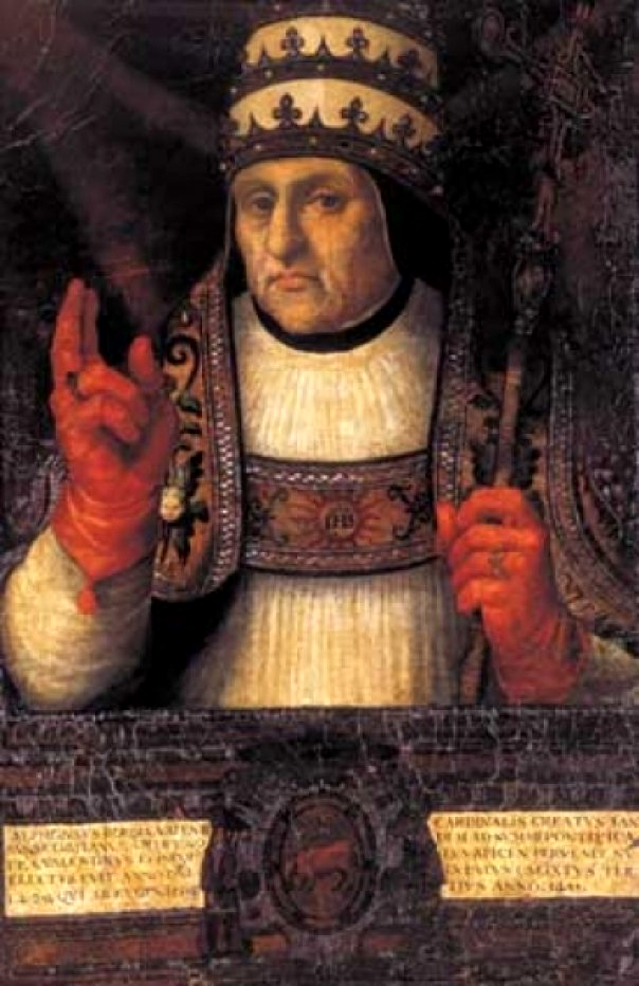
the crusade ordered by the Pope. Pius delivered the bull Ezechielis prophetae in
support of the war on 22nd October 1463.
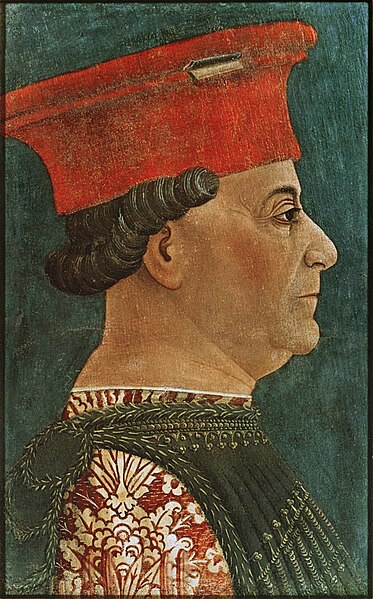 |
| Francesco Sforza |
The crusade
itself was due to leave Ancona in the summer of 1464, but Francesco Sforza, the Duke of Milan upset the balance of power in Italy by taking Genoa, making
it virtually impossible for any continental power to join the crusade. The Duke
of Burgundy sent his apologies, he needed another year to prepare and Rome was
short of money and preparations for the crusade barely started. The Burgundian
envoy reported;
‘The dispositions were the
poorest they had ever seen, and only two galleys were ready.’[xii]
When the
Pope arrived in Ancona it was to find a penniless, footloose rabble who
expected to be armed and fed. The Venetians refused to have anything to do with
the armed dross of Europe. The Venetian naval support did not arrive in Ancona harbour
until 12th August when 24 galleys sailed into the harbour.
They arrived
too late for a by now reluctant Moro to meet the Pope, who was on his death
bed. Pius II died of pneumonia two days later and the crusade died with him. An
election saw the Venetian Pietro Barbo elected Pope Paul II.
Back on the March
 |
| Fortress at Zvornik |
The Venetians
besieged Mytilene and had already occupied Lemnos. Mahmut Pasha was sent with a
fleet to relieve Mytilene and the Venetians withdrew when the news of the fleet
was received. In the summer of 1464 Mehmet sent an army of 40,000 to relieve
the Turkish garrison at Zvornik; he himself retired to Adrianople. The army cut down many of the
retreating Hungarians.
Stephen
Vučkić died in 1466 and his son Sigismund entered service with the Ottomans and
became a Muslim and was known as Hersekzade Ahmet Pasha. He married one of Mehmet’s
granddaughters.
On 16th
May 1465 Pope Paul asked the Venetians to fund the Hungarians in their fight
against the infidel. The Venetians replied asking to be excused;
‘Many and grave difficulties
are arising which make it so hard for us that we cannot see how action can be
taken on your wish.’[xiii]
Despite this
setback Paul was determined to help the Hungarians and in 1456 alone gave them
80,000 ducats[xiv].
The Venetians were spending far more freely in their attempt to gain control
over the seas and the annual expenditure of maintaining the Venetian navy and
army amounted to 700,000 ducats[xv]. . A request from
Skanderbeg in Croatia for support for his defence of Kruje had to be turned
down.
The
Venetians fight with Mehmet was complicated by a brush with the Mamluk Sultan of Egypt and it took several years of
negotiations to resolve the matter peacefully. But 1465 found Mehmet worn out
and needing to rest; he moved into the Topkapi Palace in Istanbul.
‘The Sultan himself was
greatly exhausted and worn out in body and mind by his continuous and unremitting
planning and care and indefatigable labours and dangers and trials, and he
needed a time of respite and recuperation. For this reason he knew he needed to
remain at home and rest himself and his army during the approaching summer.’[xvi]
Cerebral Pursuits
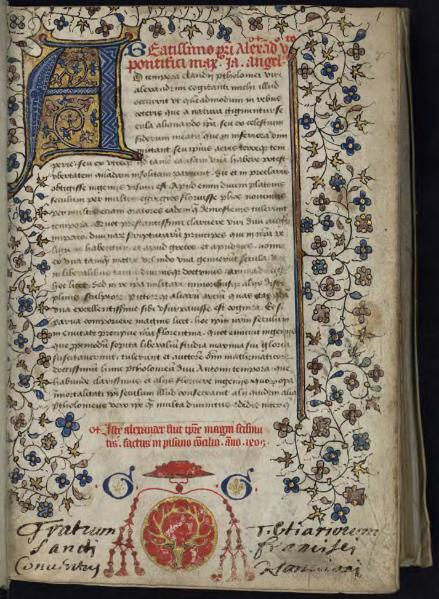 |
| Geographia |
The summer
of 1465 saw Mehmet improving his knowledge of geography as well as indulging an
interest in philosophy. He had discovered Ptolemy’s Geographia,
being particularly interested in the maps.
‘He also ran across,
somewhere, the charts of Ptolemy, in which he set forth scientifically and
philosophically the entire description and outline of the earth. But he wanted
to have these…..brought together into one united whole as a single picture or
representation…..so as to be more easily understood by the mind.’[xvii]
Mehmet
enlisted the aid of George Amirourtzes of Trebizond[xviii] to create a huge wall
map that included all of Ptolemy’s maps, so Mehmet could see at a glance how his
empire was expanding.
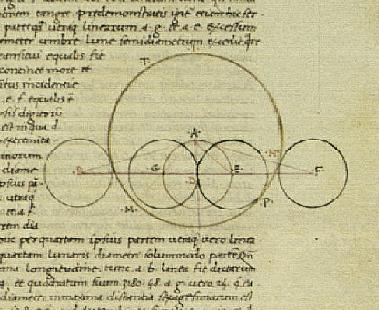 |
| Detail from Trapezuntios' translation of the Almagest |
Mehmet used
Amirourtzes’ son Mehmet Bey to translate many Greek manuscripts including the
bible. Mehmet read Ptolemy’s Almagest on astronomy; his interest in
astronomy was aided and abetted by George Trapezuntios who visited Istanbul in the winter of 1465[xix].
To further
his understanding of astronomy Mehmet contacted Ali Qushji[xx] who joined him in Istanbul in 1472,
presenting Mehmet with the mathematical treatise Muhammadiye that he had written on his journey. In 1473 Qushji
wrote a book on astronomy for Mehmet; the Book of Conquest. This joined the
many books and manuscripts that Mehmet was collecting in his scriptorium; he
had over 120 from the library of Constantine the Great. Those who met Mehmet remarked on
his interest in ancient history.
Bibliography
The Grand
Turk – John Freely, I.B. Tauris and Co Ltd, 2009
The
Janissaries – Godfrey Goodwin, Saqi Books 1994
Lords of the
Horizons – Jason Goodwin, Henry Holt & Co 1998
The Ottoman
Empire – Halil Inalcik, Phoenix 1994
The Ottoman
Empire – Lord Kinross, Folio Society 2003
A History of
Venice – John Julius Norwich, Penguin Books 1982
The Ottoman Empire
– Andrina Stiles, Hodder & Stoughton 1989
www.wikipedia.en
[i]
Son of Hunyadi
[iii]
One third sent to live in Istanbul and the other third allowed to remain in
Mytilene as Mehmet’s subjects
[iv]
The Grand Turk - Freely
[vi]
The naval shipyards
[vii]
Now Carniola
[viii]
The Grand Turk - Freely
[x]
The Grand Turk - Freely
[xii]
A History of Venice - Norwich
[xiii]
The Grand Turk - Freely
[xiv]
In 2013 the relative: historic standard of
living value of that income or
wealth is £57,370,000.00
economic
status value of that income or
wealth is £1,576,000,000.00 economic power value
of that income or wealth is £25,500,000,000.00 www.measuringworth.com
[xv]
In 2013 the relative: historic standard of
living value of that income or
wealth is £502,000,000.00 economic status
value of that income or wealth is £13,790,000,000.00 economic power value of that income or wealth is £223,100,000,000.00 www.measuringworth.com
[xvi]
The Grand Turk - Freely
[xvii]
The Grand Turk - Freely
[xviii]
Cousin of Mahmut Pasha