Wednesday, 15 April 2015

Medieval Italy - The Queen of Naples VIII


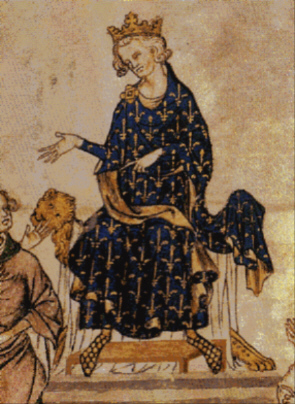
Guy de Boulogne crowning Pope Gregory XI
The Return of the Durazzo Menace
Louis of Taranto was determined to marry his brother Philip to the widowed Maria. He attempted to circumvent Cardinal Talleyrand’s influence by using Cardinal Guy de Boulogne[i]. Pressed by Talleyrand, Innocent refused to give the necessary dispensation for the marriage. The pope also demanded that Louis of Taranto release Joanna’s nieces properties to the Durazzo family, which Louis refused to do.
In an attempt to end the stalemate Philip of Taranto married Maria, hoping that the pope would change his mind. The pope refused to change his mind and excommunicated Joanna and Louis of Taranto, for failing to pay the annual tribute, and placed the country under interdict.
To make matters worse Sybil del Balzo had taken Robert of Durazzo prisoner in retaliation for the death of Robert del Balzo[ii]. Robert escaped and attacked one of the del Balzo castles in Provence and laid the area around Les Baux to waste.
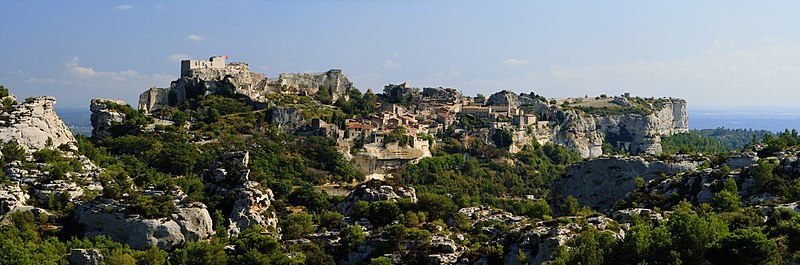
Les Baux
Louis of Durazzo with the aid of one of the Pipini brothers led an army of mercenaries into the kingdom of Naples and fomented civil war with;
‘Twenty five hundred well-mounted, well-armed barbarians, a large number of horsemen and looters on old horses and beasts of burden, one thousand scoundrels and crooks and courtesans and a motley crew of six thousand men in all.’[iii]
The rebels made camp in Apulia.
Bartering Wives
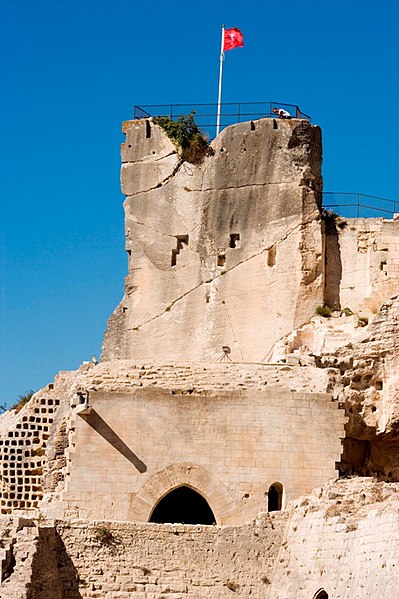
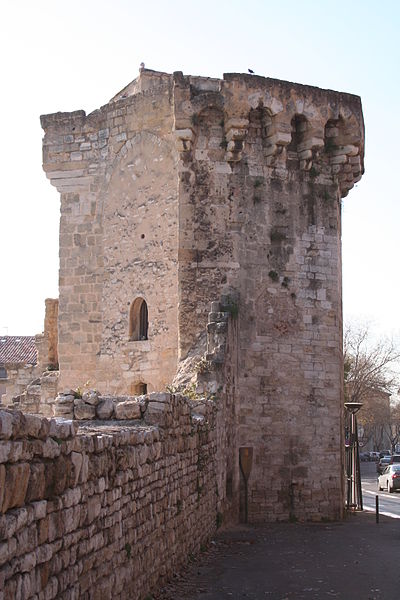
Chateau des Baux
For lack of ready money Joanna was reduced to offering Guy de Boulogne the hand of her niece Jeanne, Duchess of Durazzo, as wife for his nephew Godfrey. Guy accepted and his attempts to influence Innocent were aided by the antics of the Durazzo brothers.
On May 2nd 1355 Innocent began excommunication proceedings against Robert of Durazzo and on 20th lifted the interdict against Naples. Innocent sent a personal representative to participate in the siege of the Chateau des Baux; it took two months to overcome Robert’s forces. Joanna then had to pay the mercenaries to leave her kingdom and they took service with the Visconti family of Milan.
By the time Niccolo returned to Sicily in September 1356, with more grain to bribe the starving peasants. Louis II had died and his 14 year old brother Frederick[iv] was now king. Messina greeted Niccolo with open arms. Joanna arrived in Messina with Louis of Taranto on 24th December and the couple were installed as king and queen the following day, having finally achieved one of her family’s long-term goals.
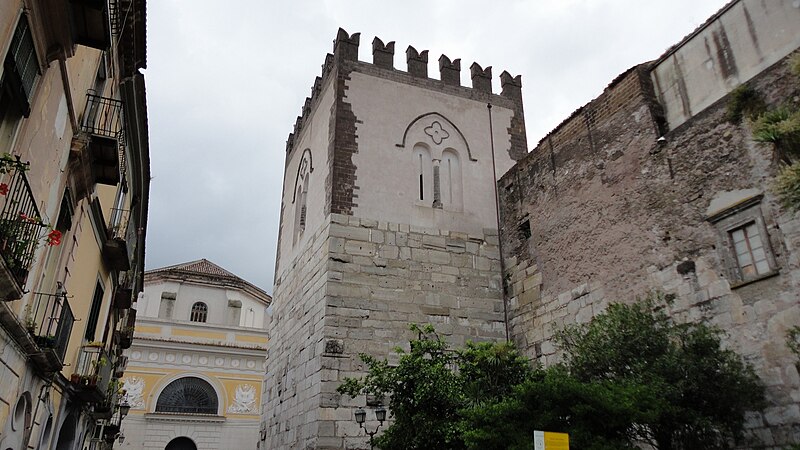
Castell Ursino, Catania
Joanna stayed in Sicily for eight months, to consolidate her rule. In agreement with the faction that had invited her intervention, all administrators were chosen from the faction’s ranks. Attempts to overcome the pro-Spanish faction were inconclusive despite a raid on Catania by the Neapolitan fleet. Joanna offered Frederick her niece Margherita as his wife.
Attack on Provence
The Durazzo family were incensed by Joanna’s determination to use her nieces as pawns in the power struggle erupting in southern Europe. Louis of Durazzo petitioned Innocent for redress.
But Innocent was powerless. The recent events at Poitiers left Jean II, king of France as a prisoner in England[v] and the Dauphin was only 18. Mercenaries ran unimpeded throughout France and one of the most notorious, the Archpriest[vi], was poised to invade Provence.
‘The Archpriest, took command of a large company of men-at-arms….they therefore went towards Provence, where they took a number of fortified towns and castles and plundered the whole country as far as Avignon. Pope Innocent VII and his cardinals….were in such fear.’[vii]
As the Archpriest’s men looted her lands in Provence Joanna returned to Naples. Panicking Innocent gave the necessary dispensation for Philip of Taranto’s marriage to Maria. In September 1358 Innocent treated with the Archpriest and bribed him with one thousand florins[viii] to withdraw permanently from Provence.
The following spring saw Talleyrand return from his mission to England and he reminded Innocent that Joanna had not returned Maria’s daughters to the care and control of the Durazzo family. Innocent renewed the interdict on the kingdom of Naples and on 21st April 1359 named the Spanish cardinal Gil Alvarez Carillo de Albornoz as legate.
The Legate
Cardinal Albornoz
Joanna and Louis of Taranto had already angered the new legate even before Albornoz arrived in Italy. Fighting in the Papal States and against the Visconti in Milan, Albornoz had made much use of the Free Companies; a move decried by Florence and Naples. To appease Innocent Joanna put together as much as she could find to pay her annual tribute to the pope.
In March 1360 Niccolo Acciaiouli took what monies were available to Avignon and by May had succeeded in having the interdict overturned and the appointment of a legate revoked. Innocent was impressed by Niccolo and awarded him the Golden Rose and appointed him papal ambassador to Milan. Despite an offer of 100,000 florins[ix] to come to terms with the pope, Visconti refused Niccolo’s attempts at peace.
In the spring of 1360 Louis of Durazzo launched a further attempt at rebellion from his base in Apulia. Louis of Taranto took to the field against his cousin, besieging and destroying the castles of many of the Durazzo supporters. Louis of Durazzo was forced to come to terms and hand over his three year old son Charles to be brought up at Joanna’s court; a hostage for his father’s good behaviour.
The Siege of Avignon and After
Sir John Hawkwood
On 28th December 1360 along with a number of other companies Sir John Hawkwood and his White Company[x] arrived in Pont Saint-Esprit to besiege Avignon. By March the companies were en route to Italy, having been paid off by Innocent to the tune of 60,000 francs[xi]. Innocent was paying Hawkwood to attack Innocent’s enemy, Bernabo Visconti in Milan.
‘On payment of sixty thousand francs by the pope and cardinals several captains of companies, such as Sir John Hawkwood, a fine English knight….and several others gave up Pont-Saint-Esprit and went off to Lombardy.’[xii]
In reply Visconti withdrew from fighting Cardinal Albornoz outside of Bologna. Albornoz’ Hungarian mercenaries, no longer needed to protect the church’s interests, were quickly contracted by Louis of Durazzo. By March 1361 Louis’ mercenary army was ready in Abruzzi to lead a revolt against Joanna and Louis of Taranto.
Monte Sant'Angelo sul Gargano
By May Niccolo Acciaiouli had managed to bribe the Hungarians into Joanna’s service. By December Niccolo had redirected their energies against Milan. Louis of Durazzo sought refuge at the sanctuary of Monte Sant’ Angelo sul Gargano. Fleeing from there Louis was captured and taken to Naples. On 6th February 1362 he prostrated himself before his cousins before being thrown into the Castel dell’Ovo.
Husband Number Three
Three months later one of his opponents was dead; Louis of Taranto died on 24th May, a victim of the resurgent plague. Worried that Philip of Taranto might make a bid for power Joanna kept Louis’ death secret until she had taken full control of the court. Joanna can hardly have mourned the death of one who so openly brutalised her.
Now the race was on to find a new husband; Philip and Robert of Taranto (both married men) were concerned that Joanna’s would choose Louis of Durazzo as her next husband;
‘They obtained letters from her with the assurance that she would not marry Louis….they imposed a guard who then poisoned him [Louis of Durazzo] with some concoction.’[xiii]
Louis died sometime in June or July 1362; Joanna now made a point of singling out Charles of Durazzo in an attempt to counter the loathed Taranto family influence at court.
Philip the Bold
Desperate for an heir Joanna began the search for a new husband; both France and Milan sent ambassadors. The French embassy was supported by the pope, but Joanna had no intention of marrying the 20 year old Philip[xiv]. She was fortunate that Innocent died in September 1362 and was succeeded by Urban V who was a compromise candidate.
The day after his coronation Urban issued Joanna with permission to remarry; on 14th December Joanna committed herself to marry James IV, King of Majorca[xv]. Joanna married James in May 1363.
Bibliography
Chronicles – Froissart, Penguin Classics 1968
The Holy Roman Empire – Friedrich Heer, Phoenix 1995
Joanna – Nancy Goldstone, Phoenix 2010
Absolute Monarchs – John Julius Norwich, Random House 2011
Hawkwood – Frances Stonor Saunders, Faber & Faber 2004
A Distant Mirror – Barbara Tuchman, MacMillan London Ltd 1989
The Flower of Chivalry – Richard Vernier, The Boydell Press 2003
www.wikipedia.en


[i] To become Talleyrand’s chief rival for influence over the pope. He had long been a supporter of Joanna’s
[ii] Although Robert had nothing to do with her nephew’s death
[iii] Joanna - Goldstone
[iv] Known as the Simple
[v] Cardinal Talleyrand was sent to England in an attempt to ransom Jean II
[vi] One Arnaud de Cervole, head of the Societa dell’Acquisito (Froissart calls him Sir Regnault de Cervoles). Although a layman de Cervole held a living in Velines in the Dordogne
[vii] Chronicles - Froissart
[viii] In 2013 the relative: historic standard of living value of that income or wealth is £608,000.00 economic status value of that income or wealth is £19,820,000.00 economic power value of that income or wealth is £238,500,000.00 www.measuringworth.com
[ix] In 2013 the relative: historic standard of living value of that income or wealth is £62,850,000.00 economic status value of that income or wealth is £1,945,000,000.00 economic power value of that income or wealth is £23,500,000,000.00 www.measuringworth.com
[x] The company numbered  3,500 horsemen and 2,000 foot soldiers
[xi] In 2013 the relative: historic standard of living value of that income or wealth is £37,710,000.00 economic status value of that income or wealth is £1,167,000,000.00 economic power value of that income or wealth is £14,100,000,000.00 www.measuringworth.com
[xii] Chronicles - Froissart
[xiii] Joanna - Goldstone
[xiv] Duke of Burgundy
[xv] James had only recently escaped from the clutches of Peter IV of Aragon who now ruled Majorca

Wednesday, 8 April 2015

Medieval Italy - The Queen of Naples VII


Angelo Acciaiouli (kneeling)
A Faithless Spouse
These victories were overshadowed by a defeat for the loyalists at Foggia, when the Hungarians were buoyed with hope by the return of King Louis. Sometime in February Catherine died and within a very short time Joanna was embroiled in a power struggle with Louis of Taranto, their marriage in ruins. He had Joanna’s chamberlain Enrico Carraciolo arrested on the grounds of adultery with Joanna.

Louis was assisted by Niccolo Acciaiouli and his cousin Angelo, the Bishop of Florence, keeper of the royal seal. Clement was not impressed by Louis of Taranto’s bid for power, writing to him;
‘Although of royal birth, you were by inheritance poorly off. By the union with the Queen, who openly honoured you….you have become possessed of abundance and an exalted position. You….do not treat her as behooves a wife and Queen….you have caused her to be reckoned rather a slave than spouse.’[i]
Joanna, who was pregnant again, defended herself. Under virtual house arrest she gave birth in March to a girl named Françoise. Louis of Taranto meanwhile reigned in her place, allied with a vengeful and penniless Maria who demanded payment of her dowry. Joanna, with an empty treasury and an army to raise to fend off the armies of Louis of Hungary.
Reversals
Clement wrote to all parties in Naples instructing all parties to work towards a reconciliation between husband and wife. He had received a letter from Joanna, detailing the humiliations to which Louis of Taranto subjected her.
Louis’ armies were besieging Aversa; he offered to marry Maria, his young wife Margaret of Bohemia had recently died. Maria welcomed the idea of marrying the man who had executed her husband.
‘After deliberation with the royal family who remained prisoner in Hungary, the king of Hungary made a secret accord with Madam Maria to make a marriage with her which dictated that the king would receive the dominion of Sicily [Naples] while Queen Joanna would remain countess of Provence.’[ii]
Clement sent Hugo del Balzo[iii], the bishop of Thérouanne and a squadron of loyalists to Naples and was allowed to speak to Joanna. The bishop then left for Aversa to speak to King Louis, leaving Hugo to spread rumours around Naples that Louis of Taranto was attempting to poison his wife. Hugo ensured that the Neapolitans were aware that the pope sided with Joanna in this war between husband and spouse.

15th century Rome
Louis of Taranto folded; the increasingly resistant population, in accord with the wishes of the pope, persuaded him to hand back power to Joanna. On 17th August Joanna named a new seneschal, replacing her husband.
The Bishop of Thérouanne had in the interim negotiated a truce with Louis of Hungary who had suffered a leg wound during the siege and he was finding the citizens of Aversa averse to his rule. His barons had finished their military service;
‘To keep them to help him conquer the kingdom, meant to pay them, and he had little money and could not get more from a country that had been ravaged by war….Thus he changed his mind easily, ready to agree to a compromise that would allow him to leave the kingdom without losing face.’[iv]
Hostilities were suspended for a six month period, each side holding onto its gains. The papacy for its part agreed to try Joanna again for her part in Andrew’s murder and Joanna was required to pay Louis 300,000 florins[v] for the return of her family. Clement agreed to loan Joanna the monies and she and Louis of Taranto left for Rome on September 17th, the same day that Louis departed Rome. Hugo del Balzo remained in Naples.
Further Treachery

Gaeta
Hugo del Balzo’s intent in remaining in Naples, while the former adversaries travelled to Rome, soon became startling clear. Presumably with the pope’s blessing, his son Robert raped Maria in the presence of his father; the unlucky Maria was then wed to Robert with Hugo in attendance.
‘When he [Hugo] arrived in the presence of the duchess, he said he wanted her to marry his son Robert, and had the marriage consummated by force.’[vi]
Clement was no doubt determined to stop the marriage Maria was trying to arrange with Louis of Hungary.
Joanna was furious at Hugo’s presumption. Louis of Taranto murdered Hugo on his galley, resting off Gaeta and Robert del Balzo and his new wife were brought ashore to meet Joanna. Robert was kept prisoner until the following spring when he was executed, despite a plea from the pope for clemency.
News Round-up
King Louis left Rome at the end of October 1450 and did not return. The following February Louis of Taranto and Niccolo Acciaiouli liberated Aversa. In December 1451, as Joanna sent a repayment guarantee for the 300,000 florins payable to Louis, Louis forgave the debt as he;
‘Did not go to war for greed, but to avenge the death of his brother.’[vii]
The following year saw accord grow between Joanna and her husband; he agreed to the limitations on his kingship while Joanna agreed to a joint coronation held on 27th May 1452.
A few days previously on 7th April an amnesty was declared towards those Neapolitans who had cooperated with the Hungarians. Joanna was reduced to borrowing the monies to pay for the coronation celebrations. The joy of the coronation was cancelled out when the couple returned home after the celebratory parade; their two year old daughter Françoise had died.
Finances were a problem in this kingdom so recently harried by war and the plague; nearly 50% of the citizens of Naples died in a three months period[viii]. The Hungarian army had deliberately destroyed homes and fields and outlaws roamed at will. Joanna named a new chief justice and gave him the powers to deal with the lawlessness in the countryside. With 400 horsemen the new judge;
‘Pursued criminals, brought barons and townships to compliance, insisted on collecting taxes and ensured that feudal services were carried out. Thanks to him, roads became free and safe.’[ix]
Within two years the kingdom was once again able to provide sufficient food to feed its population.
Change
Innocent VI
With the death of Clement in December 1352 Joanna lost a protector she knew well. The election of the new pope Innocent VI had been orchestrated by Cardinal Talleyrand. Talleyrand no longer supported Joanna; his main interest was in his Durazzo nephews[x]. In the spring of 1353 the hostages returned home to Naples; they were to cause endless problems.
Robert of Taranto was given a part of the family’s confiscated estates and Philip of Taranto received a smaller portion. Louis of Taranto intimated his intention to marry Philip to Maria, once again a widow. Maria’s daughters were now under Joanna’s guardianship and their assets were controlled by Louis of Taranto. The marriage proposal was vigorously opposed by Maria’s Durazzo brother-in-laws.
Robert of Durazzo went direct to Cardinal Talleyrand to plead his case; both brothers had been rebuffed in their attempts to recover their ancestral estates and their nieces’ property. Talleyrand, now Innocent’s chief adviser, suggested to the pope that he block the marriage between Robert of Taranto and Maria and gave control of Maria’s daughters assets to their uncle Louis of Durazzo. Robert meanwhile was affianced to a niece of Cardinal Giovanni Visconti of Milan.
Despite his promise to abide by Joanna’s dictum in state affairs, Louis of Taranto had no compunction in imposing his authority over his wife in family matters. Villani states that;
‘He honoured the Queen little; whether this was his fault (and his responsibility was great) or that of the Queen, he often beat her as one would a lowly woman, to the great shame of the Crown.’[xi]
Joanna complained to Innocent that she was humiliated and anguished in her relations with her husband. He cheated on her, fathering at least three children with other women. Joanna, bereft of children, mothered her nieces.
A Distraction in Sicily
Straights of Messina
In Sicily the plague wiped out the Regent ruling for the young King Louis II; one political faction offered the young king as a husband for a Spanish infanta, Constance. The other party turned to Naples and offered to return Sicily to Angevin rule.
The offer was too good to turn down, but the treasury was empty and the only source of capital for the venture was from the Grand Seneschal, Niccolo Acciaiouli who was richer than both the king and queen. Niccolo funded a small fleet led by eight galleys, to ferry 100 knights and 400 foot soldiers across the Straits of Messina.
The port of Palermo, where the little fleet landed, surrendered on 17th June 1354. The rest of the population followed suit when the rumours that three ships of grain accompanied the invaders. Only Messina and Catania, held by the pro-Spanish party, failed to surrender. Niccolo sent to Joanna and Louis asking for more men to subdue the two strongholds. They declined to send further troops and Niccolo and his force returned home.
Bibliography
Chronicles – Froissart, Penguin Classics 1968
Joanna – Nancy Goldstone, Phoenix 2010
Absolute Monarchs – John Julius Norwich, Random House 2011
Hawkwood – Frances Stonor Saunders, Faber & Faber 2004
A Distant Mirror – Barbara Tuchman, MacMillan London Ltd 1989
The Flower of Chivalry – Richard Vernier, The Boydell Press 2003
www.wikipedia.en


[i] Joanna - Goldstone
[ii] Ibid
[iii] Now supporting Joanna again
[iv] Joanna – Goldstone
[v] In 2013 the relative: historic standard of living value of that income or wealth is £246,800,000.00 economic status value of that income or wealth is £11,170,000,000.00 economic power value of that income or wealth is £88,160,000,000.00 www.measuringworth.com
[vi] Joanna - Goldstone
[vii] Ibid
[viii] The plague was to return in 1362 and 1373
[ix] Joanna - Goldstone
[x] Talleyrand had opposed the coronation of Louis of Taranto. Concerned that the Durazzo branch of the family were losing access to power to the Taranto branch, Talleyrand wished to reverse the imbalance
[xi] Joanna - Goldstone

Wednesday, 1 April 2015

Medieval Italy - he Queen of Naples VI


Philip VI

The Balance of Power
The English invasion of France and the victory at Crécy altered the balance of power in Europe. Centred in Avignon, Clement started funding Philip VI to the tune of 592,000 gold florins [i]in an attempt to stabilise the situation. Edward III in turn was encouraging Louis to invade Naples, a close ally of France.

Clement tried to forestall any such attempt by Louis and started to suggest that Charles Martel should be removed from his mother’s care and brought up in Avignon; he also gave permission for his legate Cardinal Bertrand de Deux to prosecute and execute any member of the Neapolitan royal family including Joanna if found complicit in Andrew’s murder.
On 4th October Joanna’s aunt Catherine died; if not involved in Andrew’s murder, she certainly influenced events after his death. When Robert of Duranto rode out of Castel Nuovo, to attend his mother’s funeral; Joanna had his retainers evicted and shut the doors of the castle, thus eliminating one very unwanted suitor.
In Robert’s place came four Clarissan nuns and Cardinal de Dreux. The cardinal’s arrival meant that Joanna could no longer protect Philippa and Sancia who were executed on 29th December after prolonged torture,
‘After that she [Sancia] was paraded here and there, stretched out on red hot coals and tortured with pliers until her internal organs burned and she breathed her last.’[ii]
But neither woman implicated Joanna in Andrew’s death. But their deaths altered nothing as far as the Hungarians were concerned. Louis sent a formal declaration of war to Avignon on 27th March 1346. His intransigence was not appeased by de Dreux’s finding of not guilty against the Neapolitan royal family and Joanna’s refusal to surrender her son to the tender mercies of the church.
Joanna set about rallying her family; Louis of Taranto was named vicar-general of the kingdom on 20th June, three days later Charles of Durazzo was named captain-general. Louis and Joanna were married on 22nd August 1347 without the necessary dispensation from the church. Robert of Taranto was appeased by a dispensation from Clement to marry Marie of Bourbon, widow of Guy of Lusignan[iii] and a wealthy woman in her own right. From now on Robert focussed his attentions on his wife’s properties in Achaea.

The Magyar Invasion
South-east Europe circa 1360
Louis invaded Naples at the end of 1347[iv]; his advance forces reached the northern borders of the kingdom in late June and were welcomed by rebellious barons. Charles of Durazzo made a stand at L’Aquila but was driven out by superior numbers. Charles along with Louis and his brother set about raising an army to defend the kingdom. Joanna was left in Naples, pregnant.
When the moment came Charles and Robert decided that the only way forward was to surrender and rode to Naples to prepare for the coming of the victor, leaving Louis of Taranto to fight alone. On 15th January 1348 the Hungarian troops[v] defeated those of Louis of Taranto at Capua.
When her two cousins rode into Naples Joanna’s thought was to flee; she knew that death awaited her at the hand of Louis of Hungary. She was unable to remove Charles Martel from the care of Andrew’s nurse. Feeling that her only option was to leave her much loved son behind in her beloved Naples, and hoping in return that the victorious Hungarians would look after Charles Martel, Joanna left taking as much cash as she could and set sail for Avignon.
Joanna’s flight became known to her husband who was persuaded to follow his wife into exile. Louis was most likely to execute Louis of Taranto who left Capua under the command of Hugo del Balzo. He took flight in a fishing boat and headed for Florence with Niccolo Acciaioli.
Retribution
Fortress at Capua
Louis marched his army down to Naples, as his troops marched past Capua the German mercenaries, hired to defend the city, deserted and the city was forced to surrender. The following day Louis took Aversa and sent to Naples demanding his nephew Charles Martel be handed over into Hungarian control. This was done immediately;
‘It was Sir Amelio del Balzo who was taking care of Lord Charles Martel – they assigned him to Count Ciccono of Hungary, who received him [Charles Martel] in the name of the King of Hungary, and they even assigned him [Count Ciccono] the Castel dell’Ovo.’[vi]
On the same day as his brother fled the kingdom, Robert of Taranto and his cousin Charles entered Aversa at the head of a procession of Neapolitan nobles to make formal obeisance to their new monarch. Louis chose the site of his brother’s assassination as the meeting place with his cousins. He greeted them in a friendly fashion and promised a great banquet in their honour on 22nd January.
At the promised feast the two men and their brothers were arrested; in the morning of 23rd January 1348 Charles of Durazzo was beheaded on the site of Andrew’s untimely death. Louis then led his army down to despoil the capital city. On the 2nd February Charles Martel was sent, with his four cousins of Taranto and Durazzo, to Hungary. Charles Martel died on 10th May 1348, soon after arriving in Hungary following an arduous journey.

The Trial
Aix-en Provence
As Countess of Provence Joanna based herself in Aix-en-Provence, the province’s capital while the Black Death was raging through the area[vii]. Joanna wrote to Clement begging him to clear her name of the taint of murdering her husband. She also asked for support in regaining her kingdom. Clement meanwhile was receiving letters from Louis demanding that Joanna be deposed and executed.
Soon afterwards Maria and her children arrived in Avignon too, and took up residence with Cardinal Talleyrand, her dead husband’s uncle. Talleyrand was able to mobilise the French faction of the Sacred College[viii] on Joanna’s behalf and Clement finally agreed to meet with Joanna, who arrived in Avignon on 15th March 1348. Joanna agreed to be tried for her alleged part in Andrew’s murder.
Joanna defended herself in the trial conducted by two of Louis’ ambassadors; Clement, who made no secret of his taste for beautiful women, was more than happy to pronounce her innocent. Honoré Bouche[ix] wrote;
‘She spoke at length with such grace and eloquence, brought forth so many good reasons for her defence, that……His Holiness was impelled to declare her innocent of the crime and of the suspicion of the crime.’[x]
Clement issued a bull legitimising Joanna’s marriage to Louis of Taranto and on May 7th wrote to Cardinal de Deux informing him that he was to deny Louis’ request to be crowned King of Naples. Louis had transgressed by illegally removing Charles Martel from the kingdom and executing the innocent Charles of Durazzo.

The Return
Danse Macabre
In an attempt to uncover the accomplices in his brother’s murder King Louis instigated a reign of terror in Naples. Although supported by the del Balzo family, Louis was woefully short on local intelligence and, among other land grabs, seized the property of the Pipini brothers which resulted them transferring their allegiance to the loyalists.
The plague arrived in Naples in April and on May 24th Louis departed from Naples in stealth, leaving misery and chaos in his wake, as well as an empty treasury. But the war between Hungary and Naples was to continue until 1352.
Now Joanna needed cash to regain her kingdom. Refilling Joanna’s treasury was not something Clement was prepared to do without some return for his money. Joanna had to sell a portion of her birthright to get the money to return home. On 9th June Joanna sold the pope the city and county of Avignon for 80,000 gold florins[xi] and on 23rd Clement issued a bull allowing Joanna one tenth of church income in Provence for her return to Naples.
Castello di Melfi
On 18th June the Neapolitan admiral won a battle against the Hungarians and Lorenzo Acciaioli[xii] held the city of Melfi which the Hungarians were besieging. Joanna’s standard was raised in Naples and a delegation was sent urging Joanna’s return. Joanna was in the late stages of pregnancy and could not undergo the lengthy sea voyage. She gave birth to Catherine on 30th June and on 3rd July Joanna and Louis solicited Clement’s protection for Catherine.
Joanna and Louis of Taranto returned to Naples on 17th August;
‘Since the castles of Naples….[and] the harbour and the armory were in the hands of the king of Hungary’s men, they could not land at the harbour or in its vicinity; but rather outside Naples….they came ashore.’[xiii]
The couple were welcomed by the nobility, but Joanna had a fight on her hands; Louis had left most of his army and they held the castles of the kingdom. Capua was recovered within a month and by the beginning of December Louis of Taranto had regained Calabria. Joanna oversaw the surrender of the Castel Nuovo and the Castel Dell’Ovo[xiv].
Bibliography
Chronicles – Froissart, Penguin Classics 1968
The Holy Roman Empire – Friedrich Heer, Phoenix 1995
Joanna – Nancy Goldstone, Phoenix 2010
Absolute Monarchs – John Julius Norwich, Random House 2011
A Distant Mirror – Barbara Tuchman, MacMillan London Ltd 1989
www.wikipedia.en


[i] In 2013 the relative: historic standard of living value of that income or wealth is £479,900,000.00 economic status value of that income or wealth is £20,550,000,000.00 economic power value of that income or wealth is £134,100,000,000.00 www.measuringworth.com
[ii] Joanna - Goldstone
[iv] His invasion was delayed as his initial point of departure at Zara was in rebellion against its overlord Venice in 1346.
[v] Louis’ army comprised 2000 Hungarian knights, 2000 mercenary heavy cavalry, 2000 Cuman horse archers and 6000 mercenary heavy infantry
[vi] Joanna - Goldstone
[vii] Between January and September 1348 62,000 people had died in Avignon and the surrounding countryside. The plague did not wane until the following spring when the population of Europe went looking for a scapegoat and found it in the Jews. In 1449 Clement issued two bulls condemning the massacres of the Jews, but over 350 massacres took place and over 200 Jewish communities were annihilated
[viii] The French were the largest faction in the college
[ix] 17th century Provencal historian
[x] Joanna - Goldstone
[xi] In 2013 the relative: historic standard of living value of that income or wealth is £54,570,000.00 economic status value of that income or wealth is £2,358,000,000.00 economic power value of that income or wealth is £15,180,000,000.00 www.measuringworth.com
[xii] Niccolo’s son
[xiii] Joanna - Goldstone
[xiv] The Hungarian defenders were several months in arrears of pay