Monday, 4 December 2017

Caterina Sforza V


Rivaldino
After Girolamo

When the Orsi brothers spoke to the town councillors it was decided to submit allegiance to the pope. The council also refused to take action against Caterina, reminding the conspirators that Caterina’s Milanese relations would not be pleased. A solution must not;

‘Further wound or irritate the Countess. That would be not only barbarous and inhuman, but would draw down fatal consequences upon the city, she being of subtle mind and of that high courage that was known to all, indomitable of spirit and inexorable in vengeance.’[i]

After several days imprisonment Caterina was taken to the fortress where the Castellan Tomasso Feo allowed her entrance as previously agreed between the two, leaving the remainder of her family in rebel hands.

Cesena
The rebels threatened to cut Ottaviano into pieces unless Caterina surrender. She told them, with an obscene gesture, that she had the wherewithal to make more children. The pope sent Bishop Giacomo Savelli[ii] with two hundred soldiers to liaise with the rebels. Savelli was able to safeguard Caterina’s relatives against rebel demands to kill them in front of the fortress in an attempt to get Caterina to hand it over. Bishop Savelli had Caterina’s mother and sisters transferred to the safety of Cesena and increased the guard on her children.

Savelli was waiting for papal reinforcements that did not arrive. Innocent was unable to decide what action to take; while not wanting to upset the powerful Sforza family he toyed with the idea of taking Forli and handing it over to his son Franchescetto Cybo. After a period of stalemate Innocent announced that he had appointed Cardinal Raffaele Riario as governor of Forli.

On 29th April 1488 12,000 men appeared outside Forli’s wall; a small contingent of the Milanese army. A ducal emissary demanded the return of Forli to the Riarios. The citizens had little choice than to do as the Milanese demanded, driving off the Orsi[iii], and Caterina was reunited with her children.

Consolidation

Caterina Sforza
Caterina decided to be magnanimous in victory and instead of allowing her uncle’s troops to sack the town sent them home, much to their dismay[iv]. Girolamo’s body was obtained and sent to Imola for burial. On 18th July 1488 Innocent issued papal confirmation of Ottaviano’s right to be Lord of Forli and Imola, until the end of his family line. Caterina was to act as his regent. It is very possible that Cardinal Raffaele Riario was involved in persuading Innocent to change his mind.

Caterina was still young and her beauty was such that, according to one chronicler;

‘Words fail to describe her glorious beauty and graceful manner.’[v]

The eldest Ordelaffi, hoping to regain Forli for his family, had already proposed that he marry Caterina. When word got out Caterina was inundated with disapproving letters from the pope, Caterina’s uncle[vi], Lorenzo de’ Medici and Cardinal Riario. The pope’s letter was self-serving; he was hoping he could override his grant of Forli to Ottaviano and enable him to present the lordship to his son.

Following a summer in the country with Ordelaffi, Caterina returned to Forli to assure her relatives and well-wishers that she had no intention of marriage, or of handing power to anyone else. She turned to good works to add lustre to her reputation, helping to build a church dedicated to the Virgin Mary following a miracle at nearby Piratello. She also started on making alliances with other noble families through her children, choosing four year old Astore Manfredi[vii], Lord of Faenza, as husband for her daughter Bianca.

A Stepfather for the Lord of Forli

Fortress at Forlimpopoli
Caterina was concerned about the safety of the fortresses she held for her son. Trouble with the Castellan of Imola over money owed to him by Girolamo resulted in her being locked out of the fortress until Cardinal Riario stepped in to negotiate between Caterina and the Castellan. Caterina placed her stepfather Gian Pietro Landriani as the fortress’ new Castellan while her stepbrother Piero Landriani was made Castellan of Forlimpopoli[viii].

Caterina also doubted Tomasso Feo, despite his support for her during the 1488 crisis. She engineered his arrest. Her reasoning? She wished to install her lover as Castellan, a lover who seemed more than happy to take over his brother’s job, Giacomo Feo, a portent of things to come.

Giacomo was handsome and twenty years old; he’d worked as a hand in the Riario stables and he blatantly adored his mistress. Giacomo and Caterina married in secret; Caterina was trying to ensure that her position as regent for Ottaviano remained secure, unlike that of her stepmother Bona. So intense was the couple’s relationship that Caterina failed to attend the wedding of her uncle to Beatrice d’Esté in January 1491.

Although the marriage was a secret rumours of it spread through Forli, sparking jealousy against the former groom. A plan was hatched to murder Caterina and Giacomo but she was informed of the plot and managed to turn the tables on the would-be assassins. When questioned it appeared that the plotters were concerned that Giacomo would undermine Ottaviano’s right to rule Forli when he came of age. The four ringleaders were imprisoned deep in the dungeons of the fortress at Ravaldino, while their sons were taken hostage.

On 19th February 1492 the twelve year old Cesare Riario was given his first tonsure; he was destined for the church. In the summer of 1492 Caterina remained secluded from her court with an alleged bout of fever. It is believed that she was delivered of Giacomo’s son Bernardino[ix], during this period. She remained blind to the dangers posed by Giacomo who was accruing power for himself, despite being madly in love with Caterina. the Florentine ambassador noted that the couple;

‘Seemed alone in the world.’[x]

Caterina herself seems to have taken her eye off the ball, ignoring the outside world, so entranced by her relationship with Giacomo. Bernardino joined the Riario children in the nursery as Giacomo’s son by an unknown mother.

A New Pope
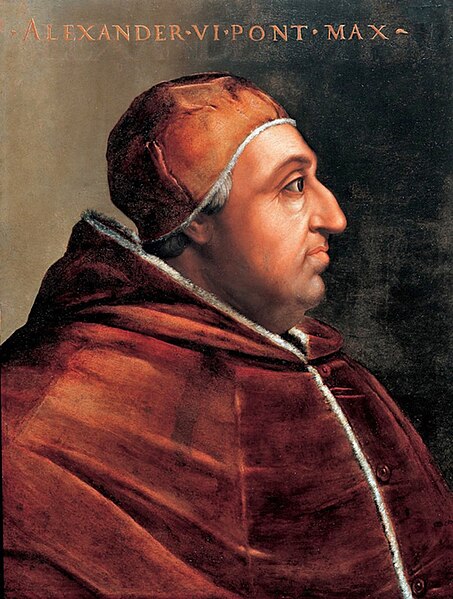
Alexander II
An era ended in April 1492 when Lorenzo de’ Medici died, leaving his son Piero[xi] to rule Florence. Three months later, on 25th July, Innocent died and the struggle to replace him centred around two men; Rodrigo Borgia and Guiliano della Rovere. Eventually the bribes paid out by Rodrigo won out and he ascended the papal throne as Alexander VI[xii].

One of those opposed to a Borgia pope had been Cardinal Ascanio Sforza who objected to a pope likely to support the Neapolitan king. However when it appeared likely that prolonging the conclave’s deadlock would result in a della Rovere papacy, Ascanio threw his support behind Rodrigo Borgia. The Florentine historian Francesco Guicciardini[xiii] wrote;

‘Alexander VI was extremely shrewd and wise, a good judge of character, immensely persuasive, and a skilled master at the political game. But these good traits were utterly surpassed by his vices: obscene behaviour, lack of sincerity, audacity, mendacity, disloyalty, impiety…..’[xiv]
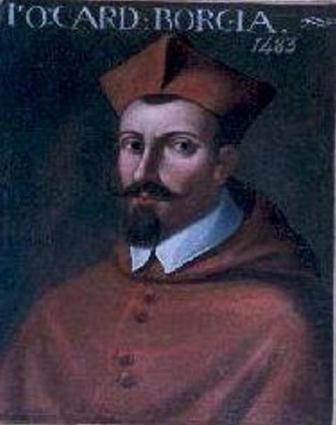

Cardinal Juan de Borgia
Under Alexander nepotism in the papacy was to become an outright scandal as the pope advanced the interests of his children, making his son Cesare a cardinal[xv]. Giovanni Borgia was made Duke of Gandia and Captain General of the church. His daughter Lucrezia was married to Giovanni Sforza, Lord of Pesaro and Gioffre Borgia, the pope’s youngest child, was married to Sancia of Aragon, the illegitimate daughter of King Alfonso II of Naples. Alexander also bestowed a cardinal’s hat on his nephew Juan de Borgia.

The ascension of Alexander VI was not good news for Caterina and her brood of Riario children, despite Alexander having stood as Ottaviano’s godfather. Guiliano della Rovere had been the family’s man in the Vatican; now his deadly rival was pope the pugnacious della Rovere lost a lot of his power[xvi]. Alexander made Ascanio Sforza his vice-chancellor, and gave him Alexander’s former palazzo.

 Bibliography

At the Court of the Borgia – Johann Burchard, the Folio Society 1990

Italian Dynasties – Edward Burman, Equation 1989

The Deadly Sisterhood – Leonie Frieda, Harper Collins 2013

The Rise and Fall of the Medici – Christopher Hibbert, Folio Society 2001

The Borgias – Mary Hollingsworth, Quercus Editions Ltd 2014

Tigress of Forli – Elizabeth Lev, Head of Zeus Ltd, 2012

The Borgias – GJ Meyer, Bantam Books 2013

Absolute Monarchs – John Julius Norwich, Random House 2011

www.wikipedia.en


[i] The Deadly Sisterhood - Frieda
[iii] Who eventually found refuge in the Papal States, having been refused harbour by the Venetians. Andrea Orsi was executed in his family’s place
[iv] Under the rules of war pertaining at the time they should have been allowed to sack the town
[v] The Deadly Sisterhood - Frieda
[vi] Who hoped to rule Forli and Imola by proxy
[vii] Murdered by Cesare Borgia in 1502
[viii] A town close to Forli, as its name indicates
[ix] Died 1509
[x] Tigress of Forli - Lev
[xi] Known as the unfortunate; Piero’s arrogance and lack of interest in state affairs was to bring about the downfall of the Medici
[xiii] A friend and correspondent of Machiavelli
[xiv] The Borgias - Hollingsworth
[xv] And appointed him to Alexander’s former Archbishopric of Valencia
[xvi] In contrast to the Sforza, della Rovere had supported a pro-Naples candidate

Monday, 27 November 2017

Caterina Sforza IV


Palazzo Colonna
War with the Colonna

Girolamo was concerned by his uncle’s ill-health. Instead of building up a strong powerbase by creating alliances, Girolamo was too busy with his feud with the Colonna, one of Rome’s foremost families, intensified when he accused them of treason during the battle of Camp Morto. He was no doubt encouraged in this by his friend Virginio Orsini whose family were deadly foes of the Colonna.

Virgilio and Girolamo occupied Colonna lands around Rome and on May 30th 1484 Girolamo and two hundred men attacked the Colonna palazzo in Rome, the two hour fighting leaving several dead. Lorenzo Colonna, wounded during the fight, surrendered to Virgilio. Girolamo tried to attack the disarmed prisoner as he was taken to the Castel Sant’ Angelo. Colonna property throughout Rome was ransacked and the Colonna treasures seized for the papacy and the greater good of Girolamo Riario.

Marino
Girolamo had his eye on the Colonna fortresses of Paliano and Marino. Members of the Colonna family begged Girolamo to release Lorenzo Colonna, in return they would hand over Marino and Ardea. This was insufficient for Girolamo whose greed overcame him raging that;

‘I will take all of their fortresses by storm.’[i]

He had the messenger put to death. During a family council, Cardinal Guiliano della Rovere, pleaded on behalf of his neighbours. His uncle Pope Sixtus was by now too ill to keep Girolamo in check. Girolamo turned on his cousin, threatening to burn his house down in retaliation for his support for the Colonna.

On June 29th 1484, on the feast day of Saint Peter and Saint Paul, Girolamo had Lorenzo Colonna dragged out into the courtyard of the Castel Sant’Angelo. The prisoner repudiated his confession made under torture before he was executed. Girolamo then sent men to pull up the family vineyard behind their palazzo. At the same time Cardinal Guiliano’s balcony was smashed, in retaliation for his daring to support Girolamo’s enemies. Throughout the excitement Caterina had remained by Sixtus’ bedside, where the pope lay in extremis.

Death of a Pontiff

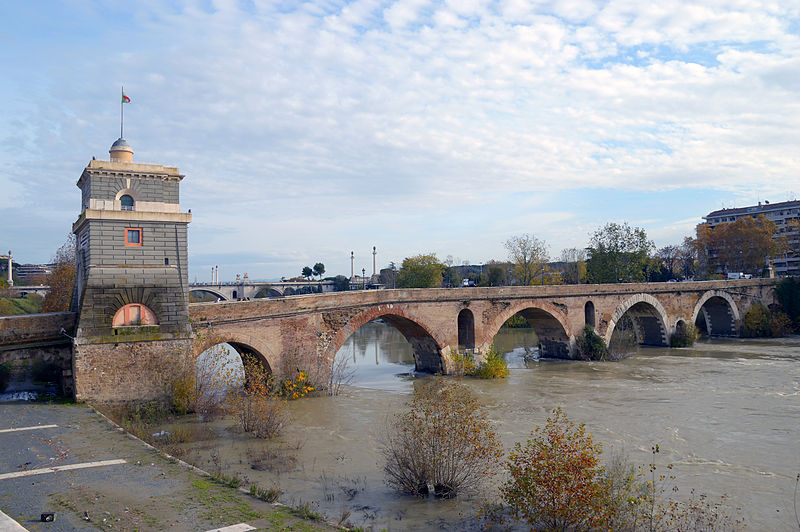
Ponte Molle blocked by papal army
Pope Sixtus IV died on 12th August 1484[ii] and with him died Girolamo’s powerbase. Sixtus’ death set off two weeks of rioting in Rome inspired by his enemies the Colonna. News of Sixtus’ death arrived in Paliano, where he and his sidekick Virginio were laying siege to the town with the papal armies while soldiers were stationed on the outskirts of Rome[iii].

Girolamo had been joined at the siege by Caterina, seven months pregnant, who brought their three children with her in an attempt to avoid the fevers and plagues that were a feature of summer in Rome. Always the coward, Girolamo preferred to let others take the risks but he had to move fast to consolidate his position now that his main benefactor was dead.

Castel Sant'Angelo
Girolamo’s understanding was never more than average and he now needed Caterina’s capabilities to deal with the crisis. He, Caterina, Virginio and Paulo Orsini rode for Rome. They arrived on 24th August; as ordered Girolamo stopped outside the city while Caterina and Paulo rode for the Castel Sant’Angelo, while Virginio joined the anti-Colonna faction[iv].

Once at the fortress Caterina informed the Castellan that she had come to hold the fortress for her husband the Papal Captain-General; she was allowed to enter. Caterina ordered that access from the Vatican be barred; the diarist Bartolomeo Cerratini recorded that;

‘She [Caterina] wore….a man’s belt whence hung a bag of gold ducats and a curved sword…among soldiers, both horse and foot, she was much feared, for that armed lady was fierce and cruel.’[v]

The cardinals rushed to ask Raffaele Riario to persuade his aunt by marriage to depart without any more fuss, even as Caterina was ejecting from the fortress those she felt were inimical to her husband’s interests. Riario’s messenger was sent back to his master with a flea in his ear. Outside in the city the Colonna faction were creating mayhem and it was not until one of the cardinals intervened that the Colonna and the Orsini agreed to lay down arms.

Coming to Terms

Cardinal Ascanio Sforza
Caterina was aware that she and Girolamo were friendless and short of funds and she applied to her uncle Ludovico for support which was duly granted. Lorenzo Lanti, a Sienese orator noted;

‘I know from a good source that the State of Milan is protecting the States of the Count [Girolamo] and has furnished him with soldiers for his safety.’[vi]

Girolamo for his part was laying out his demands to the cardinals whereby his wife would return control of the Castel Sant’Angelo to the church.

Girolamo agreed the sum of 8,000 ducats[vii], needed to pay his debts, and the continuation of all stipends paid under Sixtus, that he remain Captain-General of the papal armies and his reconfirmation as Lord of Forli and Imola. The cardinals agreed in return for Girolamo’s immediate departure from Rome and his wife’s surrender of the Castel Sant’Angelo.


Innocent VIII
Caterina failed to leave the fortress on 24th but smuggled in 150 men loyal to her husband. The cardinals fumed and threatened to withdraw from their agreement with Girolamo. They sent in eight of their number, including Caterina’s uncle Ascanio, who negotiated Caterina’s departure on 26th; her twelve days ruling the papal stronghold were over.

Sixtus’ successor was Innocent VIII, a nonentity chosen to avoid another della Rovere papacy or a second Borgia papacy[viii]. Like Sixtus before him, Innocent turned nepotism into an art form; he married his son Franceschetto off to Maddalena, Lorenzo de’ Medici’s daughter, in return for a cardinalate for Lorenzo’s thirteen year old son Giovanni[ix].

Innocent was faced with a mountain of debts left by Sixtus’ spendthrift behaviour, he was similarly incapable of restraining his own spending. Girolamo and Caterina hoped that the presence of Cardinal Julius della Rovere, as the power behind the throne, would ensure that the Riarios remained in favour.

Murder and Mayhem

Giovanni Livio Riario[x] was born in Forli on 30th October 1484. Just over a year later Caterina gave birth on 4th December 1485 to Galeazzo Maria[xi] who was born at Forli. Her last child with Girolamo was Francesco[xii] born at Imola on 17th August 1487. Less than a year later and four years after the death of his uncle, Girolamo was murdered in April 1488


Rocca di Rivaldino
Following his uncle’s death Girolamo and Caterina had returned to Forli. During his rule in the Romagna, Girolamo had managed to make himself the most hated noble in the Apennines. When he first arrived in Forli Girolamo had cancelled all taxes, an easy gesture given the amount of money flowing into his purse from the Vatican. Following his uncle’s death, Girolamo had to retrench and reinstitute the taxes, which made him wildly unpopular with his people.

On 14th April 1488 Girolamo remained in the main hall after dinner, leaving his wife and her mother and two half-sisters, Stella and Bianca, to retire to Caterina’s apartments. One of the chief citizens of Forli, Francesco Orsi, and his brother Ludovico, called on Girolamo. Although Francesco was nominally a friend of Girolamo’s the two had fallen out over the vexed question of taxes.

Orsi bowed to Girolamo and then plunged a dagger into his lord’s chest. Girolamo was not killed outright by the blow and was finished off by a couple of soldiers of Girolamo’s bodyguard, who had not been paid for months.

‘The two soldiers, with grim professionalism, stabbed him in ‘his vital parts’, then battered and stabbed his lifeless face.’[xiii]

Caterina was immediately informed that she and the children were in danger. She and her women called out of the window, crying in vain for help. Caterina was arrested and taken to the Palazzo Orsi while the fortress was ransacked.

Bibliography

Italian Dynasties – Edward Burman, Equation 1989

The Deadly Sisterhood – Leonie Frieda, Harper Collins 2013

The Rise and Fall of the Medici – Christopher Hibbert, Folio Society 2001

Tigress of Forli – Elizabeth Lev, Head of Zeus Ltd, 2012

The Families Who Made Rome – Anthony Majanlahti, Pimlico 2006

Absolute Monarchs – John Julius Norwich, Random House 2011

Niccolo’s Smile – Maurizio Viroli, IB Tauris & Co Ltd 2001

www.wikipedia.en


[i] Tigress of Forli - Lev
[ii] The Riario palazzo was sacked on 13th August; fortunately Caterina had removed most of the valuables and hidden them away from Rome before she joined Girolamo at Paliano
[iii] Ostensibly to prevent trouble in Rome by blocking one of the main exits, the Ponte Molle, the cardinals may have been hoping to fend off a joint della Rovere/Riario attempt to install a pope of their own liking using Girolamo as a tour de force
[iv] The Orsini and the Colonna were deadly enemies
[v] The Deadly Sisterhood - Frieda
[vi] Ibid
[vii] In 2016 the relative: historic standard of living value of that income or wealth is £5,144,000.00, labour earnings of that income or wealth is £50,280,000.00, economic status value of that income or wealth is £138,400,000.00, economic power value of that income or wealth is £3,448,000,000.00 www.measuringworth.com   
[ix] Later Pope Leo X
[x] Died in 1496 age eight
[xi] Married in 1504 to Maria Giovanna della Rovere (b. Senigallia, 1486 – d. Bologna 1538), Dowager Lady of Camerino, and eldest sister of Francesco Maria I della Rovere, Duke of Urbino
[xii] Known as Sforzino, who was made Bishop of Lucca, directly subject to the Holy See
[xiii] The Deadly Sisterhood - Frieda