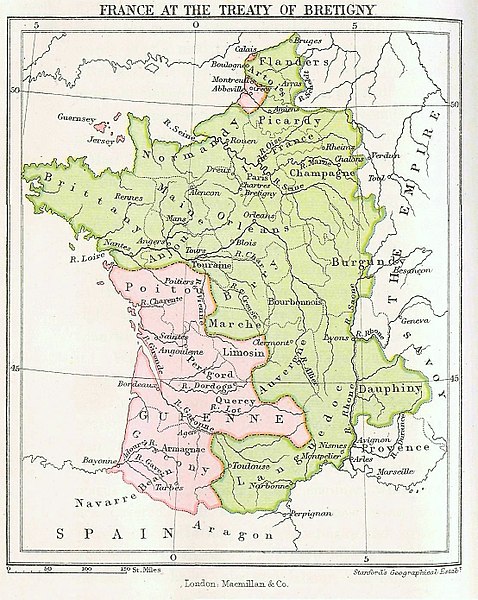
|
| Louis d'Anjou |
A New King
Very much in
love with his wife Louis, Duke of Anjou, John’s second son and a hostage for John’s behaviour,
absconded and returned home to be with his wife. With the escape of Louis, John
decided that the only thing a man of honour could do was to return to captivity
in England in his son’s place, despite his advisers begging him not to do so.
‘No-one could dissuade him
from his purpose, although he was strongly advised against it, several of the
French prelates and barons telling him that it would be a most hazardous step
to place himself in the King of England’s power.’[i]
Within three
months John fell ill with some undiagnosed illness[ii] and died. He was just
forty-four. A million florins[iii] were still owed on his
ransom leaving the hostages languishing in England. Jean’s third son, the Duke
of Berry excused himself and made so many excuses not to return to captivity
that eventually the English gave up trying to persuade him to return.
The death of
King John in April 1364, while still in captivity, brought the Dauphin Charles
to throne as the fifth of that name. He confirmed his father’s gift of Burgundy
to Philip in June and Philip’s lieutenancy was extended to cover Lyons, Mâcon, Autun, Chalons and Langres.
The Soldier
 |
| La Charité sur Loire |
In the
summer of 1364 Charles sent Philip to deal with the free companies still at
large in the French countryside.
‘The king of France sent his
brother…. against these pillagers….He went and laid siege to the castle of Marcheville….
He ordered many machines to be brought from Chartres, by
which he flung into it stones and other things day and night, that much annoyed
the garrison.’[iv]
Philip was
not an exceptional soldier, although there was no denying his personal bravery
on the battlefield. Not long after the attack on Marcheville, in August Charles
sent Philip to capture a castle near Rouen, held by followers of Charles of
Navarre. From there he was diverted in September to La Charité-sur-Loire to fight with the Constable Robert de Fiennes against more Navarrois and a number of English
adventurers.
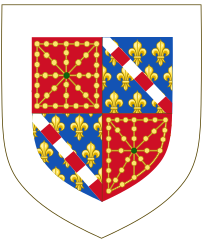 |
| Arms of Louis of Dorazzo |
Charles of
Navarre’s brother Louis attempted to raise the siege with
the aid of the English but was ordered by Charles to withdraw to Cherbourg. Charles V then authorised Philip to
treat with the garrison of La Charité to persuade them to surrender. Having
undertaken this commission Philip returned to Paris. He was also involved in
the siege and capture of Nogent-sur-Seine in January 1365.
The next
four years were relatively quiet and Philip spent much of his time harrying the
free companies harassing his domains. By 1369 Philip was involved in an
elaborate plan of his brother’s to invade England as hostilities between the
two nations had resumed. Charles had summonsed the Black Prince to appear
before him to answer complaints made against him as lord of Aquitaine. The
Black Prince refused, killing the councillors sent to make the summons.
A Royal Wedding
 |
| Marguerite and Philip |
In 1365 the Holy Roman Emperor Charles IV proposed a marriage between Philip
and Elizabeth, one of the nieces of Louis I, the King of Hungary. Another proposal that Philip marry Violante[v], the daughter of Galeazzo II Visconti, was not approved by the royal
family when it was made in 1367 by a French adventurer Jehan de Beaumont who
was able to con Visconti out of 20,000 florins[vi] while posing as an
ambassador from Charles V.
On 19th
June 1369 Philip was married to Marguerite de Dampierre, daughter of the Count of Flanders[vii]. Margaret had previously been
affianced to Philip’s predecessor as Duke of Burgundy, Philip de Rouvres.
Edward III was keen to get hands on this heiress for his son Edmund of Langley and was prepared to pledge Calais
and 170,000 livres[viii]
to her father.
Marguerite
and Edmund were within the fourth degree of consanguinity[ix] and this needed a papal dispensation to marry. The pope, Urban V, was French and Charles pressured him into refusing Edward’s request. To
obtain the Count’s permission to the match Charles had to cede to him the towns
and dependencies of Lille, Douai and Orchies and pay him 200,000 livres[x].
After a
respectable interval Urban granted Philip and Marguerite a dispensation to
marry and join the lands of Flanders and Burgundy to create a state within a state. Philip, now
27, sent throughout Europe for jewels for his new wife; Marguerite had a
passion for jewellery and Philip showered her with diamonds, emeralds, rubies
and a pearl necklace purchased for 11,000 livres[xi].
The marriage
took place in Ghent and three coffers of precious gifts
were forwarded there for Philip to give as gifts to the wedding guests and the
local burghers; they were also used as prizes for the tournaments. Philip was
determined to impress the Flemings, his future subjects.
‘They proceeded to the
marriage, which was celebrated in the city of Ghent. There were great feasts at
the solemnity of the wedding, and afterwards, which were attended by crowds of
lords, barons and knights.’[xii]
Philip
attended mass assiduously and made conspicuous offerings to the church. After
his marriage to Marguerite Philip presented the statue of the Virgin Mary in Tournai Cathedral with a cloth of gold cloak and mantle lined with miniver and embroidered with
the newly wedded couples joint coats of arms.
Return to the Fight
 |
| Tournehem |
In July
Charles handed command of the invasion of England to Philip; he was in command
of one thousand lances. Philip sent for a confessor to accompany him, but the
attack was forestalled by an English attack launched from Calais by John of
Gaunt. Charles was forced to send Philip and his army against the English.
The French
marched towards Calais and in August camped on a small eminence at Tournehem[xiii] within a league of Gaunt’s
encampment. He challenged John of Gaunt to a fixed battle, the date was fixed
but, inexplicably, although he had the larger army Philip chose to retreat,
allowing the English to maraud through Normandy. It has been claimed that
Philip did not have the wherewithal to pay his troops, but it is possible that
his failings as a military leader betrayed him.
.jpg) |
| Charles V (L) makes Bertrand du Guesclin (C) Constable |
Between
1370, when Charles made Bertrand du Guesclin the Constable of France[xiv], and 1372 Philip
participated in the re-conquest of Poitou from the English. The main drivers of the campaigns were du Guesclin and
Louis of Anjou. Philip and his brother Berry’s roles mainly involved producing
the troops, although they both led their men in action.
In 1372
Philip fought with du Guesclin in Aquitaine besieging and capturing a number of
English castles. He also harassed John of Gaunt’s army in 1373 as it made its grande chévauchée across
France in an attempt to relieve Aquitaine. It was a bold move that changed
nothing.
‘They [Gaunt and his army] marched
through various narrow passes and defiles, but kept in close and good order.
The council of the king of France therefore said to him: “Let them go; by their
smoke alone they cannot deprive you of your kingdom: they will be tired soon,
and their force will dissolve away…. thus it will befal these English.”’[xv]
Philip was
able to divert the English from Paris and fertile regions of the south. Charles
did not call upon his brother for military service again until 1377 by which
time most of France was back in French hands, bar the lands around Calais[xvi]. Philip was involved in
wresting a number of castles near Calais from the English. The plan had been to
retake Calais but the weather and the failure of the French fleet to cooperate
with the land forces, put paid to the idea.
Bibliography
Edward III –
Bryan Bevan, the Rubicon Press 1992
Chronicles –
Froissart, Penguin Books 1968
Europe:
Hierarchy and Revolt 1320-1450 – George Holmes, Fontana 1984
The Fourteenth
Century – May McKisack, Oxford University Press 1997
The Perfect
King – Ian Mortimer, Vintage Books 2008
A Distant
Mirror – Barbara Tuchman, Papermac 1989
Philip the
Bold – Richard Vaughan, Boydell Press 2011
The Flower
of Chivalry – Richard Vernier, Boydell Press 2003
www.wikipedia.en
[i]
Chronicles - Froissart
[ii]
Possibly over-indulgence at the table as John was over fond of good food and
wine and indulged himself.
[iii]
In 2016 the relative: historic standard of
living value of that income
or wealth is £579,600,000.00; labour earnings of
that income or wealth is £7,488,000,000.00; economic status value of that income or wealth is
£15,330,000,000.00; economic power value
of that income or wealth is £312,800,000,000.00 www.measuringworth.com
[vi]
In 2016 the relative: historic standard of
living value of that income or
wealth is £13,070.00, labour earnings of
that income or wealth is £148,100.00, economic status value of that income or wealth is £348,000.00, economic power value of that income or wealth is £7,053,000.00 www.measuringworth.com
[vii]
In 1356 Philip’s future father-in-law had marched his army into Brabant and forced Duke
Wenzel of Luxembourg to cede his rights in the two major towns of his
duchy, Malines and Antwerp to Louis de Male and
recognise his right to inherit the duchy upon Wenzel’s death
[viii]
In 2016 the relative: historic standard of
living value of that income or
wealth is £103,600,000.00, labour earnings of
that income or wealth is £1,262,000,000.00, economic status value of that income or wealth is £3,123,000,000.00, economic power value of that income or wealth is £63,410,000,000.00 www.measuringworth.com
[ix]
As were Marguerite and Philip
[x]
In 2016 the relative: historic standard of
living value of that income or
wealth is £121,900,000.00, labour earnings of
that income or wealth is £1,485,000,000.00, economic status value of that income or wealth is £3,675,000,000.00, economic power value of that income or wealth is £74,600,000,000.00 www.measuringworth.com
[xi]
In 2016 the relative: historic standard of
living value of that income or
wealth is £6,706,000.00, labour earnings of
that income or wealth is £81,670,000.00, economic status value of that income or wealth is £202,100,000.00, economic power value of that income or wealth is £4,103,000,000.00 www.measuringworth.com
[xvi]
Both Edward III, who was now in his dotage, and the Black Prince, who was dying,
were incapable of leading the fight back which was left to John of Gaunt who
was not their equal