Thursday, 28 June 2012

The Plantagenets - An Intractable Quarrel


Thomas Becket – Man or Saint? Henry II – King or Sinner?
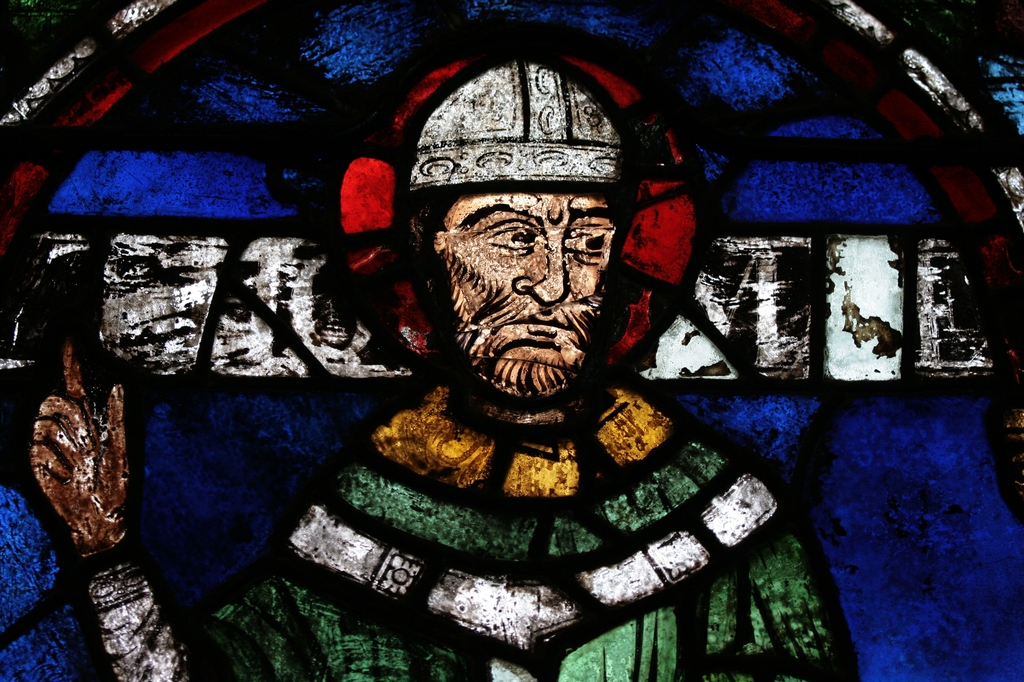
Thomas Becket was born in circa 1118 of a middle-class Norman family. Becket was the son of a merchant who served a term as sheriff of London. Thomas was educated at Merton Priory, and later attended school in London and studied for a while in Paris. After schooling Thomas worked as a clerk and accountant for the sheriff’s office. At some point in his youth Becket made a vow of chastity. He joined the household of Archbishop Theobald. Formerly Abbot of Bec, Theobald had been appointed Archbishop of Canterbury by King Stephen in December 1138.

Stephen had been in conflict with his cousin Matilda (also known as Maude) since the death of Matilda’s father Henry 1 in December 1135. Both had claimed the crown and the country was divided in a civil war that lasted until 1153. The period was described at the time as a period ‘when Christ and his saints slept’
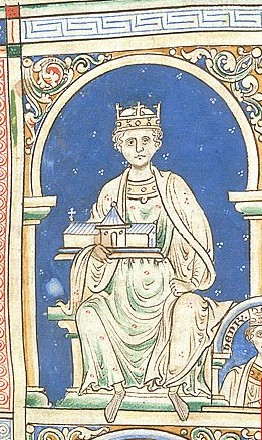
Matilda’s son Henry had taken up the reins of the fight from Matilda in 1149 at the age of 16. His father Geoffrey of Anjou was by that time already de facto Duke of Normandy, but had offered to hand the dukedom over to his son as soon as he was old enough to take over the responsibility inherent in ruling. At some point between November 1149 and March 1150 Geoffrey made good on his word and Henry Plantagenet was made Duke of Normandy. The King of France, who had only just returned from a crusade, was not prepared to confirm Henry in his dukedom, especially as there was the prospect of his being made King of England.

Geoffrey advised his son to part with the lands known as the Vexin to assure royal recognition of his dukedom. Peace was made in Paris in August 1151. Henry paid homage to King Louis and was invested as Duke of Normandy. On 7th September Geoffrey, Count of Anjou died suddenly and Henry had to journey to Anjou to be invested as its count.

Henry’s Marriage

Eleanor's marriage to Louis
On 18th May 1152 Henry, Duke of Normandy, married Eleanor of Aquitaine, daughter and heiress of the Duke of Aquitaine and former Queen of France. They were married eight weeks after a council of French clergy had agreed with King Louis’ wishes to be parted from his wife. Louis had loved his wife, although they were two very different characters – she was outgoing and enjoyed flirtations while Louis as ascetic. The marriage had produced two daughters and Louis needed a son to inherit his throne. It is believed that this was the reason for the divorce.

Henry was eleven years Eleanor’s junior but was the most eligible of those wanting to marry this exceptionally rich heiress, whose vast estates (nearly half of France) were not directly controlled by the French crown. Eleanor avoided being waylaid by the Count of Blois and an ambush by Henry’s younger brother Geoffrey on her journey to Poitou where she married Henry

His Grandfather’s Heir

It was not until November 1153 that Stephen finally met with the son of his adversary at Winchester, in an attempt to resolve the question of inheritance of the throne of England. Stephen's elder son Eustace had already died suddenly earlier int he year. Now Stephen agreed to make Henry his heir, dispossessing his son William. Henry agreed to allow Stephen to reign for the remainder of his life, providing that the king, bishops and other magnates would swear to allow Henry to become king without denial after Stephen’s death. Henry also agreed to allow William all the honours his father had bestowed upon him.

Stephen died on 25th October 1154 and on 7th December Henry and his wife Eleanor of Aquitaine set sail from Barfleur. Theobald crowned the couple king and queen of England at Westminster Abbey on 19th December. Henry was twenty-one, the first of the Angevin monarchs of England.

England’s Chancellor
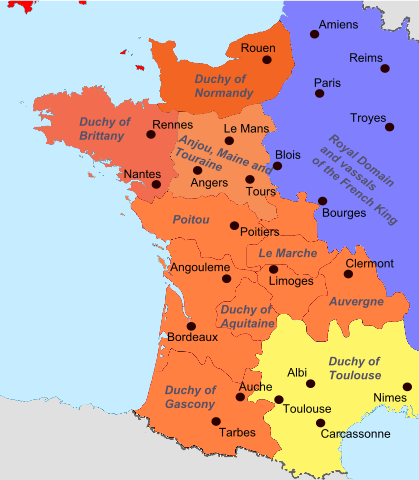
Full extent of Angevin Empire
Theobald entrusted Thomas Becket with several missions to Rome and sent him to Bologna and Auxerre to study canon law. In 1154 Becket was made Archdeacon of Canterbury and given several benefices. In 1155 Theobald recommended Becket to Henry as Lord Chancellor. Henry had already appointed one of Stephen’s men as head of the administration – Richard de Lucy and created one of his own supporters, Robert de Beaumont, his co-justiciar. Robert had been energetic in attempting to bring both sides of the civil war together, but his support was given to Duke Henry. Henry accepted Theobald’s recommendation, giving him Theobald’s support and that of the English church.

As Chancellor Thomas was much in the company of Henry and the two men became friends, as much as any man could with the peripatetic king, whose realms stretched from the far north of England to the Pyrenees. He was the companion of a young and relatively inexperienced king. But even as a young man Henry was able to extract deference from those around him. Barons and bishops bowed down before Henry’s wrath and or intransigence.

Becket’s chancellorship was partly notable for the state that he kept, displaying an eagerness for marks of status and the privileges of rank. Henry’s tastes were far simpler and his household was far less impressive. On a visit to France in 1157 Becket travelled with a great entourage, while the king’s visit was on a far smaller scale. Becket had the king’s confidence and was entrusted with matters above and beyond those normally given to a chancellor.

Archbishop of Canterbury

Theobald died on 18th April 1161 and Henry pressed the suit of his friend Thomas as candidate to the Archbishopric. An unsuccessful campaign in Toulouse had led to a waning of Thomas’ influence on Henry. Henry was apparently warned against the appointment, including by Thomas himself who said that the appointment could lead to a breach in their friendship.

But Henry was loyal to his friends and hoped to have some influence on church affairs through his friendship with Thomas. However Thomas as Archbishop seemed to go out of his way to insult the king, never a sensible option with a man of Henry’s temper. Rather than follow his predecessor’s more subtle approach Thomas may have been trying to impress his new subordinates, to prove that he was his own man, rather than the king’s.

When he received the Pope’s approval to his appointment Thomas resigned as Chancellor, much to Henry’s surprise. The joining of two posts was not unusual and the emperor of Germany had an archbishop as chancellor. Thomas claimed that he could not manage the two roles. Thomas was also provocative in other matters, demanding homage from one of Henry’s barons for a castle within the jurisdiction of Canterbury. If the case had been taken to the royal court he may have been successful, but his strategy merely inflamed the Angevin temper.

Criminous Clerks

Henry was set on reforming the English legal system and it is for this work that his reputation should be based on, rather than for the unfortunate events that followed his quarrel with Thomas. The introduction of the system of trial by jury was Henry’s triumph. The anomalous position of members of the clergy who committed crimes was an issue that Henry wanted resolved.

As many as one on six of the population were clerks in minor orders, most of whom would never be ordained as priests. But they all claimed the privilege of clergy; to be tried by the religious rather than secular authorities for any crimes. As a result ‘clerks’ were getting away with rape, murder and worse courtesy of the church. Henry wanted to ensure that criminous clerks were brought to justice. Becket wanted the church to retain secular immunity for crimes committed.

Early in his reign Henry had allowed Theobald to try and punish an Archdeacon accused of poisoning his Archbishop. This was an action Henry no doubt now regretted. It was however a precedent for Thomas to use. Notorious abuses of the clerical courts were brought to the king’s attention and there can be little doubt that the secular officials, irritated by the over 100 murders by clerks reported to the king along with numerous cases of theft and robbery with violence, were supportive of a change to the law.

Thomas did realise that some cases were too flagrant breaches of law and did try to impose harsher sentences, but in doing so he encroached upon the royal prerogative.

Bibliography

Henry II – WL Warren, Yale University Press 2000

Eleanor of Aquitaine – Alison Weir, Jonathan Cape 1999

http://en.wikipedia.org

Wednesday, 20 June 2012


Rebecca Elizabeth Lashbrook

4th October 1974 – 20th June 2008


My Tears

Like Falling Rain

Water Your Grave

Sunday, 17 June 2012

On This Day in the Third Reich 1936


Heinrich Himmler is made Chief of German Police & empowered to unify control of police duties in Reich, with a position as State Secretary in the Interior Ministry. Himmler is responsible for legal matters concerning the press/carrying of arms/arms traffic/passports/personnel issues concerning police officials.

Reinhard Heydrich is placed in charge of the Sicherheitspolizei - Gestapo/criminal police/Security service and has complete control over committal & release of prisoners from concentration camps. Despite his best efforts Himmler refuses to give Heydrich control of the camps themselves, leaving them in the care of Theodore Eicke. Kurt Daluege was placed in charge of the uniformed police (Orpo) .From now on the police are infiltrated by members of the SchutzStaffel (SS), who take increasing numbers of posts. Many policemen join the SS.

Himmler was overlooked in the original handing out of posts to Nazi chieftains. From February 1933 until April 1934 Himmler gradually collected control of the political police in the Lander. With pressure from Hitler, Goering handed over de facto control of his Gestapo (Geheime Staats Polizei) to Himmler on 20th April 1934. This was in part pre-payment for the eradication of the Sturmabteilung (SA) as a potent political force. Himmler’s SS was subordinated to the head of the SA, an old crony of Hitler’s Ernst Rohm - a notorious homosexual and Himmler wanted autonomy for his SS.

Between them Himmler and Goering appear to have persuaded Hitler that Rohm and the SA were planning a pre-emptive strike on power. Rohm had made public his plans for the SA to take over defence of the Reich from the Reichswehr. In 1934 Hitler still needed the support of the army generals, who felt threatened by Rohm’s plans. The SA by this time numbered over 3 million members.

To many Germans the SA seemed out of control, with SA members attacking German citizen’s at will, happy to wear their uniforms while creating mayhem. On the 31st January members of the SA burst into the Hotel Kaiserhof in Berlin & broke up an army officers’ celebration of the Kaiser's birthday.

Himmler with Rohm
There was conflict between Hitler and Rohm. Many of the SA believed in the socialism implicit in the name of the National Socialist party. They and Rohm believed in a ‘second’ revolution that Hitler had refused to contemplate. The result of the pressures, at the head of the Nazi state, was the downfall of Rohm and his SA during the Night of the Long Knives, engineered by Himmler and Goering. The SS took the lead role in the killings on 30th June 1934, ordered by Hitler. The SA survived, although Rohm did not, in a truncated form that never again held any real political power.

Himmler continued to build on his control of the political police, by working towards take-over of the ordinary police. The Interior Minister Wilhelm Frick (who was eventually to be replaced by Himmler in 1943) was also planning to take control of the German police. During the latter part of 1935 and the first half of 1936  Frick attempted to persuade Hitler to place him in control. It took a two pronged attack led by Himmler and Heydrich to persuade Hitler that his best interests would be served by giving control of security to his loyal Heinrich.

On the 22nd June Heydrich notified the Interior Ministry that Himmler had increased his demands to absorb a number of sections & desks in the ministry & consolidate complete control over police affairs. It was in this manner that power gradually became consolidated in Prinz Albrechtstrasse, where Himmler and Heydrich had taken up residence after April 1934.

The merging of roles of Reichsfuhrer SS & the Chief of German Police was significant in Himmler’s rise to take complete control of the German security apparatus. Control of and merging of the two organisations created a whole greater than the sum of its parts. The SS became synonymous with terror. The SS was to play major roles in the Austrian Anschluss in March 1938 and the incorporation of the Czech Sudetenland in October 1938 as well as the outright annexation of the remainder of Czechoslovakia in March the following year. By the time war broke out in September the core of the future Waffen SS was already blooded in the Czech take-over.

The name of the Gestapo resonates even today; though few people know of its head and the game changing death of Reinhard Heydrich, in June 1942. This led to the vengeful levelling of the Czech village of Lidice and the murder of its inhabitants; all a direct result of the events of 17th June 1936.

Bibliography

Hitler’s Enforcers – George Browder, Oxford University Press 1996
Foundations of the Nazi Police State – George Browder, University of Kentucky Press 2004

Heinrich Himmler – Peter Longerich, Oxford University Press 2011
Heinrich Himmler – Roger Manvell & Heinrich Fraenkel, Greenhill & Lionel Leventhal 2007

Himmler – Reichsfuhrer SS – Peter Padfield – Cassell & Co 2001
En.wikipedia.org

Saturday, 9 June 2012

The SS - Mr and Mrs Himmler


An Unlikely Couple
Heinrich Luitpold Himmler was born on 7th October 1900 to middle class Bavarian parents. Professor Himmler had been tutor to Prince Heinrich of Bavaria, who agreed to be his godfather. Like many of his generation the Great War was to be a defining element in Heinrich’s boyhood. The army mad boy suffered from poor health and wore glasses.

This standard bearer for racial health, whose face betrayed traces of possible Mongol ancestry, was a virgin when he met his future wife Margarete, who was his senior by 7 years. They met in December 1927, sheltering in a hotel lobby during a downpour. Their relationship was speedily consummated and they corresponded by post, before their marriage on 3rd July 1928. The couple had got engaged in the February and met several times in the intervening period.

Marga was a nurse and part owner of a clinic, which she sold before she married Himmler. As a Protestant divorcee Himmler was afraid that his parents would not approve of the first woman he had ever come into contact with, apart from a few female friends of the family in his student days.

The couple bought land at Waltrudering and set up a chicken farm, which was not as successful as the happy pair had hoped. Himmler was totally committed to the Nazi party; he was Deputy Propaganda Leader for the party as well as Deputy leader of the Schutzstaffel (SS), the protection squad for the party’s leader, Adolf Hitler. His duties kept Himmler away from home and Marga saw little more of her husband than before their marriage. Heinrich had passed his driving test 6 days before the marriage.

Marriage to Heinrich Himmler was a great disappointment to Marga, who appears to have hoped for romance in her second marriage to this much younger man. She was never involved in the Nazi party, unlike Magda Goebbels, who married Josef Goebbels in December 1931. Himmler’s first loyalty was to the Party, Marga came an unhappy third, far behind the couple’s daughter.

To the Devil a Daughter

Gudrun Himmler was born on 8th August 1929. She was to be the couple’s only child. Himmler was a devoted father and, even after he lost interest in Marga, would phone her regularly throughout the rest of his life. During the war years especially Himmler was constantly on the move, but even then he frequently phoned Puppi (his pet name for Gudrun). The doting father even had photographs of himself on the move taken for Puppi.

Eight months before his daughter’s birth Himmler was made Reichsfuhrer SS and he immediately took action to increase recruitment of the fledgling stepchild of the Sturmabteilung (SA); which came under the control of Himmler’s mentor Rohm in January 1931. Rohm immediately put paid to Himmler’s move for autonomy for his SS, which was not achieved until July 1934.

In June 1932 Himmler found for his SS, the man whose name became synonymous with terror – Reinhard Heydrich. He was a disgraced naval officer who formed the nascent Sicherheinstdiest (SD), building it up as an intellectual twin of the terror that was to be the Gestapo.

To Berlin
Himmler with Daleuge (L) and Rohm (R)
The Machtergreifung, bringing the Nazis to power did give Himmler some power; but he lost out on the big prizes seized by his future rivals Goering and Goebbels. In 1933 Himmler was regarded as a small time crank, who just happened to be the leader of the SS

Sometime in 1933 Himmler and Marga sold the property at Waldtrudering; buying a villa at Gmund on the Tergensee. Marga and Puppi were to live here until May 1945. During this year the couple fostered Gerald von der Ahe; the son of an SS man shot during February. Gerald was to cause problems in 1939, when he was expelled from a National Socialist school and his mother did not want him back.
It was not until April 1934, following his appointment as chief of the Gestapo, that Himmler moved his base of operations to Berlin, where he took an apartment at Tiergartenstrasse 6a, while Marga and Puppi remained in Gmund.
 In June 1936 Himmler was made Chief of the German Police, a job that he used to infiltrate his SS staff into the bowels of the security apparatus and then taking it over entirely. Himmler moved to a villa in upmarket Dahlem in July 1937, near to the home of his friend Joachim von Ribbentrop, the future foreign minister.

Private Life
Marga had a few friends; she was friends with Annalies von Ribbentrop, but this friendship may have withered when the two husbands fell out in May 1941. The wife of Hermann, Frieherr von Schade (a member of her husband’s SS) was a close friend.

As was Nini Rascher, wife of Sigmund Rascher, who conducted experiments on concentration camp inmates. Nini was possibly Heinrich’s mistress in the late thirties, although there appears to be little evidence for this. The friendship with Nini Rascher probably finished abruptly when Nini’s husband was arrested in May 1944. Nini and her husband had fraudulently claimed to the credulous Reichsfuhrer SS that they had fathered three children for the Fuhrer, despite Nini’s relatively advanced age.

One woman who decidedly did not get on with the bosses’ wife was Lina Heydrich. Early in 1936 the pair fell out. Marga had been giving coffee mornings for SS wives. Lina organised rival tea parties. Lina made rude comments about the size of Marga’s underpants and blamed her size on Marga’s love of cream cakes.

Lina and Reinhard Heydrich
Himmler quarrelled with Lina in August 1936. She objected to Himmler’s attempts to pressurise her husband into divorcing her. This attempt followed a falling out between Lina and Marga; after Lina had abused Marga. Himmler arranged for Lina to attend Kiel Regatta with the wife of another senior officer Meanwhile Himmler discussed the possibility of divorce with Heydrich, who informed Lina. Lina returned post haste to Berlin.

Himmler and Lina did not speak again until May 1942. The rapprochement occurring, weeks before Heydrich’s assassination in Prague.

Marga was only too keen to capitalise on her husband’s important job, and upset the tradesmen in Gmund by her autocratic demands. Marga’s car had the licence plate SS2 and she was infuriated one day to be overtaken by a nobody. She insisted that the driver re-overtake the car in front. It was not appropriate for SS2 to be overtaken by anybody.

The Mistress

In 1936 a young Hedwig Potthast went to work as a secretary for the Reichsfuhrer SS. It was not until Christmas 1938 that the couple professed their love for one another. She probably became Himmler’s mistress shortly afterwards.
In early 1941 Hedwig left her job as Himmler’s secretary & became his mistress semi-formally. Himmler sent her to live in Bruckenthin in Mecklenburg, near the home of one of his most trusted senior officers – Oswald Pohl.

Hedwig and Himmler’s first child was born in February 1942, a son called Helge. He was followed in 1944 by Nanette Dorothea, born on 20th July. Himmler had already appeared in front of the SS court to claim paternity of the child Hedwig was carrying. He legalised the paternity of both children before the court in September.
Hedwig and Himmler met for the last time on 26th March at their Berchtesgarten home. Himmler had built this with an 85,000 Reichsmark loan from the party, organised by Martin Bormann, a sometime friend of the family. His son says that Himmler and his mistress kept furniture made from human bones, in the attic. Gerda Bormann made friends with the lonely young woman, but was apparently horrified by the secrets in the attic.

The Holocaust
It is unlikely that Marga ever knew about the atrocities perpetrated by her husband, on Hitler’s orders. Himmler kept Marga strictly divorced from his work and her naturally abrasive personality kept many potential friends aloof.

The End
Himmler committed suicide on 23rd May 1945, while in the custody of the British. The files on the death, over which there has been some controversy with claims of murder being raised, are still classified as Top Secret. Marga Himmler and Gudrun were imprisoned by the Allies at an interrogation camp, but were later released.

Bibliography

The Himmler Brothers – Katrin Himmler, MacMillan 2007

The Order of the Death’s Head – Heinz Hohne, Penguin 2000

My Father’s Keeper – Stephan Lebert, Little Brown & Co 2001

Heinrich Himmler – Peter Longerich, Oxford University Press 2011

Heinrich Himmler – Roger Manvell & Heinrich Fraenkel, Greenhill & Lionel Leventhal 2007

Himmler – Reichsfuhrer SS – Peter Padfield – Cassell & Co 2001

En.wikipedia.org

Sunday, 3 June 2012


In today’s Observer newspaper a headline

‘Police plan pre-emptive arrests to stop disruption at Olympics’


Olympic flame in Berlin
In July 1936 the Gestapo organised a round-up of asocials from the streets of Berlin and copies of the anti-Semitic Der Sturmer newspaper were withdrawn from display in the city. Anti-Jewish notices were removed from the city in an attempt to lower public displays of anti-semitism in preparation for the Olympics in August.

Bibliography

The Years of Persecution - Saul Friedlander, Orion Books 1998
Blood and Banquets – Bella Fromm, Touchstone 1992

The Architecture of Oppression – Paul B Jaskot, Routledge 2000

Friday, 1 June 2012

On This Day in the Third Reich 1934


The Jewish owners of Frankfurter Zeitung sell their shares to IG Farben (who now own 98% of the paper). The family have seen the warning lights posted by the regime.
The incident is used to create favourable publicity for IG Farben at home & abroad. Goebbels, Minister of Propoganda and Hitler value the Frankfurter Zeitung’s reputation abroad and allow a more relaxed interpretation of the rules than is acceptable for other newspapers. The paper’s masthead continues to show the Leopold Sonnemann as the paper’s owner.

The Frankfurter Zeitung publishes articles about foreign criticism of regime into the mid 1930s. The editorial staff sometimes fail to print articles, even when ordered to do so by Goebbels, Minister of Propoganda.

Bibliography

The Third Reich in Power – Richard J Evans, Penguin 2006

The Twisted Road to Auschwitz – Karl A Schleunes, University of Illinois Press 1990

Saturday, 26 May 2012

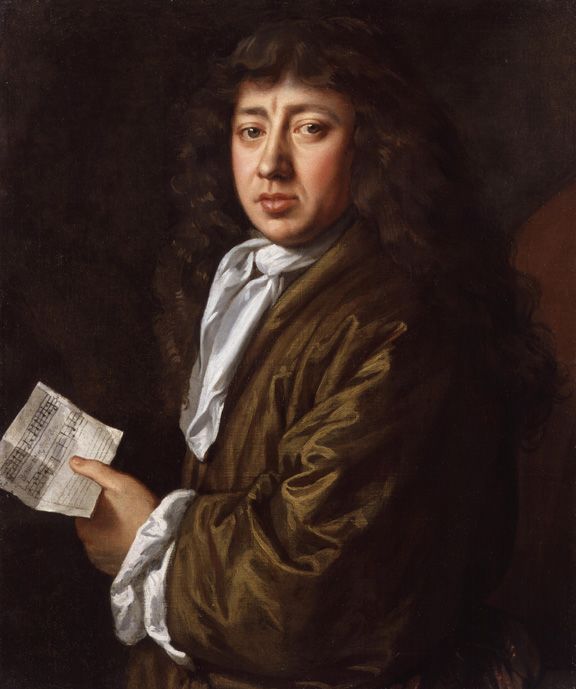
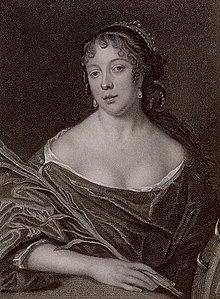
Samuel and Elizabeth Pepys


An Unequal Marriage

Samuel Pepys was born 23rd February 1633, the son of tailor John Pepys, who served the thriving law courts in London. Samuel was the fifth child, two of his siblings died before he was born. A further six children were born after him. Of the eleven children only four reached adulthood. Only the last daughter, the second Paulina, and Samuel outlived their father.
Samuel was educated at Huntingdon School. Samuel and his brother Thomas had been sent into Cambridgeshire to avoid the plague. Samuel then moved on to St Paul’s School in London, probably before the age of eleven[i]. In 1650 Pepys attended Cambridge, having had two exhibitions[ii] at St Pauls. Pepys was granted his degree in 1654.

In 1653 Pepys senior was admitted to the ranks of the Merchants Taylors Company, one of London’s Livery Companies, the same year that Oliver Cromwell made himself Protector of the country. On Cromwell’s coat tails came Edward Montagu, one of his neighbours and kin to the Pepys family.
Elizabeth Pepys was born Elisabeth de St Michel in Bideford on 23rd October 1640. She was the daughter of Alexander de St Michel, a Frenchman converted to the Protestant religion. Her brother Balthasar was born the same year. Elisabeth’s mother apparently inherited land in Devon. And the St Michels moved there from Ireland, where they met. Over the next few years any money they had disappeared, as the small family wandered around Europe. Alexander took a variety of jobs, including soldiering and working for a time at the court in exile of Queen Henrietta Maria. In 1652, left alone in Paris, Elisabeth’s mother placed her daughter in an Ursuline convent, and her brother Balthasar was made a page to the Papal Nuncio. Infuriated by his wife’s actions Alexander St Michel carried the family off to London.

Elizabeth was just 15 when she married[iii]. Nothing is known about how she met Pepys, but he was obviously swept off his feet by this bi-lingual pretty but penniless young girl. Pepys possibly persuaded himself that two can live as cheaply as one and the couple were officially married on 1st December 1655 in St Margaret’s Westminster. This was their official wedding date, but the date they celebrated every year was the 10th October. The marriage was consummated that night and it may be assumed that the couple had an illegal wedding on that day[iv]. Elizabeth suffered from ‘painful humours and swellings’ in her vaginal region; so intercourse cannot have been as pleasant for her as for Samuel.
In December too, Edward Montague was called to the Admiralty Commission. In January he found himself joint commander of the English battle fleet. Samuel was selected to look after his important relative’s affairs at home and his apartment at Whitehall, during Montague’s absence on fleet duties.

Unquiet Times
The disparity in age and education did not make for a happy marriage and Pepys’ in-laws looked down upon his lowly birth (throughout his marriage Pepys never visited the St Michel’s). Samuel and Elizabeth were living in one room, possibly in the attics at Whitehall, with little money. Neither set of parents were able to help the couple. Samuel for the first few years suffered the complications of his kidney stone and Elizabeth too suffered from ill health. She had no servants and the young girl, fed on French romantic novels, had a fiery temper. Samuel as well had a temper that would flare up to meet hers. Relatively early in the marriage Elizabeth walked out without notice to her husband and did not return. It would appear that she stayed with a lawyer named Palmer and his family. Palmer possibly encouraged a reconciliation between the married couple.

In March 1658 Samuel Pepys successfully underwent an operation to remove his stone. He was nursed by his cousin Jane Turner. The anniversary of the operation was one of the high days of the Pepys household.
‘This day it is two years since it pleased God that I was cut of the stone at Mrs Turner’s at Salisbury Court. And did resolve while I live to keep it a festival, as I did last year at my house, and for ever to have Mrs Turner and her company with me.’[v]

By now Pepys was working as a clerk for George Downing, diplomat, MP and an official at the Treasury. This work was in addition to looking after Montague’s affairs in his absence with the fleet. Samuel and Elizabeth took advantage of the situation and now rented half a house in Axe Yard, which must have reduced some of the pressures within the marriage.
In May 1660 Pepys accompanied Montague’s fleet sent to escort the new king Charles Stuart back to his kingdom. On the 13th July 1660, Samuel was made Clerk of the Acts to the Navy Board; a post in which he was to be exceptionally effective. This new job brought him into contact with the king’s brother the Duke of York. In September Pepys was made a Justice of the Peace and in 1662 was made a younger brother of Trinity House[vi].

Momentous Events
On 5th July 1665 Pepys, now working in the Navy Office, moved his family to Woolwich, following a severe outbreak of the plague in the city. The plague was an intermittent problem, re-occurring every few years. In June the numbers falling ill and dying in London started to increase.

Samuel’s career was not interrupted by the plague, nor was his private life. Pepys stayed in London, working at the Navy Office, despite the thousands of Londoners dying every week. At the end of the year the family returned home.
The following September another disaster hit the capital. It was Pepys who informed the king and his brother of the fire in London on 2nd September. It was his advice to blow up the buildings in the path of the fire to create breaks, that helped stop the spread of the devastation.

‘And word was carried to the King, so I was called and did tell the King and Duke of York what I saw, and that unless His Majesty did command houses to be pulled down, nothing could stop the fire.’[vii]
That lunch time Pepys and Elizabeth were expecting guests for dinner and Pepys went home after walking through the streets, observing Londoners fleeing with their goods and chattels. It was all noted for posterity. There were five to dinner and a good time was had by all. The party went out after dinner to observe the continuing mayhem.

By the time Samuel and Elizabeth returned home, after spending the evening in an ale-house on Bankside, Pepys was aware that the fire was moving in their direction. Carts were organised as Samuel had his gold and books of accounts brought up from the cellar. Pepys arranged a navy lighter to take his possessions to Bethnal Green for storage at the house of a colleague. The wine was buried in the garden.
‘In the evening Sir W. Penn[viii] and I did dig another and put our wine in it, and I my parmazan cheese as well as my wine and some other things.’[ix]

Pepys had buildings around the Navy Office blown up, in an attempt to save the building.
By now the Pepys were camping out in their home. On the 5th Elizabeth woke Pepys to inform him that the fire was burning at the bottom of Seething Lane. He took her back to Woolwich, where she had stayed during the plague. The house was not burnt and Pepys ordered it cleaned. Meanwhile he took time out to dally with a couple of female acquaintances, one of whom Samuel was carrying on a long-term illicit relationship with. Mrs Bagwell was the wife of a ship’s carpenter (hoping for a promotion from the liaison) from Deptford. Elizabeth came home the next day.

‘And so home and unloaden them by carts and hands before night, to my exceeding satisfaction: and so after supper to bed in my old house, the first time I have lain there; and lay with my wife in my old closet upon the ground, and Balty[x] and his wife in the best chamber, upon the ground also.’[xi]
A Marriage Under Pressure

The Pepys marriage would have been happier if Samuel had been less willing to drop his breeches at the slightest encouragement. Indeed on numerous occasions he informs us that he was sexually assaulting lower class women, if not actually raping them.
‘Finding Mrs Bagwell waiting at the office after dinner; away elle and I to a cabaret where elle and I have été before; and there I had her company toute l’après-dîner and had mon plein plaisir of elle.’[xii]

Elizabeth did not take her husband’s infidelities and chasing after women lying down:
‘And so home, where my wife in mighty pain, and mightily vexed at my being abroad with these women – and when they were gone, called them “whores” and I know not what; which vexed me, having been so innocent with them.’[xiii]

Indeed, Pepys betrayed Elizabeth with her companion Deborah Willett, who joined the household in September 1667, but left precipitately thirteen months later, after Elizabeth found Deb and Samuel in a heavily compromising position:
‘For my wife, coming up suddenly, did find me imbracing the girl con my hand sub su coats; and endeed, I was with my main in her cunny’.[xiv].

This was the first and only time that Elizabeth caught her husband out in infidelity. The betrayal was even more poignant as Deborah had been treated as a member of the family, almost as a daughter by a couple who were unable to have children. Pepys had commenced his attack on Deb’s virtue in the March of 1668, when he sexually assaulted her. She was in a difficult position as she was totally dependent on his and Elizabeth’s goodwill. In November Deb admitted the affair to Elizabeth, who insisted on her dismissal, offering to slit Deb’s nose if Pepys did not stay away from her. Pepys even agreed to be tailed by his man Will Hewer to allay any suspicions Elizabeth might be harbouring.
Yet when Elizabeth was attracted to a man, or conducted a mild flirtation, Pepys was outraged.

‘And so, well pleased, home – where I find it almost night and my wife and the Dancing Maister alone above, not dancing but walking. Now, so deadly full of jealousy I am, that my heart and head do cast about and fret, that I could not do any business possibly, but went out to my office.’[xv]
Then the couple would often argue, not necessarily over Elizabeth’s flirtations, but over some other matter picked up by the jealous husband. In the instance of the dancing master; in order to restore his supremacy over her Pepys complained of Elizabeth’s use of the word Devil some days later, after what appeared to Samuel to be further provocations on Elizabeth’s part. This is a frequent occurrence – Samuel has to be her master in all things.

The Final Separation
But however much Samuel chased after other women, there is no doubt that he did love Elizabeth:
‘Sad for want of my wife, whom I love with all my heart.’[xvi]

Elizabeth died on 10th November 1669, of typhoid fever, not long after the couple’s return from a trip to the Netherlands. Samuel was grief stricken and for several weeks was unable to apply himself to business with his normal thoroughness. He had stopped writing the diary in May, due to his worsening sight problems. Samuel did not remarry. In 1672 he was made an Elder Brother of Trinity House and served twice as Master. In 1673 the position of Secretary of the Admiralty was given to Pepys and he was elected MP for Castle Rising in the same year.


Pepys remained in public service until the Glorious Revolution, when he lost his job as he would not switch allegiance from his patron James. Thereafter he lived in retirement.
Most of the evidence of the marriage between Samuel and Elizabeth comes to us from Pepys himself, via the medium of his diary. But even in his most private writings Pepys could not lie to himself. And so we have a picture that is relatively even-handed.

To judge Pepys by the morals of the 21st century is tempting. He was an abusive man, who attempted to control his wife through a variety of methods, including his gifts to her. He was also a serial sexual predator, by his own admission. But people and events must be considered within the context within which they lived or occurred. From 1660 on mores and morals were very different even from those prevalent fifty years earlier. By seventeenth century standards Pepys’ treatment of women would not have been considered extra-ordinary. In the reign of Charles II many men were quick to emulate the king’s promiscuity; not least of whom was Pepys’s patron, the Duke of York.

Bibliography

Samuel Pepys – the Man in the Making – Arthur Bryant, Collins Press 1947

Pepys’ Later Diaries – ed. CS Knighton, Sutton Publishing 2004

The Shorter Pepys – ed. Robert Latham, Penguin 1987

Samuel Pepys – the Unequalled Self – Claire Tomalin, Alfred A Knopf 2002
www.en.wikipedia.org

[i] The headmaster of St Paul’s disliked taking boys for schooling over that age.
[ii] Scholarships
[iii] Marriage at this age was not unusual in the 17th century.
[iv] Church weddings were declared invalid in August 1653.
[v] Samuel Pepys – 26th March 1660
[vi] Responsible for training of ship’s pilots
[vii] Samuel Pepys - 2nd September 1666
[viii] Navy Commissioner
[ix] Samuel Pepys - 4th September 1666
[x] Elizabeth’s brother
[xi] Samuel Pepys - 13th September 1666
[xii] Samuel Pepys - 23rd January 1665 – Pepys recorded his sexual adventures in a mix of French, Latin, English and Spanish
[xiii] Samuel Pepys – 9th May 1666
[xiv] Samuel Pepys – 25th October 1668
[xv] Samuel Pepys --15th May 1663
[xvi] Samuel Pepys – 21st June 1663