Showing posts with label Gunpowder Plot. Show all posts

Wednesday, 20 August 2014

The Stuart Would Be Queen - The Lady Arbella III


The New King
Funeral of Elizabeth I
In early April James wrote to Henry Grey[i], the Earl of Kent, asking if he would take Arbella to live with him;
‘We are desirous to free our cousin, the Lady Arbella from that unpleasant life which she hath led in the house of her Grandmother, with whose severity and age, she – being a young lady – could hardly agree.’[ii]
Arbella departed on a visit to her cousin at Wrest Park[iii]. As Elizabeth’s highest ranking female relative Arbella was invited to attend the state funeral on 28th April as Principal Mourner. She refused on the grounds that she was not allowed near Elizabeth during her lifetime and had no intention of being staged as a public spectacle.
James I
James entered his new capital on 7th May; and on the 11th wrote inviting Arbella to visit the new court at Greenwich. Of the meeting the Venetian envoy wrote;
‘Lady Arbella, who is a regular termagent came to visit the King on Sunday last with a suite of ladies and gentlemen.’[iv]
Her behaviour impressed Lord Cobham to write that he would never press his suit upon Arbella. A Talbot retainer hinted that Arbella showed a lack of composure and talked in a tumultuous fashion, something that is noticeable in some of her letters. James allowed Arbella freedom of movement and she went to stay at Sheen, home of the Marchioness of Northampton[v].

Freedom of a Sort
On 14th June 1603 Arbella wrote to Cecil asking him to petition James to allow her a pension; the annual monies she received from Elizabeth had ceased on her death. Four letters later Arbella took pen in hand to write again to Cecil on 30th June thanking him for the lump sum of £666[vi] granted as a stop gap until the matter of her pension was decided.
‘I have received His Majestie’s liberality by your Lordship’s meanes; for which I acknowledge myself greatly bounden to your Lordship.’[vii]
Anne of Denmark
When Queen Anne arrived at in London Arbella returned to court. Although there is no record of her having attended the coronation, Arbella’s absence would surely have been noted by interested observers. She was certainly in attendance when the court moved to Farnham, taking precedence over all ladies with the exception of the queen and the princesses;
‘In her [Arbella] appointments, table and rank, she takes precedence of all the other ladies of court. She has already begun to bear her Majestie’s train when she goes to chapel.’[viii]
Dangerous Times
At the age of twenty seven Arbella was now in partial control of her destiny. She was tangentially linked to the Bye Plot[ix], by one of the conspirators, Griffin Markham[x], who had been a neighbour at Hardwick. The Bye Plot was linked to the Main Plot; the plotters planned to kill James and the eleven year old Prince Henry and place the Princess Elizabeth, or in default of her Arbella, on the throne with the assistance of the Spanish.
Princess Elizabeth
The Venetian envoy wrote;
‘Most of the conspirators belong to her [Arbella’s] faction.’[xi]
Lord Cobham had written to Arbella asking her to write to Philip III of Spain and other Spanish dignatories, promising that she would allow Catholic toleration and stop English support for the revolt in the Netherlands. Arbella immediately handed the letter over to the authorities.
The summer and autumn of 1603 saw the plague return with a virulence to London[xii] and the court wended its way round southern England, Arbella in its train. James enjoyed the hunting at Woodstock, but his courtiers were less impressed with the old palace.
Robert Cecil
November saw the beginning of the Main Plot trial and Henry Cavendish was summonsed to London for interrogation and then released. Arbella complained much of her health at this time in her letters to Gilbert and Mary Talbot; the strain of the trial was telling on her. The prosecutor Coke’s attempts to involve Arbella were forestalled by Cecil;
‘Here hath been a touch of the Lady Arbella Stuart, the king’s near kinswoman. She is as innocent of all these things as I, or any man here: only she received a letter from my Lord Cobham to prepare her, which she laughed at and immediately sent to the king.’[xiii]  
But records of the interrogations[xiv] indicate that Arbella was more involved than the evidence made public showed. There was more than one letter from Lord Cobham and Arbella answered them, such answers being burnt by Cobham. Indeed Frances Kirton, Cobham’s kinswoman in Arbella’s employ, stated that;
‘The lady [Arbella] was desirous to be acquainted with him [Cobham] and to be advised by him.’[xv]
On 28th November Arbella had a headache that meant she could only write a few lines to Uncle Gilbert and thanks to Mary who had sent pills and hartshorn[xvi]. On 8th December her letter to Gilbert rambled through visions of St Ursula and her thousand virgins and biblical prophecies. The letter ended with the news that James had pardoned the ‘not-executed’ traitors.
A Desire to Return Home
Prince Henry
In the summer of 1604 Sir William Cavendish came to court and Arbella was reconciled with her uncle; she even sent her regards to Bess and a short note; the first communication between the two since Arbella had left Hardwick. William stayed at court as Arbella was trying to get her uncle a peerage[xvii]; she spoke four times to James on the matter and even recruited Prince Henry’s support with a marked lack of success;
‘Mr Cavendish……waits hard on my Lady Arbella for his barony; but I am confidently assured that he will not prevail.’[xviii]
Arbella was incapable of living within her income and was running up debts[xix]; she also seems to have been homesick, often asking about Hardwick in her letters to Gilbert and Mary Talbot. Gilbert and Mary were also piling up the debts. During this period Arbella turned down a number of proposals for her hand in marriage.
In early 1605, when Bess was reported to be very unwell, Arbella asked James for permission to leave court to visit her grandmother. James was only too happy to promote a reconciliation between the two, even writing personally to Bess asking her to treat Arbella kindly. The visit did result in Arbella and Bess reconciling, but Arbella was no longer Bess’s favourite ‘jewel’[xx].
Back at Court
On her return to court Arbella was chief godmother of the baby Princess Mary[xxi]; the Countess of Northumberland was the other godmother and the Queen’s brother Duke Ulrik of Holstein[xxii] was Mary’s godfather. The ceremony was held on 19th April and to mark the occasion a number of peerages were bestowed; Cecil was made a baron and James gave Arbella a blank warrant to complete herself. She made her uncle William a baron[xxiii] and he was one of eight who carried the canopy over Princess Mary at the baptism.
Gunpowder Plot Conspirators
At the end of the year Gilbert Talbot was implicated in the Gunpowder Plot, he was vindicated but there was gossip about Mary Talbot’s involvement. Mary was known to have leanings towards Catholicism, wore a crucifix and was friendly with Walter Ralegh. Mary issued a writ against Lady Anne Markham and Edmund Lascelles, the perpetrators of the rumours; the pair retracted their accusations and apologised.


Bibliography
The Early Stuarts – Godfrey Davies, Oxford University Press 1987

The Gunpowder Plot – Antonia Fraser, BCA 1996
King James – Antonia Fraser, BCA 1974
Arbella – Sarah Gristwood, Bantam 2004

Robert Cecil – Alan Haynes, Peter Owen Publishers 1989
After Elizabeth – Leanda de Lisle, Harper Perennial 2006

Bess of Hardwick – Mary S Lovell, Abacus 2006
The Letters of Lady Arbella Stuart – Sara Jayne Steen ed, Oxford University Press 1994

www.wikipedia.en


[i] Arbella’s cousin was married to the Earl’s nephew and eventual heir
[ii] Bess of Hardwick - Lovell
[iii] Near Bedford
[iv] Arbella - Gristwood
[v] A friend of the old queen
[vi] In 2013 the relative: historic standard of living value of that income or wealth is £139,800.00
economic status value of that income or wealth is £4,007,000.00 economic power value of that income or wealth is £29,870,000.00 www.measuringworth.com
[vii] The Letters of Lady Arbella Stuart - Steen
[viii] Arbella - Gristwood
[ix] James was to be kidnapped and forced to give Catholics wider rights than they already possessed
[x] He went abroad to Europe as a spy for Cecil
[xi] Arbella - Gristwood
[xii] The first week of August saw 1,922 dead
[xiii] Arbella - Gristwood
[xiv] Uncovered at the end of the 20th century
[xv] Arbella - Gristwood
[xvi] Hartshorn salts used as a treatment for fevers and smelling salts; jellied and calcinated hartshorn used for diarrhea and dysentery
[xvii] William was made Earl of Devonshire on 2nd August 1618
[xviii] Bess of Hardwick - Lovell
[xix] She may have been trying to get back into her grandmother’s good books by helping her uncle
[xx] Bess’s pet name for her grandchildren
[xxi] Born on the 8th April 1605
[xxii] On a visit to his sister
[xxiii] It is possible that William paid Arbella the sum of £2,000 for her assistance. In 2013 the relative: historic standard of living value of that income or wealth is £389,100.00 economic status value of that income or wealth is £11,950,000.00 economic power value of that income or wealth is £87,820,000.00 www.measuringworth.com

Wednesday, 14 May 2014

The First Stuart King - The Wisest Fool in Christendom IV


The Succession
Edward Bruce
In 1601, convinced that an uprising against Elizabeth’s unpopular government was imminent, James sent the Earl of Mar and diplomat Edward Bruce to assist the Earl of Essex in his revolt against Elizabeth. By the time Mar and Bruce reached England Essex was already dead. Bruce and Mar approached Cecil, who made it clear that he backed James as heir to the throne of England.
A secret correspondence was set up between James and Cecil, who insisted on absolute secrecy.
If Her Majesty had known all I did…..her age and orbity, joined to the jealousy of her sex, might have moved her to think ill of that which helped preserve her.’[i]
James required that Cecil work with two Englishmen that he trusted; Lord Henry Howard[ii] and the Earl of Worcester[iii]. Cecil organised Worcester’s elevation to the Privy Council in the summer of 1601; alongside came the Earl of Shrewsbury[iv] and Sir John Stanhope[v].

Cecil worked to train James in the art of ruling England; while his mistress was declining. Elizabeth said of herself
‘I am not sick, I feel no pain and yet I pine away.’[vi]
On 24th March 1603 Elizabeth died in her 70th year never having nominated a successor for fear that her people would worship the rising sun rather than the setting one. A scramble northwards on the part of politicians and courtiers began.

A Hard Act to Follow
Three hundred knighthoods were sprinkled about those who had rushed north to inform the new king of Elizabeth’s death and James now travelled down to his new kingdom;

‘Like a poor man wandering about forty years in a wilderness and barren soil and now arrived at the land of promise.’[vii]
James visited the mansions of the English nobility as he travelled south. He did not appreciate the crowds and his indifference to ceremonial and his impatience became subjects of public gossip. The contrast with Elizabeth, who was well aware that her subjects needed an object of devotion, was marked. Anne on the other hand was made for the cheering English;

‘With great mildness……never leaving [off] to bend her body this way and that, that men and women wept for joy.’[viii]
James was able to indulge his taste for hunting in new surroundings and later in his reign would be accused of neglecting affairs of state to gratify this passion.

Ludovic Stuart
There was also the inevitable issue of money; the Crown was heavily in debt and James was not good with money. James was handing out pensions and grants of money with abandon; one recipient being Ludovic Stuart[ix], the second Duke of Lennox.
The English parliament was a very different kettle of fish to the Scottish parliament that James was used to. Parliament laid claim to controlling the grants of money to the Crown. The Puritan members had already started flexing their muscles in the dying years of Elizabeth’s reign and the Millenary Petition[x], demanding a return to purer forms of religious ceremony, was handed to James en route for London[xi].

Plotting Against the King
James did have one peerless servant; the incomparable Cecil who was made Baron Cecil on 20th August[xii]. Another servant was Lord Henry Howard[xiii], an exceptionally avaricious noble who joined with Cecil in intriguing against Sir Walter Ralegh[xiv] and Lord Cobham. Cecil had already blackened their names to James long before he became king of England. His antipathy was well known; Sir John Harington wrote to John Still, Bishop of Bath and Wells

‘I much fear for my Lord Grey[xv] and Ralegh……..Cecil doth bear no love to Ralegh as you well understand.’[xvi]
Lord Cobham
In July 1603 Ralegh and Cobham were arrested for plotting to replace James with his cousin Arbella. The plot had been uncovered during the investigations into the Bye Plot, a Puritan and Catholic conspiracy aimed at increasing religious toleration and removal of some of the king’s ministers. The Bye plotters intended to kidnap James while he was still en route to London.
The Bye plot was exposed by three of the plotters John Gerard and Henry Garnet[xvii] and George Blackwell[xviii]. Cecil was already aware of the plotting and the main conspirators were arrested and questioned and tried under the auspices of Sir John Popham[xix]. Ralegh and Cobham’s fall from grace ended with a thirteen year stay in the Tower of London; a number of the Bye plotters were executed. And by an edict on 22nd January 1604 James ordered that all Roman Catholic clergy leave the kingdom by 19th March.

Church and State
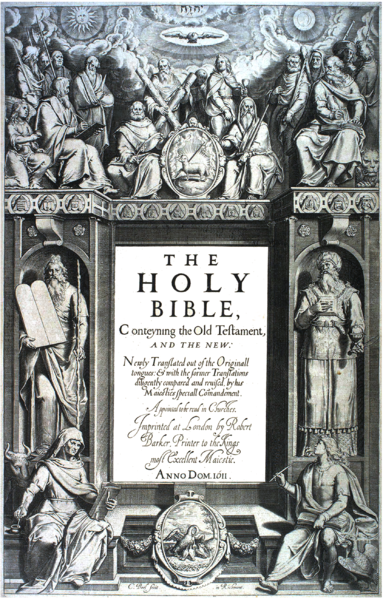
At the Hampton Court Conference, convened in January 1604, James met with leading Anglican clerics and Puritans. Always one for the middle way, James was pleased to be able to agree with all but the more extreme Catholics and Puritans. The most significant result of the conference was the commissioning by James of an authorised version of the bible, known as the King James’ Version[xx].
The conference ended without the extreme Puritans getting what they wanted and James declared;
‘I shall make them conform themselves, or I will harry them out of the land.’[xxi]
And thereafter the Puritans came to be identified with the party of dissent, even as James’ political opponents leaned towards Puritanism.

Not long after the conference the Archbishop of Canterbury, John Whitgift died and James appointed the anti-Puritan Richard Bancroft[xxii] in his place. It was Bancroft who oversaw the production of James’ new bible.
James was not anti-Catholic and told Cecil that;

‘I will never allow in my conscience that the blood of any man shall be shed for diversity of opinions in religion.’[xxiii]
Cecil was not prepared to allow the relaxation of the laws that the Catholics were expecting from James. Instead stricter measures were enacted against priests and recusants.
Remember, Remember the Fifth of November

Despite its resonance down the ages, the Gunpowder Plot was hardly a well planned conspiracy. The plotters wanted England ruled by a Catholic monarch but were unable to gain the interest or support of Philip III of Spain, nor of the Governors of the Spanish Netherlands, Philip’s daughter Isabella and her husband Albert.
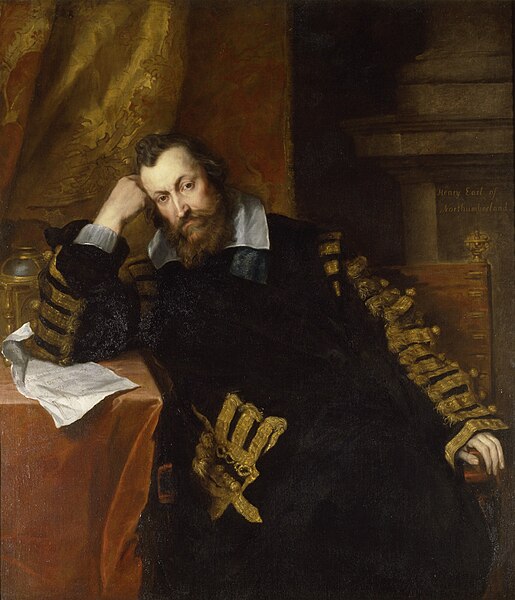
Earl of Northumberland
From relatively early on Cecil was aware of the plotting and he planned to use it to ensure that he remained essential to James, to crush Jesuit activity in England and to bring down the Earl of Northumberland[xxiv], a Catholic sympathiser[xxv].
The plot was organised by the charismatic Robert Catesby, who decided that the best way to rid the world of the moderate James was to blow up parliament when it met. James was to be replaced by his infant daughter Elizabeth. Catesby’s tool, the not so bright Guido Fawkes,  was tasked with the mechanics of the projected explosion.

The anonymous note sent to Lord Monteagle, warning him to stay away from the opening of parliament, was probably written at Cecil’s direction by forger Thomas Phelippes[xxvi]. The search of the undercroft at the palace of Westminster produced Guido Fawkes.
Lord Mounteagle
James reaction to the plot was one of a man who in youth had worn padded doublets to foil an assassin’s knife; he compared this plot with the Gowrie conspiracy;
‘I may justly compare these two great and fearful doomsdays[xxvii] werewith God threatened to destroy me…….thereby to teach me that it was the same devil that still persecuted me, so it was one and the same God that still mightily delivered me.’[xxviii]
Once James had calmed down he demanded an Oath of Allegiance, which required that all Catholics who attended Anglican services should also take the sacrament. But he was more interested in the power secular and that the Catholics should recognise him as their sovereign and repudiate the right of the Pope to depose heretical monarchs.

Bibliography

The Early Stuarts – Godfrey Davies, Oxford University Press 1987
The Gunpowder Plot – Antonia Fraser, BCA 1996

King James – Antonia Fraser, BCA 1974
Robert Cecil – Alan Haynes, Peter Owen Publishers 1989

After Elizabeth – Leanda de Lisle, Harper Perennial 2006
www.wikipedia.en


[i] After Elizabeth – de Lisle
[ii] Younger brother of the Duke of Norfolk executed in 1572
[iii] Leader of the English Catholics
[iv] Arbella Stuart’s uncle
[v] An enemy of Shrewsbury following a dispute over river rights on the Trent
[vi] King James - Fraser
[vii] King James - Fraser
[viii] Ibid
[ix] Son of James’ reputed lover Esmé Stuart
[x] Allegedly signed by 1,000 members of the clergy
[xi] Possibly at the home of Oliver Cromwell, uncle of the Cromwell who was to become Lord Protector of England
[xii] The following year he was made Viscount Cranborne and in 1605 was made Earl of Salisbury
[xiii] Made Earl of Northampton the following year
[xiv] Cecil’s brother-in-law
[xv] Involved in the Bye plot
[xvi] After Elizabeth – de Lisle
[xvii] Both Jesuits; Garnet was a major player in the Gunpowder Plot
[xviii] Archpriest of England; he died in 1613 in the Clink
[xx] Which stayed in use in Anglican churches until the 1960s when it was replaced by the New English Bible
[xxi] King James - Fraser
[xxii] Formerly Bishop of London
[xxiii] Robert Cecil - Haynes
[xxiv] The aristocratic Henry Percy looked down on the nouveau riche Cecil; suspected of being a plotter Percy was imprisoned in the Tower for 17 years and was fined £30,000, to compare the value of a £30,000 0s 0d Income or Wealth , in 2011 the relative historic standard of living value of that income or wealth is £5,404,000.00 economic status value of that income or wealth is £156,800,000.00 economic power value of that income or wealth is £1,124,000,000.00 www.measuringworth.com  
[xxv] It was fairly standard practise in Elizabethan times for the government to assist plotters on to their destruction
[xxvi] Spy, forger and cryptographer who worked on the Babington plot
[xxvii] Both taking place on Tuesday and the 5th of the month
[xxviii] King James - Fraser