Showing posts with label William of Orange. Show all posts

Wednesday, 1 January 2014

Peter the Great - What Peter Did Next


A Weakened Empire
Peter the Great
Encouraged by Augustus of Poland Czar Peter turned covetous eyes on the Baltic states[i], currently under Swedish dominion. Sweden was at the height of its imperial power but now, under the rule of an inexperienced adolescent, Sweden’s rivals sensed her vulnerabilities. The empire was over-extended and her Baltic provinces blocked Peter’s desired expansion to the Baltic. To Peter the lands bordering the Baltic’s eastern shores were Russian[ii], Karelia[iii] and Ingria[iv] had once come under Russian dominion.
Charles XI of Sweden and his ministers had been determined to crack down on their new province of Livonia[v] and in doing so created a bête noir; Johann Reinhold von Patkul was a Livonian noble, having pleaded with the Swedish King in vain

‘You have spoken like an honest man for your fatherland. I thank you.’[vi]
With the death of Charles on 5th April 1697 Patkul determined to remove Livonia from the claws of Sweden. In October 1698 he arrived in Warsaw in an attempt to persuade Augustus to join an anti-Swedish alliance.

Johann Patkul
Patkul had already met with Frederick IV, King of Denmark, who was willing to join the fray[vii]. Augustus hoped to turn his position of elected King of Poland into a hereditary position. To that end he wanted to take back Livonia from the Swedes, as a bribe to the Polish nobility. Patkul suggested that Austria, France, England and the Netherlands would do little more than protest; telling Augustus that conquering Livonia would be easy, he passed over details of the fortifications of Riga.
A joint offensive treaty between Poland and Denmark was signed. Denmark was to clear Schleswig and Holstein of Swedish troops, before mounting an attack on Scania. By January or February 1700 Augustus was to be ready to attack Riga. At this point Patkul suggested involving the Russians, who could attack Ingria, providing further distractions for the Swedes. Patkul accompanied an embassy from Augustus to Russia.

The Swedish king Charles XII sent a rival embassy to Russia; Peter met with both embassies and agreed with the Swedes to confirm treaties of peace between the two countries. Three days after the Swedish embassy’s departure Peter agreed to make war on Sweden, but only after the signing of a Russo-Turkish amnesty or peace treaty.
The War in the North
To meet his promises to Augustus Peter had to mobilise, train and equip an army within three months. A decree was issued to all clerical and civil landowners[viii] and volunteers were called for. Peter deeply felt the loss of General Gordon[ix], who died in November 1699. This was the second death of an old friend; Lefort had died in the previous March. Peter placed himself in charge of the training. In charge of the army he placed three Russians[x] all the regimental commanders were foreigners.

In February 1700 war was launched on Sweden without any formal declaration; 14,000 Saxon troops invaded Livonia and laid siege to Riga. The commanding general was killed; Peter, in Voronezh preparing for a possible further outbreak of war with the Turks, was disgusted with his ally.
‘The King…..should have been Livonia leading his troops himself instead of “diverting himself with women” in Saxony.’[xi]
Frederick of Denmark
In March Frederick of Denmark attacked Holstein[xii], besieging Tönning. His allies wanted Peter to attack Ingria, but as Peter said
‘It is a pity, but there is nothing to be done. I have not heard from Constantinople.’[xiii]
The rumours that the Turks were preparing for war again led Peter to rekindle good relations with Sweden. Throughout the spring these rumours proliferated, but on 8th August the news was finally received in Moscow; the Sublime Porte had signed a thirty year armistice on 3rd July. The following day Peter declared war on Sweden.

The Alliance of Poland, Denmark and Russia
Charles XII of Sweden, although young was determined to rid his empire of the invaders;

‘It is curious that both my cousins, Frederick and Augustus, wish to make war on me. So be it. But King Augustus has broken his word. Our cause then, is just, and God will help us.’[xiv]
Sweden was a powerful military power, but her enemies viewed Charles’ youth as a major weakness. Charles was not distracted by having two opponents in the first instance. His strategy was to deal with one and then the other.

Charles XII was supported by the major Protestant sea powers in Europe, England and the Netherlands; King William was implacably opposed to any change in the European status quo that might advantage Louis XIV of France. He also did not want his fellow sovereigns to be distracted by a war in northern Europe.
‘This reason has long engaged the English and Dutch, as much as possible, to hold the balance even between the Princes of the north. They joined themselves to the young King of Sweden, who seemed ready to be swallowed up by so many enemies.’[xv]
The Swedish navy of 38 ships and 12 frigates controlled the Baltic; but the open seas were controlled by the Danish-Norwegian navy. To gain access to the North Sea and the Atlantic Ocean required a joint action by the Swedes and the Anglo-Dutch squadron sent by William.

By June the combined allied navy of sixty ships were ready to meet the forty strong Danish-Norwegian navy. The Danes were unwilling to risk their navy with these odds and Charles was free to ferry his army across to Zealand and attack the Danes on their home ground.
In early July a force of 4,000 Swedes were landed on the island and within a further ten days a force of 10,000 were established. The outnumbered Danish forces withdrew into Copenhagen. Frederick IV hurried back from Holstein to find himself forced to come to terms.

‘The King of Sweden would not suffer the artifice of the ministers to draw out the negotiations into any length; he would have the treaty finished with as much rapidity as he made his descent into Zealand.’[xvi]
Narva

The Treaty of Travendal was signed on 18th August 1700; the Danes were required to leave the anti-Swedish alliance and return Holstein to its duke. Charles was now free to turn his attentions on the Poles in Latavia.
Peter’s attack on the Baltic provinces focussed on Ingria and Karelia. The news of his proposed line of attack was not received with pleasure by his allies.
‘We found him [Peter] so stubborn that we feared to touch anymore on such a delicate subject and must be satisfied with the Tsar’s break in the hope that in time Narva will be in our hands.’[xvii]
By mid-September the governor of Novgorod had received orders to march on Narva and invest it with a force of 8,000 men. Command of the army was given to Golovin[xviii]; by 4th October his troops before Narva totalled 35,000 men. The army suffered from supply problems, being over one hundred miles from the nearest Russian town.

Golovin
By the end of November the artillery bombardment of the town was temporarily ceased for lack of ammunition. Augustus had gone into winter quarters and news arrived in the Russian camp that Charles XII had landed Swedish troops on the coast, 150 miles from Narva.
Charles had withdrawn his troops from Zealand; the protection of the Anglo-Dutch squadron had been withdrawn. The hazardous trip across the Baltic was enlivened by a storm that crippled ships and cavalry horses. Nevertheless Charles had his army en route for Narva by 13th November.

Eighteen miles west of Narva General Sheremetev waited with 5,000 horse. Charles positioned his artillery and charged. Sheremetev’s men, lacking artillery retreated, under orders from Peter not to engage with the Swedish army.
Sheremetev’s troops pursued a scorched land policy in their planned retreat. Overnight on 17th-18th November Peter passed command of his army to the Duc du Croy[xix], and with Golovin left for Novgorod to speed up reinforcements and demand of Augustus why he was not prosecuting the fight during the winter[xx]. Peter, used to the leisurely speed that Russian armies conducted war, did not believe that Charles would act precipitately.
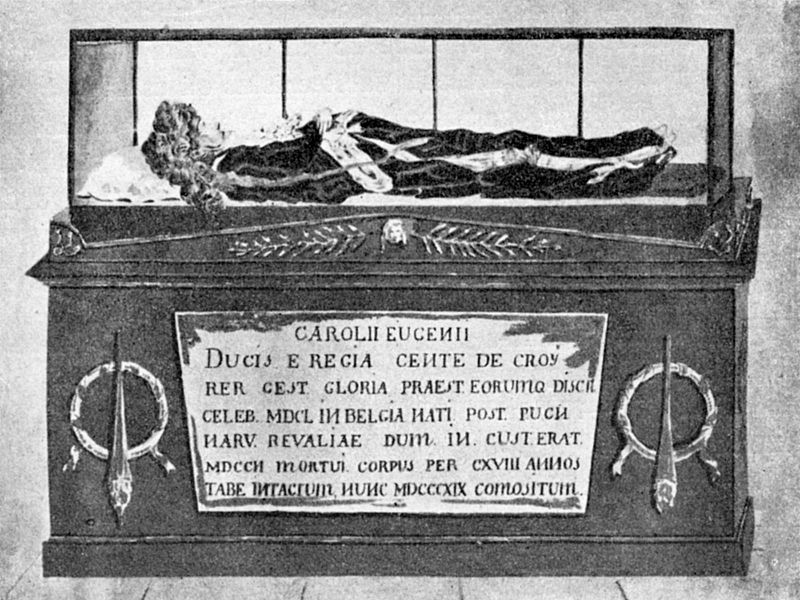
Tomb of the Duc du Croy
But Charles was a man with a mission, to save Narva. Du Croy was in an unfortunate position; he did not speak Russian and he did not know the disposition of the troops. On 20th November Charles took advantage of a storm that blew up; snow was blowing into the Russian lines. He attacked against an enemy blinded by the snow. The Russian lines before Narva fell like ninepins; all save six Russian battalions, including the Preobrahensky and the Semyonovsky guards.
Most of the foreign officers, including du Croy, surrendered and were sent to Reval along with Peter’s personal physician and Peter Lefort, the nephew of Peter’s old friend. They were to remain there for a very long time[xxi].

‘But at last their generals Dolhorouky, Gollouin, and Fedorwitz surrendered themselves to the King, and laid their arms at his majesty’s feet. And in the instant they were offering them, came up the Duke of Croy the general of the army, to surrender himself with thirty officers.’[xxii]
The small exhausted Swedish army had defeated an army much greater in size than their own. For Peter it was a huge disgrace. Charles struck a medallion showing his enemy running away from the battle, which caused much amusement across Europe. The battle instilled in Charles a belief in himself and his invincibility and an undeserved contempt for Peter that was to be the cause of his undoing.

Bibliography
Natasha’s Dance – Orlando Figes, Penguin Books Ltd 2002

Russia and the Russians – Geoffrey Hosking, The Penguin Press 2001
Peter the Great – Robert K Massie, Abacus 1992

The History of Charles XII of Sweden – Mr de Voltaire, C Davis & A Lyon 1732
www.wikipedia.en


[i] Now Estonia, Latvia and Lithuania
[ii] Russian hero Alexander Nevsky had beaten the Swedes at the Neva river in 1240.
[iii] North of Lake Ladoga
[iv] At the eastern end of the Gulf of Finland
[v] The Protestants of Livonia had been subject to the domination of Catholic Poland and in 1660 Livonia had transferred to Sweden. The new king now demanded the return of lands parcelled out to the nobility (reduction), in an attempt to centralise power in the hands of the monarchy. Despite a prior promise to the Livonians that the policy of reduction would not apply to them, the Livonian nobility were now to be dispossessed
[vi] Peter the Great - Massie
[vii] The Danes had never accepted the loss of land inflicted upon them by Gustavus Adolphus
[viii] One serf per 50 households for civil landowners and one serf per 25 households for clerical landowners
[ix] Peter had sat beside his friend as he died
[x] Golovin, Weide and Repnin
[xi] Peter the Great - Massie
[xii] Ruled by the King of Sweden’s brother-in-law
[xiii] Peter the Great - Massie
[xiv] Ibid
[xv] The History of Charles XII - Voltaire
[xvi] Ibid
[xvii] Peter the Great - Massie
[xviii] One of the ambassadors on the Great Embassy
[xix] An observer for King Augustus
[xx] Not normally a season for fighting
[xxi] Du Croy died in captivity, and due to the fact that he was in debt, his creditors would not allow him to be buried.
[xxii] The History of Charles XII - Voltaire

Tuesday, 22 October 2013

A Female Soldier - Mother Ross

Supporting King James


Battle of the Boyne
When James II was driven out of England, following the Glorious Revolution he took his cause to Ireland, supported by the troops and cash of the king of France, Louis XIV. Many of his former subjects rallied to the cause, among them the father of one Christian Cavanagh.
‘The Battle of the Boyne put an end to all my father’s hopes for King James; for his army was there defeated, and he, with the rest of the shattered troops, trusted their safety to the swiftness of their horses’ heels, rather than to the strength of their own arms.’[i]
For his support of the former king, the Cavanagh family lost all their not inconsiderable property[ii]. Christian refused an offer from her mother’s first cousin, informing him that he could do better than marry a penniless woman. But Christian inherited a public house in Dublin from an aunt and was able to run the business prosperously. She attracted the attention of one of her servants, a Richard Welsh, who was able to successfully press his suit upon his mistress.
The Loss of a Husband
According to Christian the Welsh’s lived happily together for four years, having two children and another on the way. Richard Welsh then disappeared one night with 50 livres[iii] in his pocket. His wife assumed that he was dead and the money stolen.
It was a year later that Christian received a letter from Richard, claiming that he had been carried off and gotten drunk by a friend, Ensign C-m. He had found himself on a recruiting vessel, ready to take fresh fodder to fight in King William’s wars on the continent.
‘I was not sensible of what was doing upon deck. In the interim, the wind sprung up fair, the captain set sail with what recruits were on board, and we had so quick a passage, that we reached Helvoet Sluys[iv], before I had recovered from the effects of the liquor.’[v]
Richard, finding himself penniless in a foreign land, had been forced to sign up to fight in the English army, now involved in the Nine Years War against the expansionist policies of Louis XIV.
A Trip to the Continent
Christian Welsh aka Christopher Welsh
Being slender and of a similar size to her husband Christian decided to dress in one of her husband’s suits and make her way to the continent to be re-united with her husband. Her two elder children were left in the care of her mother and the youngest was placed with a nurse.
‘I cut off my hair, and dressed me in a suit of my husband’s, having taken the precaution to quilt the waistcoat, to preserve my breasts from hurt, which were not large enough to betray my sex.’[vi]
Christian informed the recruiting officer that her name was Christopher Welsh and she was enlisted in Captain Tichbourne’s company of foot.
One of Christian’s first duties, upon arrival in Holland, was to stand guard at the door of the Elector of Hanover. Shortly thereafter Christian was involved in the fighting at the Battle of Landen, on 29th July 1693. The Allied army was forced into retreat; Christian was wounded before the fighting began and it took two months to recover from the graze from a musket ball.
Duke of Berwick
During the summer of 1694 Christian was taken prisoner during a foraging expedition. The former Queen Mary arranged for the English prisoners to be well treated and given an allowance, food and drink. The prisoners were visited by the Duke of Berwick[vii], who tried to persuade them to swap sides and fight for the French.
After nine days Christian was freed in an exchange of prisoners; she had considered the possibility of declaring herself to her cousin, Captain Cavanagh who was fighting for the French and visited the prison on a number of occasions. Believing that discovery of her identity would hamper her search for her husband, Christian did not approach her cousin, who did not recognise her amongst the prisoners.
The Duel
The winter of 1694-5 was spent at Gorcum[viii], and Christian paid court to a burgher’s daughter. She later came to regret this masquerade as the poor girl fell in love, seeing Christian as a potential husband. A sergeant of the same regiment also had designs on the poor girl and attempted to rape her.
The young woman asked Christian to avenge her honour and the sergeant and Christian set to. Christian wounded her superior.
‘The first thrust I made, gave him a slight wound in his right pap, which had well-nigh done his business. He returned this with a long gash on my right arm…..but before he could recover his guard, I gave him a thrust in the right thigh, about half a span from the pope’s eye.’[ix]
When the duel was stopped Christian was taken off to prison. She passed a message on to the burgher, whose daughter’s honour she had been defending. Within four days the burgher managed to get a pardon from King William and Christian was discharged from the regiment.
La Fille du Regiment
Lord John Hays
Almost immediately Christian re-enlisted into Lord John Hays’ regiment of Dragoons. When the army broke winter quarters Christian’s regiment was sent to fight at the Siege of Namur. King William invested the town, but not before Marshal Duc de Boufflers had quartered himself and seven regiments in the town[x], which capitulated on the 1st September 1695.  
Duc de Villeroy
In attempt to divert William from Namur the French, under Marshal Duc de Villeroy, had bombarded Brussels to no avail. The Namur garrison marched out on 5th September;
‘The garrison, which still consisted of five thousand one hundred and sixty eight men, marched out at the breach, with drums beating, matches lighted, colours flying, six pieces of cannon and two mortars, through a lane of thirty battalions of our troops.’[xi]
 
 
Seige of Namur
During the siege of Namur the French had captured the towns of Diense and Dixmunde and had refused to ransom the garrisons. In return Boufflers was arrested, his incarceration was short as Louis agreed to release the two garrisons in return for Boufflers’ release.
Christian’s regiment went into winter quarters at the Boss where, when visiting a brothel with fellow officers, she was approached by one of the denizens of the house[xii]. When Christian refused to have sex with her, the female had her revenge by claiming, having given birth a short time later, that she the child was Christian’s. Rather than expose the impossibility of this claim Christian agreed to fund the baby, which died within a month of being born.
It does not appear that Christian was involved in any fighting after that and, following the Peace of Ryswick signed on 20th September 1697, she was discharged and returned to Dublin, still dressed in male garb. Arriving home Christian discovered that, having been absent a lot longer than planned, she owed the nurse looking after her youngest child a lot of money that she did not have. In the circumstances, having ascertained that the family were well, Christian decided not to reveal herself.
Back to War
Christian took a job in Dublin, while husbanding what capital she had. When the English joined the War of the Spanish Succession in May 1702[xiii], Christian again joined up to fight. William III had recognised Louis XIV’s grandson Philip as the new king of Spain, but Louis’ ambitions went beyond a Bourbon hegemony in France and Spain and this was unacceptable to the English.
Queen Anne
William’s death[xiv] in March 1702 did not stop the English fears of France overrunning the whole of continental Europe. Queen Anne’s ministers Sidney Godolphin and James Churchill, Earl of Marlborough[xv], were able to persuade her to declare war. Churchill was given command of the joint Anglo-Dutch army, beating the claims of many rivals.
‘As the only general who could command the respect of them all, Marlborough was given command of the British, Dutch and hired German forces of the Grand Alliance at a salary of £10,000[xvi] a year.’[xvii]
Although relatively inexperienced[xviii], he was the husband of his monarch’s bosom friend Sarah Churchill. It was fortunate for his country that he turned out to be one of England’s most successful generals.
Duc de Boufflers
Christian Davies joined her old regiment, Lord John Hays’ dragoons. She was involved in the battle of Nijmegen. The fighting covered the retreat of the Dutch army, following an attack by Boufflers’ troops. Christian was among a number of dragoons who put to rout a superior force of French cavalry.
‘We….put them to the run, with a considerable loss on their, and very little on our, side. I had here the good fortune, though in the thickest of the engagement, to escape without hurt, and to be taken notice of by the officers.’[xix]
A detachment of troops besieged Venlo, which capitulated on 23rd September. The French were pushed back to Maastricht; the Allies appearing before the town of Liege on 14th October and carried the attack on 23rd. Christian picked up some booty in the sack of the citadel.
‘I got but little of the plunder……a large silver chalice, and some other pieces of plate, which I afterwards sold to a Dutch Jew for a third part of their value.’[xx]
The troops were quartered at Venlo and Christian was one of those chosen to escort the Earl of Marlborough along the banks of the Maas. During the march the soldiers took possession of five pigs and Christian got into altercation with a Corporal Taylor over one of them. He struck at her with a knife and cut the sinews of her little finger, while she hit him with her pistol, knocking out one of his eyes.
While in winter quarters Christian recommenced her somewhat dilatory search for her husband, but of him she found no trace.
Bibliography
Mother Ross – Daniel Defoe, Oakpast Ltd 2011
Queen Anne – Edward Gregg, Routledge and Kegan Paul 1980
The Marlboroughs – Christopher Hibbert, Penguin Books 2002
Marlborough – Richard Holmes, Harper Perennial 2009
Marlborough – JR Jones, Cambridge University Press 1993
William and Mary – John van der Kiste, Sutton Publishing 2003
William and Mary – Henri and Barbara van der Zee, The History Book Club 1973


[i] Mother Ross - Defoe
[ii] Mr Cavanagh had been a maltster and brewer, employing twenty servants
[iii] To pay for the beer purchased for the public house
[iv] In the province of South Holland
[v] Mother Ross – Defoe
[vi] Ibid
[vii] James II’s illegitimate son by Arabella Churchill, the sister of the Duke of Marlborough
[viii] In the province of South Holland
[ix] Mother Ross – Daniel Defoe
[x] Bringing the total of defenders to 14,000
[xi] Mother Ross- Daniel Defoe
[xii] Who was in the later stages of pregnancy
[xiii] The war between France and the majority of the continent commenced in July 1701 when Prince Eugene of Savoy, leading the Austrian forces, invaded the Duchy of Milan
[xiv] Queen Mary died in December 1694
[xv] Churchill was made Duke of Marlborough in December 1702
[xvi] In 2011 worth £1,340,000.00 using the retail price index or £18,500,000.00 using average earnings www.measuringworth.com
[xvii] The Marlboroughs - Hibbert
[xviii] He had never commanded a large army in the field
[xix] Mother Ross – Daniel Defoe
[xx] Ibid