|
| Philip the Bold |
Family
Philip was
prone to wearing gorgeous outfits, often in an attempt to outshine his brother
the Duke of Berry, but also for political purposes. Philip’s hats were decked
with feathers from ostriches, pheasants and one with feathers reputed to come
from a bird from far off India.
Like Berry
Philip was a passionate collector and was a dedicated hunter, moving from
estate to estate, often sleeping outdoors. He also played tennis and was in
addition a prolific traveller who frequently went on pilgrimages, taking a
portable reliquary and rosary with him at all times.
Philip and
Marguerite had nine children;
- John the Fearless born on 28th May
1371, was made Count of Nevers[i] in 1384
- Charles born in 1372[ii]
- Marguerite of Burgundy born in October 1374
- Louis born in 1377[iii]
- Catherine of Burgundy was born in April 1378 at Montbard
- Bonne born in 1379 at
Arras
- Antoine, Duke of Brabant born in August 1384[iv]
- Mary of Burgundy born in September 1386 at Dijon[v]
- Philip Count of Rethel[vi] born at Villaines-en-Duesmois in October 1389
Marguerite bore at least another two children of whom
there are no records.
Talk the Talk, Walk the Walk
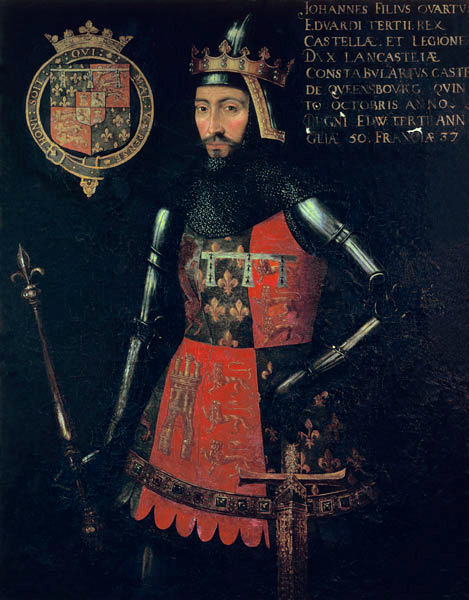 |
| John of Gaunt |
From 1375-7 there
was a series of on-off peace conferences between the French and English at
Bruges, conducted with great magnificence and at great expense by John of
Gaunt, Philip[vii]
and numerous cardinals acting as mediators.
‘When the feast of All-Saints was
drawing near, the duke of Burgundy, the count de Saltzbourg,
the bishops of Amiens,
and of Bayeux,
came to Bruges by orders of the king of France, to hold a conference.’[viii]
To avoid the
1375 meetings from being a complete waste of time and money a one year truce
was agreed. The parties never came to a permanent agreement as Edward was
determined to keep sovereignty of the Plantagenet possessions in France and
Charles V was equally determined to regain sovereignty over Guyennne[ix]. The truce resulted in
the free companies taking out their angst once again on the French countryside.
Enguerrand de Coucy was ordered by Charles to deal with
the pests.
 |
| de Coucy arms |
Once he had
undertaken this commission he was given another; having feet in both camps and
torn between the two[x], de Coucy was sent on an
embassy to London in an attempt to extend the temporary truce. According to
Froissart;
‘He [de Coucy] was regarded
as one of the wisest and prudent of nobles….in whom one could not want more of all
good and all loyalty.’[xi]
De Coucy
arrived in England to find the Black Prince dying and his father in his dotage.
John of Gaunt had taken over the running of the country and popular opinion was
resentful of corrupt royal officials, the war which was dragging on to no end,
military mismanagement and the wasting and embezzlement of tax monies. It was
now England’s turn to suffer; soldiers returning from the war were taking to
pillaging the countryside with a vengeance.
End of an Era
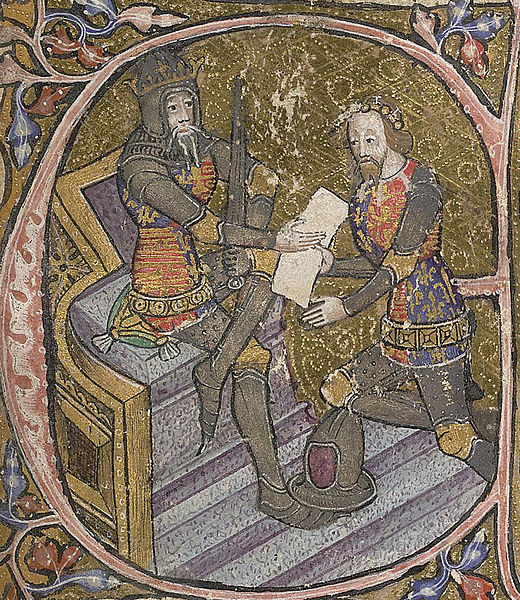 |
| Edward III & the Black Prince |
The Black
Prince died, at the age of forty-six, in June 1376 leaving his son Richard as his father’s heir.
‘In this year, on
Trinity-Sunday, that flower of English knighthood the lord Edward of England,
prince of Wales and of Aquitaine….His body was embalmed, placed in a leaden
coffin and kept until the ensuing Michaelmas, in order that he might be buried
with greater pomp and magnificence when the parliament assembled in London.’[xii]
He left
behind a country in turmoil. King Edward was being ruled by his mistress Alice Perrers who used her position to advance her circle of friends into
high positions, and she became Edward’s principal adviser on all matters
relating to the country. He finally died on 21st June 1377, leaving
behind his ten year old grandson to inherit his country and his war with
France.
 |
| Rye |
By 1377,
imitating Spanish maritime excellence, the French had created a navy that
dominated the English Channel. In that year the navy went so far
as to raid the English coast causing consternation among the enemy, so used to
going on the attack abroad. The raids followed the ending of yet another truce.
Admiral Jean de Vienne landed at Rye on 29th June and emulated the English savagery
imposed on French towns.
‘The French landed in Sussex
near the borders of Kent, in
a fairly large town on fishermen and sailors called Rye. They pillaged and
plundered it and burnt it completely.’[xiii]
The raids
continued down the coast attacking Folkestone, Weymouth, Portsmouth, Plymouth and Dartmouth. A month later the fleet returned to
overrun the Isle of Wight. One reason for the attacks, as well
as retaliation against English devastation of France, was to stop
reinforcements being sent to Calais.
Extending Influence
 |
| Margaret of Bavaria |
Both Louis
de Male and his son-in-law Philip were interested in extending their influence
across Europe; Philip used his children as pawns in marriage alliances as well
as gaining lands by treaty and military acquisition. Philip first turned to the
house of Hapsburg in 1377 to find husbands for his
daughters. He negotiated with the Wittelsbach princes Albert[xiv] and Leopold[xv].
Philip
arranged for Albert’s son William VI, Count of Holland and
Duke of Bavaria-Straubing to marry Margaret with a dowry of
100,000 francs[xvi].
In addition Margaret of Bavaria[xvii] was to marry John in a double
wedding that took place in Cambrai on 12th April 1385 and Philip splurged on a magnificent
wedding, borrowing jewels from his cousin Charles who graced the weddings with
his presence.
Philip
organised a great tournament in honour of the two young couples and provided a
thousand lances for the occasion. The liveries for his staff and court alone
cost 34,000 livres[xviii] and the prizes for the
tournament cost another 78,000[xix].
 |
| Leopold of Austria |
Catherine
was to marry Leopold of Austria[xx], son of Prince Leopold. The couple
didn’t marry until 1387 due to Catherine’s youth. The festivities stretched for
three days from 14th-17th September 1387. Her parents
kept her at home despite the marriage treaty allowing for her to live with her
in-laws; the marriage was not consummated until May 1392. Even then she did not
depart from her family until the following year when she was fifteen, taking
with her gifts from her family including a gold chess set, a present from her
sister Mary.
In 1382
Bonne was affianced to John, the Count of Clermont and son of the Duke of Bourbon, but she died before the wedding
could take place[xxi].
Bibliography
Chronicles –
Froissart, Penguin Books 1968
Europe:
Hierarchy and Revolt 1320-1450 – George Holmes, Fontana 1984
The Fourteenth
Century – May McKisack, Oxford University Press 1997
A Distant
Mirror – Barbara Tuchman, Papermac 1989
Philip the
Bold – Richard Vaughan, Boydell Press 2011
The Flower
of Chivalry – Richard Vernier, Boydell Press 2003
www.wikipedia.en
[i]
He ceded the title to his brother Philip when their father died
[ii]
Died at the age of two
[iii]
Died the following year
[vi]
Also died at Agincourt
[vii]
Who was paid 5,000 francs a month for his pains; In 2016 the relative: historic standard of
living value of that income or wealth
is £2,884,000.00, labour earnings of that
income or wealth is £34,210,000.00, economic status value of
that income or wealth is £96,040,000.00, economic power value of that income or wealth is £1,979,000,000.00 www.measuringworth.com
[ix]
His lawyers claimed that the yielding of sovereignty violated the oath of
homage given to the kings of France by the kings of England for their French
possessions
[x]
He was Edward’s son-in-law, bring married to Princess Isabella
when a hostage for King John. De Coucy had been given the earldom of Bedford.
Isabella was the apple of her father’s eye and was loath to live away from his
court
[xi]
A Distant Mirror - Tuchman
[xiii]
Chronicles - Froissart
[xvi]
In 2016
the relative: historic standard of living
value of that income or wealth is £76,410,000.00, labour earnings of that income or wealth is £702,600,000.00, economic status value of that income or wealth is £1,959,000,000.00, economic power value of that income or wealth is £41,270,000,000.00 www.measuringworth.com
[xvii]
Whose dowry was 200,000 francs while Philip gave his daughter no dowry at all.
Margaret of Bavaria’s dowry was worth the relative: historic standard of living
value of that income or wealth is £149,900,000.00, labour earnings of that income or wealth is £1,387,000,000.00, economic status value of that income or wealth is £3,842,000,000.00, economic power value of that income or wealth is £84,330,000,000.00 www.measuringworth.com
[xviii]
In 2016
the relative: historic standard of living
value of that income or wealth is £25,480,000.00, labour earnings of that income or wealth is £235,700,000.00, economic status value of that income or wealth is £653,100,000.00, economic power value of that income or wealth is £14,340,000,000.00 www.measuringworth.com
[xix]
In 2016
the relative: historic standard of living
value of that income or wealth is £58,460,000.00, labour earnings of that income or wealth is £540,800,000.00, economic status value of that income or wealth is £1,498,000,000.00, economic power value of that income or wealth is £32,890,000,000.00 www.measuringworth.com
[xx]
Leopold had originally been promised Margaret for his son, but he accepted the
substitution of Catherine
[xxi]
She died in 1399