|
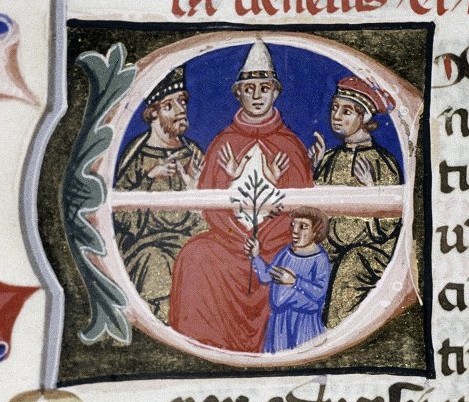
| York Minster |
Chancellor of England
Although
Bishop of Lincoln Geoffrey was still in minor orders and had not been
consecrated. Losing patience Pope Alexander decided that the current situation
could not continue and in 1181 he wrote to Henry demanding that Geoffrey be
consecrated straight away or made to resign. Geoffrey was not prepared to take
this step that would lock him into the church and wrote asking for a further
three years. Alexander refused.
Geoffrey and
Henry came to an agreement; if Geoffrey resigned his see his father would make
him Chancellor of England and be granted lands and office to
offset his lost clerical revenues. Geoffrey was granted the archdeaconry of
Rouen, the post of treasurer of York Cathedral and two castles in Anjou, giving him an income of £650 per annum[i].
Geoffrey
resigned the see of Lincoln on 6th January 1182. Geoffrey
was to remain Chancellor for the rest of his father’s reign, but his father’s
prodigious energy was failing; what was to follow was a long period of decline.
Rebellious Offspring
.jpg/640px-BnF_ms._12473_fol._160_-_Bertran_de_Born_(1).jpg) |
| Bertan de Born |
Henry was increasingly isolated by his legitimate children’s lust for
power. Henry the Young King was determined to inherit all his father’s lands;
on the other hand Richard was determined to have Aquitaine. He refused to pay
homage to his elder brother, arguing that they were equals. Richard decided to
strengthen his borders and built a castle at Clairvaux. Bertran de Born, a
minstrel, wrote a chanson;
‘Someone
has dared to build a fair castle at Clairvaux, in the midst of the plain.
I
should not wish the Young King to know about it or see it,
for
he would not find it to his liking;
.jpg) |
| The Young King |
Henry the Younger alleged that the new chateau encroached on territories
bound to Anjou. In February 1183 open
warfare broke out; Henry the Younger left for Aquitaine, ostensibly as a
mediator between Richard and his father. But when Henry travelled to Limoges he was
met by flights of arrows, one of which pierced his cloak. Henry the Younger,
along with Count
Aymer and other discontented rebels, claimed
the assault was a misunderstanding.
Henry the Younger was supported by his brother Geoffrey of Brittany who
organised a wholesale invasion of Poitou. The
French king Philip[iv] sent
assistance to the rebels, joining brigands provided by Aymer.
Henry was concerned that a general uprising would ensue and ordered the
arrest of any of his nobles in England likely to join his sons. Henry’s fears
were unfounded; none of his barons in England rose up and nor did Aquitaine,
although the county dissolved into general disorder.
Henry the Younger left Limoges to attack some of Richard’s more
vulnerable castles, after plundering the townsfolk and the shrine of St Martial of their
wealth to pay his mercenaries. Failing in his mission Henry the Younger
returned to Limoges where he was greeted with a hail of rocks. He retreated,
picked up dysentery and died at Martel on 11th
June 1183. He was buried at Rouen. Without the Young King the revolt faded
away; his supporters
‘Made
haste to go about their own business.’[v]
France Intervenes
 |
| Geoffrey of Brittany |
Henry tried to play his children off one against the other, but Philip put
his oar in, continuing to play Henry’s children off against their father. In
1186 Geoffrey of Brittany died after being unhorsed and trampled underfoot in a
tourney in Paris on 9th June; he succumbed to the resultant fever.
Geoffrey appears to have been plotting with Philip. He left behind a pregnant
wife. His posthumous son Arthur of Brittany[vi] was to be his heir. Geoffrey was
buried in Notre Dame;
‘With
but few regrets from his father, to whom he had been an unfaithful son, but
with sore grief to the French.’[vii]
King Philip apparently had to be restrained from throwing himself into
the grave. Instead he started working on the new heir apparent’s discontent. He
was fortunate in that Richard had built up a huge backlog of discontent with
the aid of his mother, whose darling he was.
Philip now demanded that Henry allow Richard to marry Alys[viii], Countess
of the Vexin. Alys, Philip’s half-sister, had been living in the English court
for twenty-five years[ix]. Richard had not pressed
for the marriage to take place. Rumour claimed that Henry had seduced Alys and
Richard seems to have believed the stories[x].
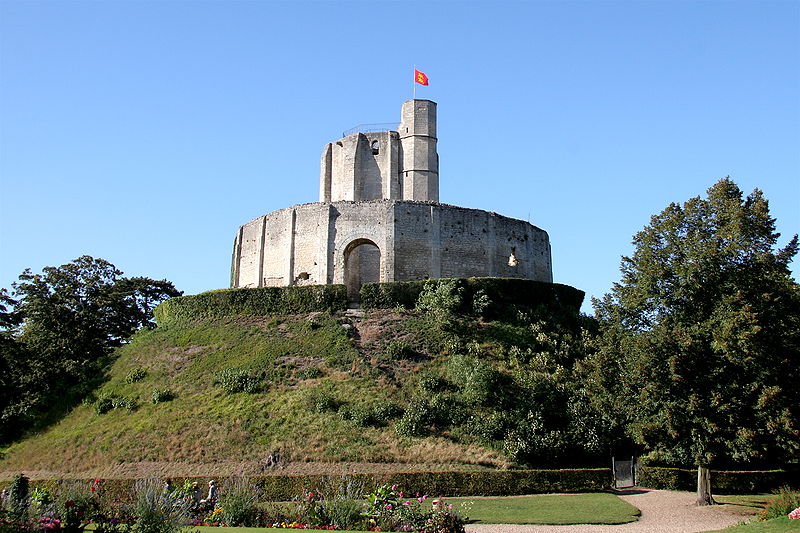 |
| Chateau de Gisors |
In 1187 the vexed question of the Vexin arose once again; Philip ordered
the building of a castle at Gisors, close to
Henry’s stronghold on the
border. Henry’s men rode out to stop the building and in the ensuing fight
killed the son of one of Philip’s sworn men. Two conferences held in the spring
kept the peace for a short while, but in the summer Philip invaded Berry. War
looked imminent but the papal legates intervened to stop the battle both sides
were preparing for.
Richard was persuaded to return to Paris with Philip and Richard offered
allegiance to Philip for all his father’s lands across the seas. The two men
became close;
‘Every
day they ate at the same table and from the same dish, and at night had not
separate chambers.[xi]’[xii]
Philip was not as successful at separating Richard from his father as he
had been with Geoffrey. Richard was intent on holding Aquitaine against all
comers and was rightly suspicious of Philip’s motives.
Death of a King
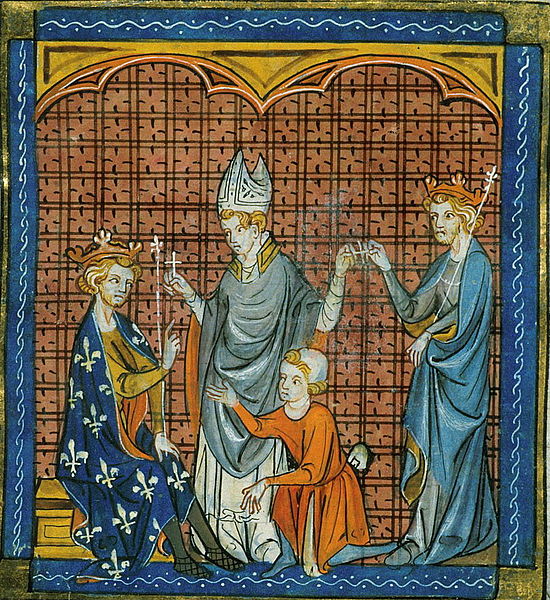 |
| Philip and Henry take the cross |
By 1189 Henry was feeling his years, an old man at the age of fifty-six
and at odds with the majority of his sons. Only base-born Geoffrey stayed true
to his father. Henry tried to keep Richard in check by playing him off against
John. He refused to confirm Richard as heir to the throne of England or to his
French dominions, holding over his head the threat of disinheriting him in
John’s favour.
A new crusade was announced and Richard was eager to win fame and
fortune by the force of his arms. To do so, Richard needed to sort out the
succession issues before he departed for Outremer. Philip too was eager to go
on crusade.
The war between Henry and Philip was renewed; Geoffrey acted as his
father’s chief of staff in this last campaign. Henry sent him to secure his
castles in France and then Geoffrey made for Normandy to alert the garrisons
there.
Henry made for Le Mans, by the
time he arrived he was facing disaster. His troops set fire to the suburbs and
the flames spread into the town itself. Henry was forced to retreat, and
Richard and Philip took his baggage train and followed this up by taking Le
Mans and then Tours.
 |
| Chateau de Chinon |
Henry made for his castle at Chinon, but was forced to meet his enemies
for a conference at Ballon. Henry
was so ill he nearly fell from his horse. He was forced to accept humiliating
terms from Philip; he would hand over Alys, Philip would retain his conquests
in Berry and the
Auvergne and Henry would pay 20,000 marks in compensation. Henry was helpless
and raged at Richard;
‘God
spare me until I may be revenged upon you!’[xiii]
Most of Henry’s barons had deserted to the winning side, including John,
Henry’s favourite legitimate son.
Henry returned to Chinon and seems to have suffered a stroke upon
reading the lists of those who had changed sides. His faced changed colour and
his speech was unintelligible. Only Geoffrey was at his father’s deathbed when
on 6th July 1189 Henry was carried on a litter into the castle
chapel where he suffered a further stroke and died.
Henry’s belongings were stolen by the servants and his corpse was left
dressed only in a shirt and breeches. The new king left Geoffrey to arrange Henry’s
funeral; he was buried at Fontrevault Abbey. Unlike
his half-brothers Geoffrey was devastated by the loss of his father and
protector.
Bibliography
Philip
Augustus – Jim Bradbury, Longman 1998
King John –
Stephen Church, MacMillan 2013
Early
Medieval England – MT Clanchy, The Folio Society 1997
Richard the
Lionheart – John Gillingham, George Weidenfeld and Nicholson 1989
The Royal
Bastards of Medieval England – Chris Given- Wilson and Alice Curteis, Barnes
& Noble Books 1995
The
Plantagenets – Dan Jones, William Collins 2012
Henry II –
WL Warren, Yale University Press 2000
King John –
WL Warren, Yale University Press 1997
Eleanor of
Aquitaine – Alison Weir, Jonathan Cape 1999
The
Plantagenets – Derek Wilson, Quercus Editions Ltd 2014
www.wikipedia.en
[i]
Comparisons of wealth are not calculated for before the year 1270, but if
Geoffrey’s income had been granted in that year, not 1181 then the relative
worth in 2014 would have been; historic standard of living value of that income or wealth is £555,500.00 labour earnings of that income or wealth is
£9,800,000.00 economic status value of that income or wealth is £23,220,000.00 economic power value of that income or
wealth is £189,300,000.00 www.measuringworth.com
[iii]
Henry II - Warren
[iv]
Junior king of France from November 1179 and Senior king from 18th
September 1180
[v]
Henry II - Warren
[vi]
King Philip immediately claimed Arthur as his ward, but Henry refused to allow
this
[vii]
Eleanor of Aquitaine - Weir
[viii]
One of Louis VII’s children by his second wife
[ix]
Following an agreement in January 1169 between Louis and Henry that Alys would
marry Richard
[x]
While on crusade he claimed that Henry had fathered a bastard on Alys
[xi]
It has been alleged that Richard was homosexual, this comment from Richard of
Howden being taken as evidence in the theory’s favour
[xii]
Philip Augustus - Bradbury
[xiii]
The Royal Bastards – Given-Wilson & Curteis



.png/603px-William_I%2C_King_of_Scots_(seal_01).png)