Showing posts with label Queen Isabella. Show all posts

Tuesday, 17 November 2015

Renaissance Europe - Juana la Loca III


Juana
A Meeting in Blois

In April 1501 Philip sent ambassadors to Paris proposing the marriage between Charles and the Princess Claude, only child of Louis XII. The proposal was made without his mother’s agreement[i]. The marriage contract between Claude and Charles was signed at Lyon, on 10th August 1501, by Philip’s ambassadors François de Busleyden, Archbishop of Besançon, William de Croÿ, Nicolas de Rutter and Pierre Lesseman. A part of the contract promised Claude’s inheritance of Brittany to Charles. The first Treaty of Blois, signed in 1504, gave Claude an considerable dowry besides Brittany in the all too likely event of Louis XII's death without male heirs:.

In November Philip, Juana and a large part of the Burgundian court travelled to Spain for Juana to receive fealty from the Cortes of Castile as Princess of Asturias, heiress to the Castilian throne. The children stayed with their aunt the Archduchess Margaret at her court at Mechelen, where they were being brought up.

Philip insisted on travelling by land through France, the hated enemy of Spain, in part to annoy his father-in-law. But Philip’s main reason was to meet with Louis XII
at the Château de Blois. Louis greeted Philip

‘As his own brother and entertained him and his wife for five days with jousts, tournaments and other good cheer.’[ii]

The two princes ratified the Treaty of Trent Throughout the journey Juana insisted on wearing Spanish costume and refused to acknowledge the Queen of France, Anne of Brittany, as an equal[iii].

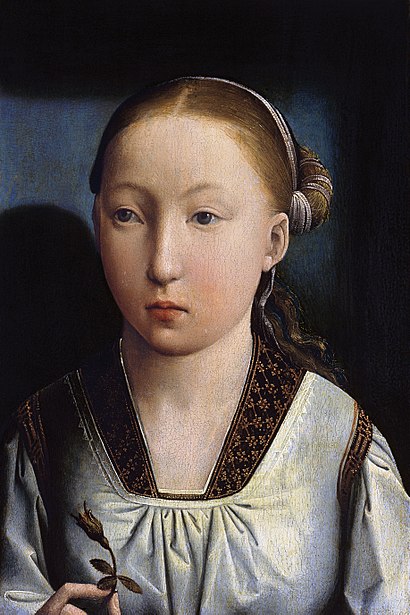
Princess of the Asturias

Philip, Duke of Burgundy
On the couple’s arrival in Spain Ferdinand and Isabella found themselves disappointed in their son-in-law. Philip was personally ambitious, greedy and very pro-French. He had no intention of being just Juana’s husband, sitting back while she ruled Spain. Philip had every intention of ruling Spain himself; Isabella doubted whether Juana would be able to assert herself to counter Philip’s intentions.

Accordingly Isabella pressed for Philip and Juana to stay in Spain for a longer period, to help mould the couple in the best interests of Spain. Isabella hoped to instill in Juana the rules of good governance and to introduce Philip to the customs of Spain.

Philip had no intention of staying in Spain one second longer than he had to. Ignoring the pleas of his wife and mother-in-law, Philip and the majority of the Burgundian court returned to the Low Countries late in the year, leaving a pregnant and distraught Juana behind, on the grounds that the journey would be too dangerous for her to undertake. Philip was bored, he disliked Spain and he disagreed with his father-in-law’s policy towards France.

Juana gave birth to her and Philip's fourth child, Ferdinand in Madrid on 10th March 1503. Ferdinand was to stay in Spain and was brought up by his grandparents, not meeting his elder brother until 1518.

The Madness

La Mota castle
Philip wanted his wife back under his control and Juana too wanted to return to Burgundy. Isabella hoped to delay Juana’s return to her domineering husband and claimed that travel back to Brussels was impossible as Spain was at war with France.

Juana lost control of herself and was hysterical and violent in an attempt to persuade her mother to let her return to Burgundy. One night she fled from the castle in Medina del Campo[iv] in her nightdress. She stayed outside for over 24 hours in the driving rain before her mother was able to persuade Juana to enter the palace.

Isabella was in her fifties and ailing; she could not stand against Jauna’s indomitable will. It was hastily agreed that Juana would return to Burgundy. But the damage was done; Juana’s reputation would never recover; following these antics from henceforth she was to be known as Juana la Loca.

By May Juana was back in Burgundy, but Philip was unwelcoming, having found consolation elsewhere. Juana responded with a repeat of the behaviour that had been rewarded by her mother. But Philip was not in his fifties and ill and was easily able to ignore Juana’s tantrums, which only played into Philip’s hands[v]. Juana physically attacked with scissors the woman she believed had supplanted herself in Philip’s affections, only adding to the detrimental rumours circulating about her.

As a young woman, Juana was known to be highly intelligent. It was only after her marriage to Philip that the first suspicions of mental illness arose. One reason for this may be due to the sympathy she showed for Martin Luther's ideas. By now Philip and Juana were mostly living apart and Philip, with his eyes on the throne of Castile, had every reason to have his wife considered insane.

Death of a Queen

Isabella at prayer, Capilla Real
On 26th November 1504 Queen Isabella died, leaving Juana to rule in her place at her father’s side. Isabella had been concerned that Philip might exclude Juana from exercising her rights; Philip had no interest in governing Spain in the interests of the Spanish people[vi]. Ferdinand immediately announced that he was renouncing his title as King of Castile in favour of Juana and Philip and wrote to them asking;

‘’To come to Spain, in order to take upon themselves the government of Castile,’[vii]

which was the last thing he actually wanted. Juana attended requiem masses for her mother’s soul, unaware of the pitfalls that lay ahead. Her father was determined to keep control of her kingdom just as her husband was determined to wrest control from herself.


Philip was assiduously circulating rumours of Juana’s madness; he was not assisted by Juana’s public performances of the perfect Archduchess. After a visit by Maximilian in 1505 the Venetian Ambassador reported that;

‘Her bearing [was] that of a sensible and discreet woman.’[viii]

Philip & Juana's children
Mary, Juana and Philip’s penultimate child was born in Brussels on 15th September 1505. The birth was very difficult; Juana’s life was endangered and it took her a month to recover. On 20 September, Mary was baptized by Nicolas Le Ruistre, Bishop of Arras, and named after her paternal grandmother, Mary of Burgundy, who died in 1482. Her godfather was her paternal grandfather, Maximilian.

Political Shenanigans

Henry, Prince of Wales
In October 1505 Henry VII started negotiations with Philip to marry Prince Henry, still embroiled in the on-off betrothal with Caterina, to his daughter Eleanor, a far more attractive matrimonial prize than her aunt. Philip saw this as a way of revenging himself for his father-in-law’s interference with Castilian affairs. Henry saw it as a way of winkling the remainder of Caterina’s unpaid dowry out of Ferdinand[ix]. Ferdinand, perennially short of cash, managed to scrape the outstanding 100,000 gold crowns together in April 1509.

Meanwhile Juana’s father had been busy; In January 1506, at the Castes of Toro Ferdinand secured what amounted to a regency over the kingdom of Castile. He privately informed the councillors of the reasons for Juana’s inability to rule, saying that;

"[Her] illness is such that the said Queen Doña Joanna our Lady cannot govern"[x]

His authority was not secure as Ferdinand was not much liked in Castile. In the event it only took Philip and Juana’s arrival on Spanish shores for the Castilian grandees to desert Ferdinand and pay court to the young couple.


Germaine de Foix
To ensure that Philip would not win over the Castilian grandees Ferdinand had already done the unthinkable and allied himself with France. By the Treaty of Blois signed 12th October 1505 Ferdinand agreed to marry Germaine de Foix, the niece of Louis XII. The marriage took place on 19th October.

Ferdinand hoped to father a new heir for Aragon, separating it from Castile. A male heir would have stopped his son-in-law Philip I, and his grandson Charles I, from inheriting the crown and governance of Aragon. A son, John, Prince of Girona, was born on May 3, 1509, but died within hours. The child was buried in the convent of Saint Paul in Valladolid.

Bibliography

Louis XII – Frederic J Baumgartner, MacMillan Press Ltd 1996

Henry VII – SB Chrimes, Eyre Methuen 1987

Sister Queens – Julia Fox, Ballantine Books 2011

Ferdinand and Isabella – Melveena McKendrick, Cassell 1969

Henry – David Starkey, Harper Press 2008

Six Wives – David Starkey, Chatto & Windus 2003

Catherine of Aragon – Giles Tremlett, Faber & Faber 2010

The Wives of Henry VIII – Alison Weir, Pimlico 1992

The Hapsburgs – Andrew Wheatcroft, Folio Society 2004


[i] Nor that of her parents; Charles was second in line for their throne after his mother
[ii] Louis XII - Baumgartner
[iii] See Anne of Brittany – part V
[iv] In Valladolid
[v] This behaviour led in great part to the rumors of her insanity due to reports of depressive or neurotic acts committed while she was being imprisoned or coerced by her husband; most historians now agree she was merely clinically depressed or schizophrenic at the time, not 'insane' as commonly believed.
[vi] The same could be said of Juana’s four year old son, Charles, being educated in Brussels, far from the people he would eventually rule
[vii] Sister Queens - Fox
[viii] Ibid
[ix] Due to be paid when Caterina’s marriage was consummated, which to date it had not. Caterina claimed throughout her life that she never had sexual intercourse with Arthur

Tuesday, 10 November 2015

Renaissance Europe - Juana la Loca II


Marriage contract between Juana and Philip of Burgundy
Marriage Plans

Ferdinand and Isabella looked to strengthen the newly united Spain with a series of alliances fortified by marriage and guard against the growing influence of France. Isabella’s marriage with Alfonso of Portugal was an attempt to create a guard against incursions from the rear.

On 22nd August 1496 Juana set sail from Laredo surrounded by a great fleet commanded by the Great Admiral of Castile. The destination was the Netherlands where Juana was to marry Duke Philip of Burgundy, the eldest son of Maximilian, the King of the Romans[i] and Mary of Burgundy. When he saw Juana for the first time Philip demanded that the bishop marry them that very afternoon so that the couple could consummate the marriage without delay. The marriage took place on 20 October in Lier.

On its return journey the fleet brought back to Spain Philip’s sister Margaret[ii] as Juan’s bride-to-be. The alliance with Maximilian would help counter France and reduce the possibility of French incursions into Aragon.

Manuel of Portugal
Isabella was sent back to Portugal, this time to marry Manuel[iii], Alfonso’s cousin. He had succeeded to the throne after the death of John II of Portugal in 1495, and immediately sought Isabella's hand. Ferdinand and Isabella, offered him Maria, but he refused. There remained a stalemate between them until Princess Isabella agreed to marry Manuel on the condition that he expel all Jews, who would not convert to Christianity, from Portugal. He agreed to her ultimatum.

An alliance with England was first mooted in 1488 when the three year old Caterina was proposed as the bride of one of Henry VII of England’s sons, Arthur. But Caterina was not to marry Arthur until 1501[iv] when she was sixteen. When she arrived in England one of her gentlemen wrote to Isabella to say;

‘[Caterina] could not have been received with greater joy than if she had been the saviour of the world.’[v]

Caterina d'Aragona
The Spanish marriage was popular in England. The couple were married on 14th November 1501, at St. Paul's Cathedral. A dowry of 200,000 crowns had been agreed, and half was paid shortly after the marriage[vi].

Once married, Arthur was sent to Ludlow Castle on the borders of Wales to preside over the Council of Wales and the Marches, as was his duty as Prince of Wales, and his bride accompanied him.

The couple stayed at Castle Lodge, Ludlow. A few months later, they both became ill, possibly with the sweating sickness which was sweeping the area. Arthur died on 2 April 1502; C

Caterina recovered to find herself a widow. Desperate to keep Caterina’s dowry Henry kept her in England with a promise of marrying his younger son Henry, a wedding that did not take place until 14 years later

 
Death of a Prince


Margaret of Austria
Margaret and Juan were well suited and married within a month of Margaret’s arrival. The couple spent every minute they could together and the physical side of their relationship was so intense that Juan’s doctor’s feared for his health. Isabella was dismissive;

‘Whom God hath joined together, let no man put asunder.’[vii]

Margaret and Juan were left in Valladolid as Margaret had conceived; Ferdinand, Isabella, Caterina and Maria escorted the Infanta Isabella to Douro on the Portuguese border. Ferdinand and Isabella were alerted that Juan had fallen ill. Ferdinand rode furiously back to Valladolid where he found Juan on his deathbed. The cause of death is not known; he died on 4th October 1497.

In public Isabella was stoic about her son’s death, quoting the scriptures. Juan had been well liked by his parents’ subjects and the country mourned;

Never was there a death that occasioned such deep and general lamentation throughout the land.’[viii]

Briefly the country focussed on Margaret’s baby, but she miscarried and Juan’s eldest sister Isabella was left as heir to the throne. Margaret returned home to Burgundy[ix].

Love and Marriage


Juana
Juana was volatile and she fell madly in love with her new husband who was nicknamed Philip the Handsome. Juana was very possessive and could not bear to let her husband out of her sight, a trait Philip soon tired of and he took mistresses. Philip flaunted his indifference to his wife provoking Juana to fall into terrible rages. The marriage became a public scandal in both Flanders and Spain.

Moreover many of Philip’s advisers were pro-French and hostile to Juana and her entourage. Philip insisted on controlling Juana’s household which, according to royal protocol, should have been Juana’s responsibility. But Philip took advantage of Juana’s youth and disempowered her.

Philip also took control of her finances, refusing to give Juana the annual sum allocated for her household according to the marriage treaty. Eventually Isabella became so concerned about Juana she sent her envoy Friar Tomás de Matienzo, sub-Prior of the Convent of Santa Cruz, to find out what was happening. De Matienzo wrote to Isabella, reporting that;

‘[Juana] is so poor that she has not a maraverdi to give alms.’[x]

Juana could not pay her Spanish servants and so many left; within six months of arriving in Burgundy 80 of her 98 male servants had left her employ. Philip was more than happy to fill these posts with his own people and isolating Juana. According to Matienzo the servants Philip appointed intimidated Juana. Philip’s former governess Madame de Hallewin was appointed as one of Juana’s ladies-in-waiting instead of Dona Marina Manuel whom Juana desired be given the post.

Difficulties


Charles, Eleanor and Isabella
Ten of Juana’s ladies did stay with her, helping to maintain a link home; Juana suffered from homesickness in the early years of her marriage. Matienzo reported to Isabella;

‘She could never think of how far she was from your Highness without feeling the desire to cry, because she was so far from your Highness for ever.’[xi]

Any crying Juana did was done in private; in public she played the part of the gracious Archduchess while Philip played the part of the affable Archduke and loving husband. He showered his wife with jewels, elaborate saddles for her horses, pictures and religious gifts including an image of St Margaret[xii]. The couple lived in the ducal palace at Coudenberg.

Juana had her first child Eleanor in November 1498. Philip was disgusted that his first child was a girl and required Juana to pay for the cost of the nursemaids and attendants;

The Archduchess may provide for the places in the household of this child because it is a girl. When God grants us a son I shall provide for his household.’[xiii]

In March 1500 God did provide and Juana gave birth to Charles[xiv]; Philip had fireworks light up the sky, the church bells rang and Juana was given a magnificent emerald. Isabella was born in July 1501.

Disaster Upon Disaster


Isabella d'Aragona
Following Juan’s death Isabella was made Princess of Asturias and the heiress of the Crown of Castile Juana’s husband Philip claimed the crown, although Isabella, being the eldest daughter enjoyed greater rights.

Ferdinand and Isabella took steps to counter the pretensions of their son-in-law who, immediately after Juan’s death, started calling himself Prince of the Asturias. They held court in the city of Toledo in 1498 to have Isabella and her husband Manuel sworn as the legitimate heirs of the crowns of Spain, and then the royal family went to Zaragoza, to convene the courts of Aragón for the same purpose.

Isabella was pregnant at the time of the swearing-in and she gave birth, while in Zaragoza with her family, on 23rd August 1498 to Miguel da Paz. Perhaps because of her constant fasting and self-denial, or the constant travelling at her advanced stage of pregnancy, she died within an hour of her son's birth.

Isabella’s son Miguel was later sworn heir by the courts of Portugal, Castile, and Aragon, as the heir to these crowns. Miguel died on 19th July 1500 not yet two. Now Ferdinand and Isabella’s heir was Juana. Manuel then asked for a dispensation from Pope Alexander VI to marry Maria, the last of the Spanish Infantas. Manuel and Maria were married in Alcácer do Sal on 30 October 1500[xv].

Bibliography

Sister Queens – Julia Fox, Ballantine Books 2011

Ferdinand and Isabella – Melveena McKendrick, Cassell 1969

Henry – David Starkey, Harper Press 2008

Six Wives – David Starkey, Chatto & Windus 2003

Catherine of Aragon – Giles Tremlett, Faber & Faber 2010

The Wives of Henry VIII – Alison Weir, Pimlico 1992

The Hapsburgs – Andrew Wheatcroft, Folio Society 2004
www.wikipedia.en


[i] Heir to the Holy Roman Emperor; Maximilian became Emperor in 1508
[ii] Margaret had previously been betrothed to Charles VIII of France. She lived in France until the autumn of 1491 when Charles renounced the treaty and married Anne, Duchess of Brittany
[iv] Through her mother Caterina had a stronger claim to the English throne than Henry Tudor
[v] The Wives of Henry VIII - Weir
[vi] In 2014 the relative: historic standard of living value of that income or wealth is £64,330,000.00 economic status value of that income or wealth is £2,318,000,000.00 economic power value of that income or wealth is £37,320,000,000.00 www.measuringworth.com
[vii] Six Wives - Starkey
[viii] Sister Queens - Fox
[ix] In 1501, Margaret married Philibert II, Duke of Savoy. who died three years later, the couple had no children. After his death, she vowed never to marry again.
[x] Sister Queens - Fox
[xi] Ibid
[xii] The patron saint of childbirth
[xiii] Sister Queens - Fox
[xiv] Later Holy Roman Emperor and married to Isabella of Portugal, see footnote ix
[xv] The couple had ten children, eight of whom reached adulthood including King John III of Portugal, Holy Roman Empress Isabella of Portugal, and Beatrice, Duchess of Savoy.