Showing posts with label Suleiman. Show all posts

Monday, 5 June 2017

The Spare Prince VII


Henri crushes heresy underfoot
Persecuting Heretics

By 1547 the French monarchy had ranged itself against the Protestant tide sweeping over northern Europe. Henri was allegedly encouraged by Diane to persecute the heretics in France. Montmorency was another of Henri’s advisers not known for his liberal tendencies. François de Guise too was strongly anti-Protestant; he encouraged Henri to believe that conciliation with the papacy was necessary and that France should support Pope Paul III and after him Pope Julius III. Henri certainly attended more than one auto-da-fé.

On 5th April 1547 Henri issued an edict against blasphemy and set up a special tribunal[i] of the Paris Parlement to deal with cases of heresy, by-passing the ecclesiastical courts. By March 1550 the tribunal had handed down 39 death sentences out of 215 cases heard before it. There were other sentences, apart from death, ranging from public penance to public whipping, loss of all goods and possessions, exile and being sent for a galley slave. Confiscated estates were handed out to Henri’s favourites and few refused. The Maréchal de Vieilleville was one of the few who objected to enrich himself in this manner;

‘It would be to incur the pains of hell for next to nothing.’[ii]

The church objected to its exclusion from all but cases involving clerics and eventually in June 1551 Henri issued the Edict of Châteaubriant. Only simple heresy was henceforth to be dealt with by the ecclesiastical courts. From now on;

·         Parlement personnel were to be reviewed every three months to ensure they did not suffer from the taint of heresy.

·         All public appointments were made subject to the appointee receiving a certificate of Catholicity.

·         All teachers were to be good Catholics

·         Magistrates were to seek out heretics and destroy forbidden books.

·         Money was not allowed to be sent to Geneva or other hotbeds of Protestantism.

·         Attending church was made obligatory

·         Bishops had to reside in their bishoprics and the articles of faith[iii] were to be read out from the pulpit every Sunday; without adherence to the articles no-one was allowed to preach.  

The edict resulted in an exodus of heretics to Geneva, prepared to exile themselves for their faith. By 1560 it is estimated that close to 10,000 people may have left France for the safety of Geneva which became a centre for the printing of heretical books.

The Emperor’s Revenge

Bouvignes
In April 1553 Charles, in revenge for his defeat in Metz, invaded Picardy besieging Thérouanne. When the town surrendered he had it razed to the ground. France was surrounded by enemies; England and Spain were allied by the marriage between the two monarchs, Mary Tudor whose brother Edward died in July 1553[iv], and Charles’ son Philip.

Henri decided that the answer was to invade the Low Countries; in June 1554 three French armies reached the southern Netherlands and on 28th they captured Mariembourg[v]. On 12th July Henri and Montmorency captured Bouvignes and the 800 man Spanish garrison was put to the sword. The French marched on Brussels and, in an attempt to draw Charles out of his stronghold, attacked the fort of Renty on 10th August.
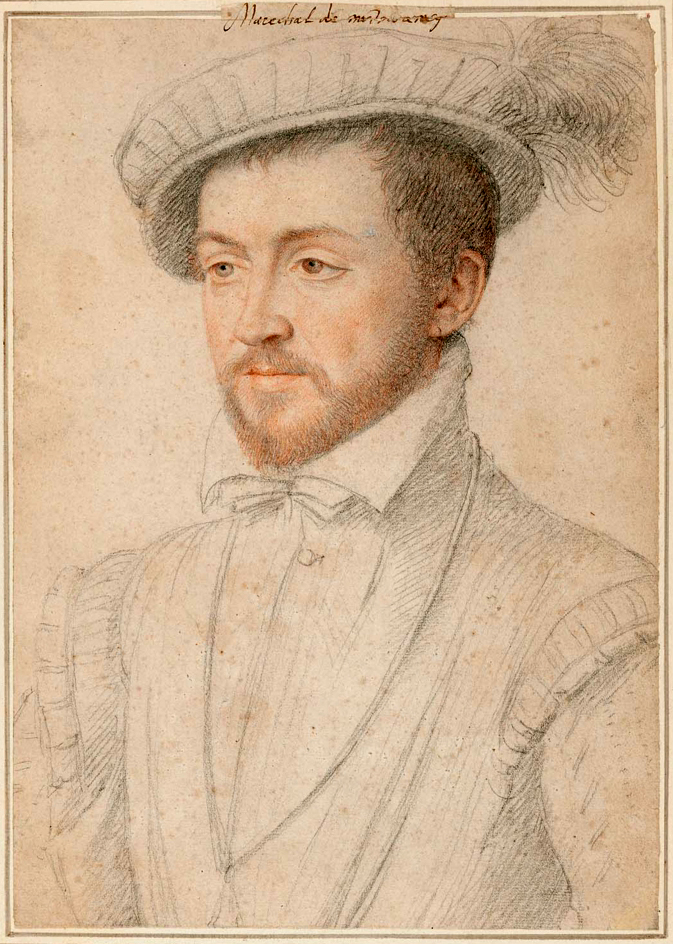
Francois de Montmorency
Battle was joined on 13th but Charles held on to Renty and on 15th Henri called off the campaign. Montmorency was accused of failing to capture Charles and the Venetian envoy Giovanni Capello reported;

‘He used to be regarded as pusillanimous; now he is seen as a veritable coward, as he is afraid of chasing an enemy who was beaten and almost fleeing.’[vi]

The Guises were at the forefront of the Constable’s critics whose son François was held captive[vii] by Charles. Montmorency longed for peace while the Guise family saw their future in war.

War Comes to Italy

The war was also fought in long-contested northern Italy where the Cardinals Francois de Tournon and Ippolito d’Ésté held a conference with French allies about creating a diversion in Italy. On 26th July the citizens of Siena rose against the Spanish garrison and expelled it. The following month Paul de Termes[viii] took control of Siena’s defence and appointed Cardinal d’Ésté as governor.

Cosimo de’ Medici, Duke of Florence[ix] intrigued with Charles to bring Siena back under imperial control. Pedro Alvarez de Toledo, the Viceroy of Naples laid siege to Siena in January 1553 but was forced to raise the attempt when France’s ally, the Ottoman Empire, threatened the south of Italy. Henri had written to Suleiman asking him to send a fleet in the spring and early in 1553 Baron de la Garde[x] travelled to Constantinople to liaise with the Turks.
Battle of Marciano
The Turkish fleet was joined by French galleys and, given that Siena was safe, followed Henri’s orders to attack Corsica[xi], which fell to the invaders easily enough. The Genoese captured much of the island back the following year in an expedition under the command of Andrea Doria, although all the French troops were not cleared out until 1555.

Piero Strozzi[xii] was placed in charge of Tuscany but he was defeated on 2nd August 1554 at the battle of Marciano[xiii] which was followed by the besieging of Siena. The city fell in April 1555. Elsewhere in Italy things had being going France’s way; Casale and Ivrea fell and Marshall Brissac took Montferrat and controlled the exits from the Po valley.

The Emperor’s Departure

Emperor Ferdinand
Following the disappointment of Siena’s fall Montmorency attempted to negotiate a general peace; talks began in May 1555 in Marck[xiv]. Diane too was interested in peace as her nephew Robert de la Marck had also been taken prisoner. The French treasury was depleted with the cost of raising and keeping so many armies on the march.

By now Charles’ ill-health was getting the better of him and between October 1555 and January 1556 he laid down his titles and responsibilities, leaving the empire to his brother Ferdinand and Spain to his son Philip. In an emotional speech Charles told his audience of his travels;

‘I have made eight voyages in the seas of the Mediterranean and three in the seas of Spain, and soon I shall make a fourth voyage when I return there to be buried.’’[xv]

Charles retired to the monastery of Yuste[xvi].

Following the death of Pope Julius III in March 1555[xvii] the rabidly anti-Spanish Paul IV became pope; he hated Charles and nourished ambitions for his nephews. The new pope was a great believer in nepotism and demanded the see of Naples for his cardinal-nephew Cardinal Carafa[xviii] and Piacenza for another nephew Giovanni, the Duke of Paliano[xix] who had been placed at the head of the papal army. Philip refuse to accommodate the pope’s demand and in return Paul IV excommunicated Philip and his father.

Philip II
Henri was delighted by Philip’s intransigence and planned;

‘To force the emperor and his allies to shift the main burden of the war to Italy in order to relieve our territories and subjects on this side [of the Alps]’[xx]

At the instigation of the Cardinal of Lorraine the Franco-papal alliance was signed in December 1555, despite the concerns of Montmorency who pointed out that the papal treasury was empty and the pope lacked allies in Italy.

Bibliography

Martyrs and Murderers – Stuart Carroll, Oxford University Press 2009

Suleiman – André Clot, Saqui Books 2012

Catherine de Medici – Leonie Frieda, a Phoenix Paperback 2003

Philip of Spain – Henry Kamen, Yale University Press 1997

Charles V – Harald Kleinschmidt, Sutton Publishing 2004

French Renaissance Monarchy – RJ Knecht, Longman Group 1996

The Rise and Fall of Renaissance France – RJ Knecht, Fontana Press 1996

Catherine de’ Medici – RJ Knecht, Pearson Education Ltd 1998

A History of France – David Potter, The MacMillan Press 1995

Emperor Charles V – James D Tracey, Cambridge University Press 2010

Henri II – H Noel Williams, Methuen and Co 1910 (reprint 2016)

www.wikipedia.en


[i] Called the Chambre Ardente as a result of the severity of its sentencing
[ii] Henri II - Williams
[iii] Laid down by the Paris Faculty of Theology in 1543
[iv] The short-lived claim by the Duke of Northumberland on behalf of his daughter-in-law Lady Jane Grey was ended with her execution
[v] Now a suburb of the town of Couvin in the Ardennes
[vi] The Rise and Fall of Renaissance France - Knecht
[vii] Taken during the fall of Thérouanne
[viii] Henri’s lieutenant in Italy
[ix] Upgraded in 1569 to the Grand Duchy of Tuscany
[x] Former ambassador to the Sublime Porte and General of the Galleys.
[xi] Part of the Genoese Republic territory, causing Genoa to ally with the Holy Roman Emperor
[xii] Leader of the Florentine exiles; a favourite of Catherine de’ Medici’s who mortgaged some of her dower lands in the Auvergne to fund him and his supporters
[xiii] Also known as the battle of Scannagallo
[xiv] The talks were unsuccessful as Henri demanded that the status quo be preserved while Charles insisted on a return to the pre-war position
[xv] Philip of Spain - Kamen
[xvii] Whose successor Marcellus II died 22 days after his election
[xviii] Formerly a condottiero
[xix] To replace Paliano which the Spanish had recently conquered.
[xx] The Rise and Fall of Renaissance France - Knecht

Thursday, 7 February 2013

The Ottoman Empire - Suleiman; the Twilight Years


The Death of Mustafa
Rustem Pasha Mosque
The eldest of Suleiman’s sons was not Roxelana’s child and she was very aware that if Mustafa inherited the Sultanate that her sons would be murdered. Roxelana had obtained a great deal of influence over Suleiman in the years since Ibrahim’s death and the move of the Seraglio into the Topkapi Palace.
Roxelana had arranged for her son-in-law Rustem Pasha’s appointment as Grand Vizier. Suleiman gradually relinquished control of his empire to Rustem, who was very much influenced by his mother-in-law. Rustem spent much of his wealth on charitable foundations, mosques and public buildings.

Suleiman had decided that Mustafa was to succeed him, but Roxelana was able to play on Suleiman’s addiction to power and his innate suspicion of any potential rival. She was determined that her alcoholic weak son Selim would inherit. Mustafa had great potential being
‘Being marvellously well-educated and prudent and of the age to reign.’[i]
Mustafa was Governor of Amasya[ii] and had military experience and the support of the Janissaries, who saw in him a worthy successor to his father.

At the beginning of the third Persian campaign Suleiman was reluctant to lead his troops into battle and delegated command to Rustem Pasha. Rustem sent messengers to Suleiman to inform him that the Janissaries were calling for Mustafa to lead them into battle. Rustem also reported that the Janissaries were preaching sedition to Mustafa and that he was favourably inclined towards the proposals.
Roxelana seized the moment and persuaded Suleiman that his son was contemplating seizing his throne. Riddled with religious doubt, Suleiman placed the problem before the Mufti, the Sheikh of Islam, as a theoretical problem. The Mufti’s answer favoured torturing the miscreant to death. Relieved of his religious worries Suleiman marched to his field headquarters at Eregli, on the Black Sea, summoning Mustafa from Amasya.

Mustafa’s friends urged him not to obey his father but Busbeq[iii] wrote
‘Mustafa was confronted by a difficult choice: if he entered the presence of his angry and offended father, he ran an undoubted risk; if he refused he clearly admitted that he had contemplated an act of treason. He chose the braver and more dangerous course.’[iv]
Upon his arrival at Eregli Mustafa was escorted to his father’s tent, where he was ceremoniously strangled. To appease the distraught Janissaries, Suleiman removed Rustem from his post, replacing him with Ahmed Pasha. Within two years Rustem was again given the Grand Vizier post, following the execution of his successor/predecessor.

The Death of Bayezid

Selim
On 15th April 1558 Roxelana died, to be deeply mourned by Suleiman. She left her son Selim, as his father’s heir. Her youngest son Jehangir, who was disabled, had died not long after the execution of his beloved half-brother. Selim and his remaining brother Bayezid detested each other and after their mother’s death were released from the control that had kept them from each other’s throats.
The Janissaries supported Selim while Bayezid’s supporters were the discontented peasants and timariotes[v]. A former servant of Bayezid’s Lala Mustafa, who had changed masters, persuaded Selim that he could ruin Bayezid. Lala Mustafa wrote to Bayezid offering to have Selim killed and Bayezid eagerly agreed.

Selim informed Suleiman, who sent a letter of warning to Bayezid. Lala Mustafa had the messenger murdered and Suleiman was informed that this was of Bayezid’s doing. Bayezid was transferred from the governorship of Konya[vi] to Amasya. Bayezid refused to leave Konya and raised 20,000 troops. An army of regular troops was sent to support Selim who defeated his brother’s army outside Konya.
Bayezid fled to Persia where he was welcomed and imprisoned by Shah Tahmasp. Pressurised by Ottoman military might Tahmasp finally agreed to allow the execution of Bayezid in Baghdad. Bayezid was garrotted by an official executioner from Istanbul in 1559. Allegedly Suleiman was relieved to have been spared continuing war between his two remaining sons, although he must have been aware that Selim was mediocre in the extreme, and was not very religious.

‘I thank God that I have lived long enough to see Muslims free of war between my sons. I will therefore be able to live out the rest of my days in peace. If the opposite had occurred, I would have lived and died in despair.’[vii]
The Last Campaign

Following attacks by the Knights of St John on Ottoman shipping, Suleiman sent his fleet to take the island. The failure of his sea-borne forces to take Malta in the summer of 1565 led Suleiman to bemoan
‘Only with me do my armies triumph.’[viii]

John Sigismund Zapolya meets Suleiman
He decided to salvage his wounded pride with a further campaign against Hungary and Austria. On 1st May 1566 Suleiman left Istanbul for the last time. Unable to sit astride a horse, Suleiman travelled in a litter. At Semlin Suleiman was met by the young King John Sigismund, whom he greeted as his dearly beloved son.
The army then travelled to the fortress of Sziget, whose commander had attacked and killed a sanjak bey, one of Suleiman’s favourites. The fortress was invested and sappers worked to undermine the citadel, to which the defenders had repaired. On 5th September the mine was fired and the citadel fell.

Death of Suleiman
In his last years Suleiman was enfeebled and Busbeq noted

‘His Majesty during many months of the year was very feeble of body, so he lacked little of dying, being dropsical, with swollen legs, appetite gone, and face swelled and of very bad colour. In the month of March last, he had four or five fainting fits, and he had had one since, in which his attendants doubted whether he was alive or dead, and hardly expected that he would recover from them.’[ix]
Suleiman died before he could be informed of his last victory. He may have died from apoplexy or from a heart attack. News of the Sultan’s death was kept from the army and his followers were informed that an attack of gout kept Suleiman in his tent.

Suleiman's tomb
The business of government continued as if Suleiman was still alive, as the Grand Vizier was determined to effect a peaceful accession for Selim who was informed by messenger of his father’s death, in Kutahya[x],. After the fall of Sziget the army made its slow way back to Istanbul, to give time for Selim to reach the city before them.
Outside Belgrade the Grand Vizier was informed that Selim had reached Istanbul and the army was finally informed of the Sultan’s death. The poet Baqi wrote of the sense of loss Suleiman’s subjects felt after nearly 46 years of his rule;

‘Will not the king wake from sleep? Broke has the dawn of day.

Will he not move forth from his tent bright as heaven’s display?

Long have our eyes dwelt on the road, and yet no news has come

From yonder land……’[xi]

 By the end of Suleiman’s reign, in common with much of Europe the empire was suffering from food shortages, population increases and rising inflation. The cost of the increasing bureaucracy, the splendour of the court and the never-ending wars put huge pressures on the treasury.

Suleiman’s works contained the seeds of the Empire’s eventual downfall; rooted in the corruption and favouritism in the Seraglio and in the corruption and venality in the bureaucracy. Like other empires before and after the Ottoman Empire grew too big for careful governance, even if officialdom had not become riddled with dishonesty, nepotism and carelessness.
Bibliography

Suleiman the Magnificent – André Clot, Saqui Books 2012
Lord of the Horizons – Jason Goodwin, Henry Holt & Co 1998

The Ottoman Empire – Halil Inalcik, Phoenix 1997
The Ottoman Empire – Patrick Kinross, Folio Society 2003

Safavid Iran – Andrew J Newman, IB Tauris & Co Ltd 2006
The Ottoman Empire – Andrina Stiles, Hodder & Stoughton 1991

En.wikipedia.org

[i] The Ottoman Empire - Kinross
[ii] On the road to Persia
[iii] Charles V’s envoy in Istanbul
[iv] The Ottoman Empire - Kinross
[v] Irregular cavalrymen who served the emperor in times of war in exchange for a fief or timar.
[vi] In central Anatolia
[vii] Suleiman the Magnificent - Clot
[viii]The Ottoman Empire - Kinross
[ix]Ibid
[x] In western Turkey
[xi] The Ottoman Empire - Stiles

Monday, 4 February 2013

The Ottoman Empire - Suleiman the Conqueror


War in the Mediterranean
Admiral Doria

In retaliation to the exploits of Admiral Doria in Greece and in opposition to Charles V’s ambitions in the Mediterranean Suleiman appointed Khair ad-Din, better known as Barbarossa, as the admiral of his fleet.  
Barbarossa exploited the raiding talents of the Turkish corsairs[i]. He was an advocate of working with France to suppress Spanish naval ambitions in the Mediterranean. In 1536 a Turco-French treaty was signed, with secret mutual defence clauses. François 1 hoped that the Turks would be able to assist in his fight for territory in northern Italy.

In 1534 Barbarossa sailed out with his fleet to ravage the coast of Italy and then on to Tunis; on his arrival such was the power of his name that the ruler, Muley Hassan, fled. Strategically important Tunisia was annexed to the Ottoman Empire. Charles V sent an envoy to Tunis, almost immediately, with instructions to raise a revolt, with the support of the deposed ruler, against the Turks. The plot was uncovered and Charles’ agent was put to death.
In the summer of 1535 a Spanish fleet, under the command of Doria, landed at Carthage. They besieged the fortress that guarded the entrance to Tunis harbour and after 24 days the walls were breached. Barbarossa prepared to defend the city, but was hampered by the break-out of thousands of Christian prisoners, who captured the arsenal. Barbarossa fled as Muley Hassan was reinstated as ruler.

Barbarossa
Barbarossa fled to Bone, on the coast, where his reserve fleet awaited. After reinforcing the fleet Barbarossa attacked the Balearic Islands. Flying Spanish and Italian flags the fleet sacked Mago[ii], carrying off captives and treasures to Algiers.

In 1536 Suleiman instructed Barbarossa to build a new fleet of 200 ships, which sailed the following year to attack Italy; in association with an army sent from Albania under Suleiman’s command. The plan counted on the intervention in the north by François, but unfortunately the French king had decided that for the present a truce with the Holy Roman Empire was more advantageous for his country.
Instead of the planned convergence of army and navy Barbarossa attacked the Venetian islands in the eastern Mediterranean, who had been annoyed by the preferential treatment given to the French in trade matters. Barbarossa returned to Istanbul loaded with treasure to lay at Suleiman’s feet.

‘The Pasha dressed two hundred boys in scarlet, nearing in their hands flasks and goblets of gold and silver. Behind them followed thirty others, each carrying on his shoulders a purse of gold; after these came two hundred men, each carrying a purse of money; and lastly two hundred infidels wearing collars, each bearing a roll of cloth on his back.’[iii]
In 1538 the fleet under Barbarossa defeated a crusader fleet commanded by Doria at Preveza. The stand-off between Doria and Barbarossa was to continue for many years. In 1541 Charles V took advantage of Barbarossa’s absence in Istanbul to attack Algiers. The attack was foiled by a hurricane. In 1543 Barbarossa was sent to attack Sicily and the western coast of Italy. When the fleet reached the French Mediterranean coast they were allowed to use Toulon as their naval headquarters.

War with the Safavid
When Shah Tahmasp of Persia ascended to the Safavid throne in 1524 Suleiman wrote a revealing letter 

‘If there still remained a spark of honour and ardour in a personality corrupted by error, you would long ago have vanished. I have decided to bear arms to Tabriz and into Azerbaijan and to pitch tent in Iran and Turan, in Samarkand and Khorosan.’[iv]

Shah Tahmasp
It was not until 1532 that Suleiman was finally able to turn his attention to the irritant in Baghdad. The divide between the Sunni and Shiite factions of Islam was bitter and Sunni Moslems were persecuted within the boundaries of the Safavid Empire. As Suleiman saw himself as a protector of Islam his duty must have seemed clear to him. And there was reason to act.
The Bey of Bitlis[v] placed his territory under the protection of the Shah. In a counter-action the governor of Baghdad sent the keys of the city to Suleiman, but was then assassinated. Suleiman believed that, as possessor of the keys, he was the ruler of Baghdad. After the assassination Tahmasp had retaken the city but this action was seen in Istanbul as dragging the city back down into the Shiite heresy.

In the autumn of 1533 Ibrahim took an army to annex Azerbaijan, en route he was sent the head of the former Bey of Bitlis. Several fortresses surrendered and Ibrahim then spent the winter at Aleppo. In the spring the army marched on Baghdad and Ibrahim entered the capital of the Safavid Empire on 16th July 1534. The city was a shadow of its former self. In 1437 one writer commented
‘Baghdad is in ruins. There are neither mosques, a faithful congregation, call to prayer nor souks; most of the palm trees are dried out. It cannot be called a town.’[vi]
The Turkish system of administration was set up in Mesopotamia. Janissaries and Sipahis were garrisoned and a governor installed.

In 1535 Suleiman led his army against Tahmasp in Tabriz[vii]. The Safavid Emperor retreated into the hills; while Suleiman took possession of the town but left after two weeks. The campaign although glorious, was costly in terms of men and mounts; circa 30,000 men died[viii]. Suleiman returned to Istanbul in January 1536, his army having suffered guerrilla attacks from the Persians throughout the return journey.
In 1538 the Emir of Basra submitted to the Ottomans, who were now masters of the Persian Gulf as well as the eastern Mediterranean and the Red Sea. Renewal of the war in Europe saw a Safavid counter attack and Suleiman’s army marched against Iran. The war was finally resolved by treaty on 29th May 1555, whereby Baghdad was to remain in Ottoman hands.

Death of Ibrahim

Francois 1 with Suleiman
By the beginning of 1536 Suleiman and Ibrahim were back in Istanbul. On 18th February Ibrahim signed, in Suleiman’s name, the treaty with France. Less than a month later he was dead, garrotted in his bedroom in the Topkapi Palace. Ibrahim had fought for his life, evidenced by the bloodstains and torn clothing.
The job of Grand Vizier had always ensured a high mortality rate for its holders. Suleiman was aware of Ibrahim’s arrogance and his boasting of his usurpation of his master’s authority.

‘Although I am the Sultan’s slave, whatever I want is done. On the spur of the moment I can give kingdoms and provinces to anyone I like, and my master will say nothing to stop me. Even if he has ordered something, and I do not want it to happen, it will not happen; and if I command something, and he happens to have commanded the contrary my wishes and not his are obeyed. I can make war and I can grant peace. I can make men rich.’[ix]
Ibrahim had already brought about the death of the Minister of Finance, Iskender Chelebi, on charges of misuse of public monies and intrigues against the Sultan. After the minister’s death Suleiman persuaded himself that Iskender was innocent. Before his death Iskender had put pen to paper to accuse the powerful Ibrahim of conspiring against Suleiman.

It is believed that Roxelana, jealous of his influence, intrigued against Ibrahim and it was during 1536 that the Seraglio was moved into the Topkapi at Roxelana’s request. This move increased the influence of those living in the Seraglio. Suleiman’s mother, a protector of Ibrahim, had died the previous year and Roxelana may have used her access to the Sultan to poison Suleiman’s mind against his Grand Vizier.
As a slave all Ibrahim’s possessions reverted to his master on his death.

Hungary Again

John Zapolya
In 1540 John Zapolya, Suleiman’s choice for king of Hungary, died; and Ferdinand marched into Hungary, with as many troops as he could raise on short notice. Zapolya and Ferdinand had recently concluded a secret treaty allowing Ferdinand to take the kingdom in the event of Zapolya dying without issue. Hearing of the treaty Suleiman commented
‘These two kings are unworthy to wear crowns, they are faithless men.’[x]
On his deathbed Zapolya was informed of the birth of a son and the new king’s ministers appealed to Suleiman to support the new-born infant, King John Sigismund. Suleiman agreed in return for the payment of tribute.

That winter the Ottoman army prepared its return to Buda. Frederick had been repulsed from the city by Stephen’s adherent, a monk named Martinuzzi who had previously been his father’s chief adviser. Suleiman entered Buda on 2nd September 1541, having informed John Sigismund’s mother that he was going to annex Hungary. This decision was partly based on the difficulties that John Sigismund would face trying to hold onto his crown faced with an enemy in his prime and bankrolled by Charles V. Buda and its surrounding territory was turned into a Turkish province.
Ferdinand sent envoys again demanding the return of Hungary. To which Suleiman’s Grand Vizier replied

‘Do you believe that the Padishah is out of his mind, that he would relinquish what he has won for the third time with his sword?’[xi]
In 1543 Suleiman again marched into Hungary and captured Gran. It was fortified as the north-western outpost of the Ottoman Empire. His armies then turned and conquered much of the rest of Hungary which was to remain under Turkish rule for the next 150 years.

The next years saw another campaign in Persia, more land grabs in Hungary and in 1553 Suleiman’s final campaign in Persia following Persian attacks on the Turkish borders. Suleiman’s troops marched across the River Euphrates to take the fight to the enemy. They laid waste to Persian lands, but the Turkish supply lines were over-extended and eventually the two sides agreed a treaty. 
Bibliography

Suleiman the Magnificent – André Clot, Saqui Books 2012
Lord of the Horizons – Jason Goodwin, Henry Holt & Co 1998

The Ottoman Empire – Halil Inalcik, Phoenix 1997
The Ottoman Empire – Patrick Kinross, Folio Society 2003

Safavid Iran – Andrew J Newman, IB Tauris & Co Ltd 2006
The Ottoman Empire – Andrina Stiles, Hodder & Stoughton 1991

En.wikipedia.org

[i] He had previously been their chief, with forty ships under his command
[ii] Now Mahon
[iii] The Ottoman Empire – Kinross
[iv] Suleiman the Magnificent - Clot
[v] In Turkey
[vi] Suleiman the Magnificent - Clot
[vii] Now capital of East Azerbaijan province of Iran
[viii] Mostly from hunger
[ix] The Ottoman Empire - Stiles
[x] The Ottoman Empire - Kinross
[xi] Ibid