Showing posts with label the Plantagenets. Show all posts

Monday, 5 February 2018

Philip the Bold II


the Jacquerie

Outside Paris the Free Companies were creating havoc; their manpower was provided by English soldiers released from service by the Black Prince after Poitiers[i]. Support from the provinces for the Dauphin, allied with public disgust at their failure to deal with the scourge of the free companies meant that, in August 1357, the Dauphin felt emboldened to dismiss his council of twenty-eight. And it was now that Marcel allied with Charles of Navarre who arrived in Paris to press his own claim to the throne.

In January 1358, on the pretext of rescuing a man accused of murdering the Dauphin’s treasurer Marcel unleashed a wave of terror, starting with the murder of two of the Dauphin’s marshals in front of the Dauphin himself, along with the killing of another of Charles’ councillors. These killings cost Marcel what little support he had from the nobility.

Captal de Buch
By May 1358 the Jacquerie revolt had begun at Marcel’s instigation, allegedly started because of the Dauphin’s order that the nobles in the environs of Paris should fortify and provision their castles in an attempt to forestall any action by Marcel. The peasants blamed the nobility for the miseries of their own lives and the capture of the king, claiming that;

‘They shamed and despoiled the realm, and it would be a good thing to destroy them all.’[ii]

Marcel encouraged the enraged peasantry to attack the propertied, an action which promptly lost him the support of those who owned property, noble or not. His next action, that of sending a gang to attack the royal family sheltering at Meaux, lost him a lot more.

The Dauphin’s wife and children were rescued by an English noble, the Captal de Buch and his French cousin, the Count of Foix. Along with a company of forty lances[iii] the two men engaged the peasantry as they attacked the fortress. This outrage brought the nobility back in line and the revolt was swiftly crushed and led to the fall of Marcel.

Upsetting the Treaty

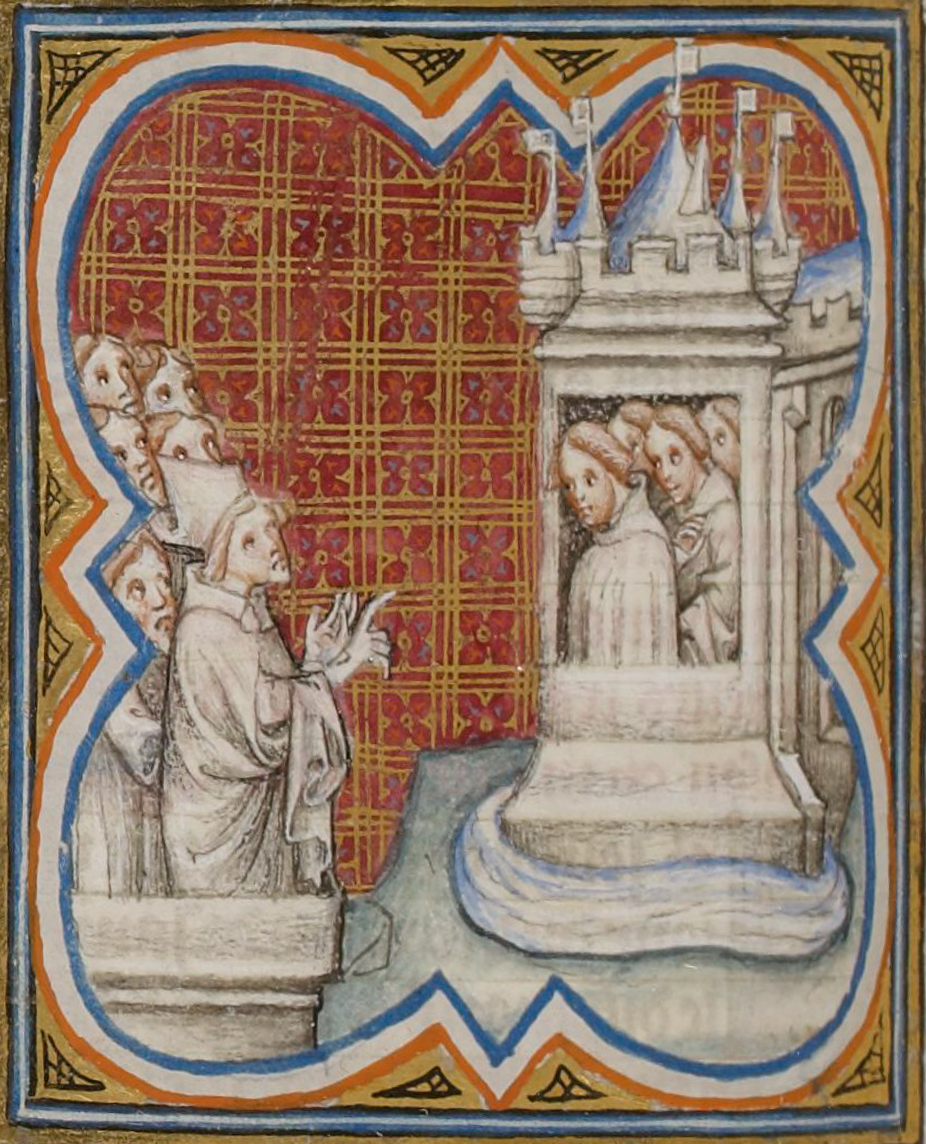
Rheims cathedral
The turmoil in Paris and its environs meant that collecting monies to pay John’s ransom was problematical. The Treaty of London[iv] in January 1358, in which John traded half his kingdom for his freedom, set John’s ransom at four million gold eçus[v], payment of which in fixed instalments was to be guaranteed by forty noble French hostages. If there was any obstruction to the ceding of the agreed territories[vi] John was to pay for Edward’s cost of sending in his army.

The Dauphin, who had done a lot of growing up since Poitiers, and his council were loath to agree to the terms that John had conceded to the enemy. The Estates General were convened and their answer to the treaty was disparaging;

‘The Treaty was displeasing at all the people of France and intolerable, and for this ordered war to be made on England.’[vii]

Edward was outraged at the French response and in October 1359 he and his four sons embarked on a no expenses spared campaign on the continent. The English made for Rheims[viii] where Edward was determined to be crowned king of France. Intending to live off the land, the English found poor pickings in a countryside already devastated by war and the ravages of the free companies. The French were unhelpful in that they failed to field an army against them.

A Winter Campaign

Coin of Philip de Rouvre
Edward arrived in Rheims in December, but the city was closed against him and stoutly defended. The countryside around had been denuded of anything that could succour the English and buildings had been destroyed to prevent their usage by Edward’s army. The siege was lifted after forty days, as the English ran out of provisions and instead headed for the rich pickings to be found in Burgundy.

After two months Philip de Rouvres, Duke of Burgundy, paid Edward large sums of money to have the scourge of the English army directed elsewhere. Edward then turned his attention to Paris, having heard the news that the French had attacked Winchelsea in a botched attempt to rescue John who had been transferred to the Tower of London[ix].

the Strand Gate Winchelsea
Early in April the English heralds called for the French to come out of their besieged city and do battle, knowing full well that a pitched battle was to England’s advantage. The Dauphin refused to comply and after a week Edward turned his army in the direction of Chartres where the English army was struck by the heavens, causing more havoc than the French had; men and horses were killed by outsize hailstones, tents torn up by the wind, the baggage train dragged through mud and the resultant floods.

‘Wherfor unto thys day many men callen it Black Monday.’[x]

Papal envoys and the Dauphin had been requesting terms for some time and now, with this sign from God, Edward accepted the advice of John of Gaunt, that it was time to come to an agreement.

Return to France
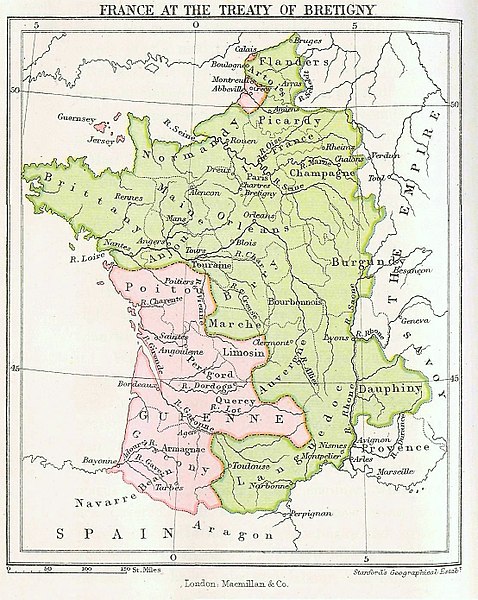
France at the Treaty of Bretigny
On 8th May 1360 the Treaty of Brétigny[xi] was agreed between Edward and John; it was to end the first phase of what was to become known as the Hundred Years’ War. The treaty was signed by the Black Prince and the Dauphin. The part of the agreement whereby the English agreed to drop their claim to the throne of France was dropped from the treaty, thereby causing much resentment in France.

Desperate for money to pay his ransom John hit on the idea of selling his daughter Isabelle to Gian Galeazzo Visconti, the nine year old son of Galeazzo II Visconti, Duke of Milan, for the sum of 600,000 gold florins[xii]. In return for his release a number of the French nobility were taken as hostages against payment of John’s ransom, including Philip of Orléans.

After father and son finally returned home John was moved to grant his son the duchy of Touraine, a relatively minor duchy. John had remained popular with his people, despite his capture by the English which the French blamed on traitors who sold out France to the enemy.

When Philip de Rouvres died on 21st November 1361 leaving no heirs, John laid claim to the dukedom[xiii]. He may have planned to incorporate Burgundy into the royal domains, but the Burgundians were not predisposed to this idea. Instead John on 27th June 1363 appointed his youngest son as his Lieutenant-General and granted him the apanage in perpetuity of the duchy, making Philip first peer of France.

Battle of Cocherel
Philip surrendered his duchy of Touraine back to his father. John planned to marry Philip to Joanna of Naples in the hope of extending French influence in Italy, but Joanna was not interested in the offer despite support from Pope Urban V.

One of the side effects of John’s gift of the duchy of Burgundy to Philip was to drive Charles of Navarre to declare war on France[xiv]. He launched his attacks on Burgundy and from his strongholds outside of Paris[xv]. He was joined by English soldiers laid off by the peace of Brétigny. The two sides met at Cocherel where a new star was born; Bertrand du Guesclin[xvi] was hailed as the ‘best knight in the field.’ Du Guesclin led the French to victory, crushing Navarrese hopes again.

In the spring of 1361 the plague erupted again in Europe and England. No respecter of rank, the plague hit common man and noble alike. The Count of St Pol, one of Edward’s hostages, died as did John of Gaunt’s father-in-law, the Duke of Lancaster whose dukedom was promptly granted to John of Gaunt.

Bibliography

Edward III – Bryan Bevan, the Rubicon Press 1992

The Hundred Years War – Alfred Burne, Folio Society 2005

Chronicles – Froissart, Penguin Books 1968

Europe: Hierarchy and Revolt 1320-1450 – George Holmes, Fontana 1984

The Fourteenth Century – May McKisack, Oxford University Press 1997

The Perfect King – Ian Mortimer, Vintage Books 2008

A Distant Mirror – Barbara Tuchman, Papermac 1989

Philip the Bold – Richard Vaughan, Boydell Press 2011

The Flower of Chivalry – Richard Vernier, Boydell Press 2003

www.wikipedia.en


[i] To avoid having to pay them further
[ii] A Distant Mirror - Tuchman
[iii] Totalling about 120 men
[iv] The treaty gave Normandy, Anjou, Maine, Aquitaine and Calais to the English
[v] In 2016 the relative: historic standard of living value of that income or wealth is £2,558,000,000.00; labour earnings of that income or wealth is £35,420,000,000.00; economic status value of that income or wealth is £69,190,000,000.00; economic power value of that income or wealth is £1,385,000,000,000.00 www.measuringworth.com
[vi] Stretching from Calais to the Pyrenees
[vii] A Distant Mirror - Tuchman
[viii] The traditional site for the coronation of French kings
[ix] Following rumours of the possibility of a rescue attempt
[x] A Distant Mirror - Tuchman
[xi] Handing Aquitaine to the English without French suzerainty over the region
[xii] Half the monies to be paid upfront. In 2016 the relative: historic standard of living value of that income or wealth is £401,100,000.00, labour earnings of that income or wealth is £4,976,000,000.00, economic status value of that income or wealth is £10,380,000,000.00, economic power value of that income or wealth is £207,800,000,000.00 www.measuringworth.com  
[xiii] De Rouvres had been a nephew of John’s wife
[xiv] He had a valid claim on the duchy
[xv] Charles was also Count of Évreux and held the fortresses of Melun, Mantes and Rolleboise all within close proximity of the capital
[xvi] An employee of the Duke of Orléans
Monday, 29 January 2018

Philip the Bold


Launching the Hundred Years War

Bonne and John
Born in Pontoise, on 17th January 1342, Philip the Bold was the youngest son of the Dauphin of France John II, and his wife Bonne of Bohemia. Philip was named after his grandfather Philip VI, King of France. Bonne died of the plague in 1349 when Philip was seven. Bonne also had six daughters, two of whom predeceased her, Margaret died in 1352. Joan[i] was born the year after Philip, Marie[ii] born in 1344 and Isabelle[iii] in 1348.

In July 1346, when Philip was four years old, Edward III of England launched a major invasion of France[iv] and on 26th August the English annihilated the French, who were caught unawares, at the Battle of Crécy. The chronicler Matteo Villani wrote;

‘The English guns cast iron balls by means of fire. They made a noise like thunder and caused much loss in men and horses….the whole plain was covered by men struck down by the arrows and cannonballs.’[v]


Battle of Crecy
Over 1,500 French lords and captains died along with 10,000 other ranks. King Philip fled to Amiens and Edward cast his eyes on Calais to regroup and re-victualise his army.  He proceeded to besiege the town which fell to the English in 1347. Edward III allied himself with Charles the Bad, the king of Navarre who had been offered the hand of Joan of France, albeit without any dowry. Charles had been turned down as Constable of France in favour of Don Carlos de la Cerda, and now Charles was prepared to make John pay for what he deemed insults.

Philips’ grandfather King Philip did not die until August 1350 when Philip was eight. John lacked his father’s capabilities, lacking any subtlety; he was a bluff cheerful man.

Poitiers

the Black Prince
In September 1355 the Black Prince conducted a grande chevauchée from Bordeaux to Narbonne and back. In the spring of 1356 John gathered together a mighty army to put in the field against the invaders. He and his military advisers lacked the strategic brilliance of the Black Prince and Sir John Chandos.

On 19th September 1356 the two sides met again at the Battle of Poitiers; once again the English routed the French army. In the midst of battle the Dauphin Charles fled the fighting while his father laid about himself with his battle-axe cheered on by the fourteen year old Philip, who cried out warnings to his father;

‘Beware father to the right, beware to the left.’[vi]

Philip’s exemplary behaviour during the frenzy of battle meant that thereafter he was endowed with the soubriquet of Philip the Bold.

The Battle of Poitiers
John II was taken prisoner during the battle despite having dressed nineteen members of his entourage in identical raiment to himself. In the aftermath of John’s capture English lords jostled to claim him as prisoner when he told them

‘I am so great a lord that I can make all of you rich.’[vii]

Chivalry was set aside when it became a question of making money from ransoms and booty; aside from John’s ransom the English made over £300,000[viii] in money from this one battle alone, more than covering Edward’s outlay for the war that year.

Captivity

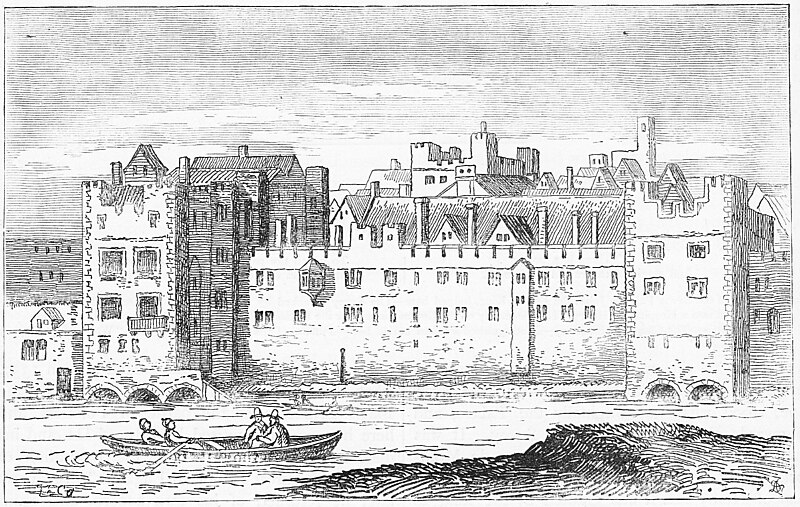
The Savoy Palace
Philip and his father were taken to England while Edward awaited the payment of John’s ransom. He was paraded through the city of London on a;

‘Whyte courser, well apparelled, and the prince on a lyttell black hobbey by hym.’[ix]

Father and son were to spend the first months of their captivity at the Palace of the Savoy, recently built by Edward’s third son John of Gaunt, the Duke of Lancaster at a cost of 52,000 marks[x]. They were frequently visited by Edward and his queen Philippa of Hainault[xi]. Philip played chess with the Black Prince and was taught the art of falconry by the French royal chaplain, Gace de la Buigne[xii], who had gone into captivity to be with his master. John and Philip were guarded to ensure they did not escape and to prevent any attempt at a rescue.  

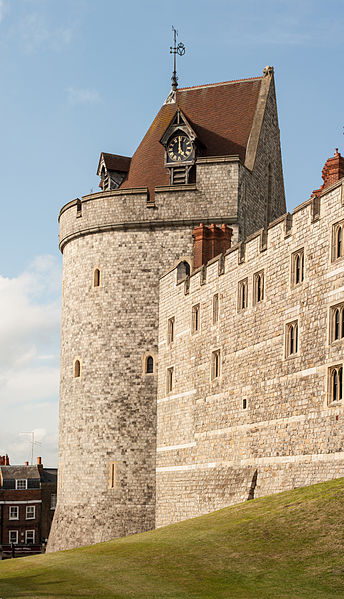
Windsor Castle
The first winter of their imprisonment John and Philip were treated to extravagant festivities by the English court, including a tournament held by torchlight. In the summer John and Philip were moved to Windsor Castle where they were able to enjoy hunting and hawking.

A number of the imprisoned French nobles were placed on parole to enable them to visit their monarch. Languedoc sent a delegation of nobles and bourgeois and a gift of 10,000 florins[xiii], along with the assurance that their lives, goods and fortunes were dedicated to the king’s delivery from this shameful imprisonment. Laon and Amiens were among towns that sent money to succour their monarch.

John spent the monies on elaborate clothing for himself, his son and his jester who received several hats trimmed with ermine, gold and pearls. He also purchased horses, dogs, falcons, a chess set, an organ, a harp and a clock. In addition the money from his loyal subjects went towards an astrologer and a ‘king of minstrels’ along with an orchestra.

The negotiations for John’s release were hampered by Edward’s demands; he wanted outright cession of Guyenne, Calais and all former Plantagenet holdings in France. In return for that and three million eçus[xiv] Edward would give up his claim on the French throne.

Turmoil in Paris

Paris
When the Dauphin returned to Paris after Poitiers he was

‘Received with honour by the people, grief-stricken by the capture of his father the king.’[xv]

They believed that the Dauphin would bring about his father’s release and save the country. John’s capture at Poitiers resulted in a power struggle between the Dauphin, Regent in his father’s absence, and Charles of Navarre who claimed the throne of France in his own right. Charles of Navarre was allied with Estienne Marcel[xvi], leader of the third Estate[xvii] in Paris.

Instead the Dauphin found himself beleaguered by Marcel’s plans to contain the monarchy. The delegates of the Estates General of Paris met in October and the Dauphin, embarrassed by his failure at Poitiers had to ask for aid to help deliver the king from the English and to defend the kingdom.

Robert le Coq (front L)
Marcel demanded that seven of the most venal of the king’s advisers be dismissed. The royal advisers were to be replaced by a council of twenty-eight nominated by the estates and Charles of Navarre was to be released from prison[xviii]. These demands were deliberately made to pressure the Dauphin who refused the demands.

The crown’s opponents were not united which gave the Dauphin some leeway when Marcel tried to raise Paris against his regency. In March 1357, with a general strike declared the Dauphin was forced to come to terms with Marcel and his opportunistic cronies who included Robert le Coq, Bishop of Laon who longed to be Chancellor of France and bore a grudge against the Valois rulers of France for failing to give him the post. Prince Charles was browbeaten into signing off the demands of his opponents by the threat of mob rule in Paris.

Bibliography

Edward III – Bryan Bevan, the Rubicon Press 1992

The Hundred Years War – Alfred Burne, Folio Society 2005

Chronicles – Froissart, Penguin Books 1968

Europe: Hierarchy and Revolt 1320-1450 – George Holmes, Fontana 1984

The Fourteenth Century – May McKisack, Oxford University Press 1997

The Perfect King – Ian Mortimer, Vintage Books 2008

Hawkwood – Frances Stonor Saunders, Faber and Faber 2004

A Distant Mirror – Barbara Tuchman, Papermac 1989

Philip the Bold – Richard Vaughan, Boydell Press 2011

www.wikipedia.en


[i] Joan was to marry the king of Navarre
[ii] She married the Duke of Bar
[iii] She was to marry Gian Galeazzo Visconti
[iv] He had put forward his claim to the French throne in 1337 as the only male grandchild of Philip IV of France. The French chose the grandson of Philip III
[v] Edward III - Bevan
[vi] Ibid
[vii] Hawkwood - Saunders
[viii] In 2016 the relative: historic standard of living value of that income or wealth is £197,200,000.00, labour earnings of that income or wealth is £2,412,000,000.00, economic status value of that income or wealth is £5,411,000,000.00, economic power value of that income or wealth is £107,800,000,000.00 www.measuringworth.com
[ix] Edward III – Bevan
[x] In 2016 the relative: historic opportunity cost of that project is £31,810,000.00, labour cost of that project is £418,000,000.00, economic cost of that project is £18,680,000,000.00 www.measuringworth.com
[xi] Who had acted has her husband’s regent the previous year
[xii] Author of Le Roman de Deduis written circa 1377, a book of the hunt
[xiii] In 2016 the relative: historic standard of living value of that income or wealth is £6,573,000.00, labour earnings of that income or wealth is £80,390,000.00, economic status value of that income or wealth is £180,400,000.00, economic power value of that income or wealth is £3,592,000,000.00 www.measuringworth.com
[xiv] In 2016 the relative; historic standard of living value of that income or wealth is £1,972,000,000.00, labour earnings of that income or wealth is £24,120,000,000.00, economic status value of that income or wealth is £54,110,000,000.00, economic power value of that income or wealth is £1,078,000,000,000.00 www.measuringworth.com
[xv] A Distant Mirror - Tuchman
[xvi] The head of a reform movement that tried to institute a controlled French monarchy, confronting the royal power of the Dauphin
[xvii] The other two estates were the noblesse de epée (nobility) and the noblesse de robe (the clergy)
[xviii] John had arrested Charles in 1356 for trying to foment discord between John and his heir