Showing posts with label Prince Henry Frederick. Show all posts

Wednesday, 5 November 2014

A Stuart Princess - The Winter Queen


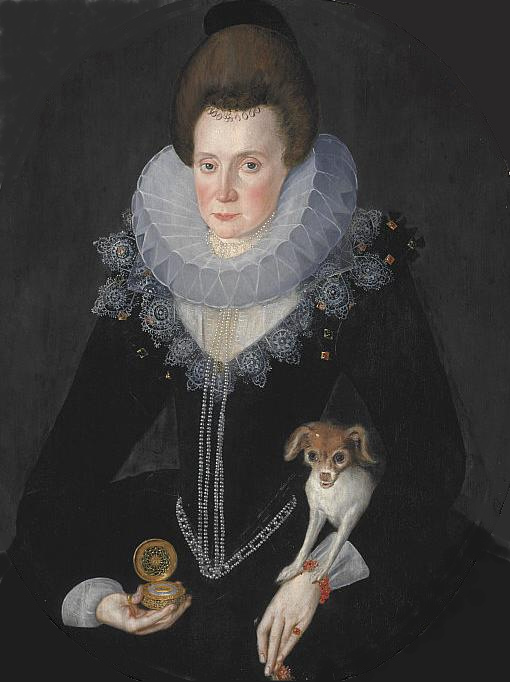
Anne of Denmark
Childhood
Elizabeth Stuart was the third child of Anne of Denmark[i] and her husband James VI of Scotland. Elizabeth was born on 19th August 1596 at Dunfermline Palace in Fife; three and a half years before her father became king of England as well as Scotland. She was placed under the governance of Lord and Lady Livingstone, as was her sister Margaret born two years later. Margaret died when Elizabeth was four. For the most part Elizabeth lived at Linlithgow Palace.
More siblings followed; Charles, born in November 1600, Robert who died at the age of four months and a stillborn child. Mary was born in 1605 and died two years later. Finally there was Sophia who was born in 1606 and died the day after her birth.

Elizabeth age 7
At the age of seven Elizabeth was removed from Scotland and followed her parents down to England, when James became king upon the death of Elizabeth, the princess’s namesake. The young Charles was left in Scotland, entrusted to the care of Lord Fyvie[ii], as it was believed that he was too frail to travel[iii].
Elizabeth was with her mother and her elder brother Henry when James met them at Easton Neston[iv]. The new king was delighted to be rejoined with his family, asking Henry Wriothesley, Earl of Southampton;
‘If he did not think his Annie did not look passing well…….my little Betsy is not too ill-favoured a wench and may outshine her mother one of these days.’[v]
Henry as Prince of Wales
After the move to England Elizabeth was transferred from the Livingstones’ care to that of Frances Howard, daughter of Thomas Howard[vi]; a most unsuitable lady[vii], given the job by virtue of her high connections. A friend of Robert Cecil, Elizabeth’s chief councillor, Frances’ father was created Earl of Suffolk and Lord Chamberlain by James and was appointed a Privy Counsellor. Elizabeth was extremely upset to be parted from Lady Livingstone.
Elizabeth attended Windsor Castle on 2nd July to see Henry being presented with the Order of the Garter. She stood with Lady Anne Clifford[viii] and watched Henry’s flawless performance, Henry Howard[ix] and Charles Howard[x], Earl of Nottingham, both admired;
‘[Henry’s] quick and witty answers, princely carriage and reverend performing his obeyance at the altar, all of which seemed very strange unto them and the rest of his beholders, considering his tender age[xi].’[xii]
Schooling
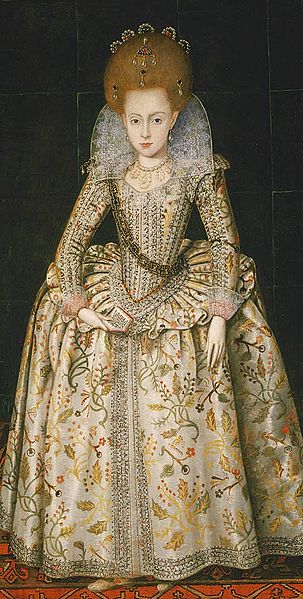
Elizabeth age 10
Elizabeth’s tuition was carefully inspected by James and, once she had learned to write, he encouraged her to write letters to himself and to Henry; a task which cemented the relationship of the two siblings.
At the end of 1603 Elizabeth was given into the care of Lord John Harington and his wife Anne[xiii]; a decision that Elizabeth regretted as it separated her from her siblings. Elizabeth wrote to Henry from her new home, Coombe Abbey;
‘My dear and worthy brother, I most kindly salute you, desiring to hear of your health; from whom, though I am now removed far away, none shall ever be nearer in affection, than your most loving sister, Elizabeth.’[xiv]
The Harington’s were chosen as Elizabeth’s governors because they were the parents of Queen Anne’s especial friend, Lucy Bedford. Their son John was a friend of Prince Henry’s.
Of Lord Harington’s efforts to school his charge, James wrote in 1606;
‘My cousin, Lord Harrington of Ex[t]on doth much fatigue himself with the royal charge of the Princess [Elizabeth]……[and] hath much labour to preserve his own wisdom and sobriety.’[xv]
The cost of looking after Elizabeth proved ruinous for Lord Harrington and he was given the licence to mint farthings; a reward that only partially compensated him for the expense[xvi].
Death of a Prince
The Stuart family were a loving family; both James and Anne loved their children. Like any teenager Henry rebelled against some of his father’s preoccupations, in particular his intellectual concerns, saying;
‘I know what becomes a Prince, it is not necessary for me to be a professor, but a soldier and a man of the world.’[xvii]
Henry took after his mother’s side of the family. In 1605 Henry was sent to study at Magdalen College, Oxford, where he took an interest in sports. A witty, outgoing & popular young man, Henry was also interested in naval & military matters, as well as national concerns; about which he was unafraid to take issue with his father. Henry was also able to keep financial control of his money (unlike his father & brother).
On 6th November 1612 the family was beside themselves with grief when Henry, a devout Protestant, died of typhoid fever. He’d been playing tennis, although unwell, and had failed to wrap up warm after the game. Elizabeth attempted to visit her brother during his last illness; knowing that visits from close family had been forbidden for fear of contagion, she dressed up as a country girl. But she was recognised and turned away.
Prince Charles
Elizabeth and Charles had always been close to Henry and their letters show much evidence of their love for him. On one occasion Charles wrote;
Sweet, sweet brother, I will give anything that I have to you: both my horse and my books and my pieces and my cross-bows or anything that you would have. Good brother, love me and I shall ever love and serve you.’[xviii]
Henry left the highly unsuitable young and distraught Charles as heir to the throne. He was buried with much pomp in Westminster Abbey on 7th December; Charles was the principal mourner.
A Husband Fit for a Princess
Elizabeth’s future husband had already been decided upon; Frederick, the Elector Palatine[xix] was visiting England when Henry died and he walked in the funeral procession which James did not attend[xx].
James had originally leaned towards an alliance with Spain as England’s best hope for continued prosperity. Elizabeth’s suitors had included the Dauphin, Louis, Frederick Henry the Prince of Orange, Gustavus Adolphus of Sweden and Philip III of Spain. Indeed the Swedes had been given to understand that Elizabeth was;
‘More inclined to Duke Gustav than to any other prince in the world.’[xxi]
James eventually chose Frederick to strengthen England’s ties with the Protestant powers in Germany.
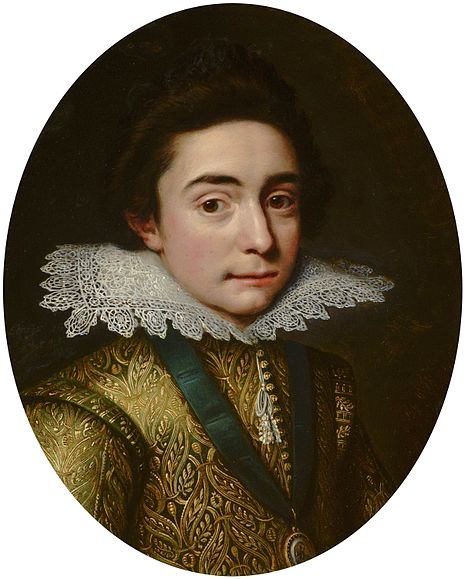
Frederick, Elector Palantine
Elizabeth attended her betrothal ceremony on 27th December, wearing black satin and silver lace. Frederick was invested with the Order of the Garter in a private ceremony and on 1st January there was an exchange of gifts between Frederick and the royal family. Frederick gave Elizabeth a carcanet[xxii], a tiara and a ring while she gave him a miniature of St George set in gold and precious stones.
The marriage was set for 14th February and there were great celebrations much to James’ dismay. On 11th there was a great fireworks display at Whitehall and on the 13th a naval fight was staged.
The 14th itself saw Elizabeth robed in a gown of white and silver studded with diamonds; her train was carried by thirteen young ladies also wearing white. The courtiers were not to be outdone and Lady Wotton, wife of Sir Edward Wotton[xxiii], wore an embroidered dress costing £50 a yard![xxiv]. Lord Montagu[xxv] spent £1500[xxvi] on apparel for his two daughters.
Dinner lasted three hours and then a ballet was performed, prepared by Lord Hay which the audience felt lasted far too long. The celebrations exhausted the royal treasury which had spent £140,000[xxvii] on the wedding.
Bibliography
Gustavus Adolphus the Great – Nils Ahnlund, 1999 History Book Club
Memoirs of Elizabeth Stuart, vols 1 & 2 – Elizabeth Benger (ed), General Books LLC 2012
The Early Stuarts – Godfrey Davies, Oxford University Press 1987
The Gunpowder Plot – Antonia Fraser, BCA 1996
King James – Antonia Fraser, BCA 1974
Robert Cecil – Alan Haynes, Peter Owen Publishers 1989
After Elizabeth – Leanda de Lisle, Harper Perennial 2006
Charles I – Christopher Hibbert, Penguin 1968
www.wikipedia.en


[ii] A friend of James
[iii] He didn’t journey down until mid-July 1604
[iv] The home of Sir George Fermor
[v] After Elizabeth – de Lisle
[vi] Second son of Thomas Howard, Duke of Norfolk, executed by Elizabeth for treason
[vii] Later imprisoned for the poisoning of Sir Thomas Overbury
[viii] Daughter of the Earl of Cumberland
[ix] Brother of Thomas Howard (see note 2 above) and made Lord Warden of the Cinque Ports the following year
[x] Known as Howard of Effingham; he was Lord High Admiral for both Elizabeth and James
[xi] Henry was just 9½
[xii] After Elizabeth – de Lisle
[xiii] Daughter of Robert Keilway
[xiv] Memoirs of Elizabeth Stuart, vol 1 – Elizabeth Benger (ed)
[xv] Ibid
[xvi] After his death, on his journey back from Bohemia escorting Elizabeth to her new home, Harrington’s estates were taken by his creditors
[xvii] King James - Fraser
[xviii] Charles I - Hibbert
[xix] One of the princes deputed to elect the Holy Roman Emperor
[xx] James did not attend funerals, nor visit the dying; this has led to a belief that he did not care for his family
[xxi] Gustavus Adolphus - Ahnlund
[xxii] An ornamental necklace, chain, collar, or headband
[xxiv] In 2013 the relative: real price of that commodity is £8,071.00 per yard; labour value of that commodity is £140,400.00 per yard;  income value of that commodity is £275,900.00 per yard, www.measuringworth.com
[xxv] An MP and sponsor of the Observance of 5th November Act 1605
[xxvi] In 2013 the relative: real price of that commodity is £242,100.00 labour value of that commodity is £4,211,000.00 income value of that commodity is £8,276,000.00 www.measuringworth.com
[xxvii] In 2013 the relative: historic standard of living value of that income or wealth is £22,600,000.00 economic status value of that income or wealth is £772,500,000.00 economic power value of that income or wealth is £5,364,000,000.00 www.measuringworth.com

Tuesday, 2 September 2014

The Stuart Would Be Queen - The Lady Arbella V

Escape
Traitor's Gate and lodgings above
On Monday 3rd June 1611 Arbella’s maid slipped the porter some dishes from Arbella’s table as Arbella walked to the stables in male costume; she rode thirteen miles to the river where she took a boat down to Blackwall where she waited in a tavern before fleeing on towards Calais.
Meanwhile in the Tower William made out that he was sick and slipped out of his rooms over Traitor’s Gate. William walked in disguise out of the Tower and down to the river near St Katherine’s Docks where he and his friend Edward Rodney embarked in a rowing boat. They were late at the meeting point at Blackwall and pressed further down river where they joined an empty coal vessel that took William and his friends to France.
Alerted by a letter from Rodney[i], Francis Seymour hastened to see Cecil and he was examined by the council. The King’s Shipwright Phineas Pette had orders to take twenty musketeers and search every vessel for the escapee, while Admiral Monson went to Blackwall to question the watermen who uncovered Arbella’s presence at the tavern.
By Wednesday William was becalmed in Harwich while Arbella was caught mid-channel by the Adventure, her captain having received orders to stop all shipping to France a mere two hours before. Her boat was ordered to heave to and refused;
‘The royal ship proceeded to compel obedience by firing, but finding this useless she dispatched her frigate and as the sea was calm and the wind had dropped, about a league off Calais she came up with the Lady Arbella’s ship and instantly seized her.’[ii]
£2,800[iii] had been raised for the escape, but Arbella’s captors found only £868[iv], some jewels and gold on her. The Venetian ambassador said that she had given most of the money she had to the ship’s captain, Tassin Corvé. What was found on Arbella was confiscated and handed to the Exchequer to be used, by James’ order, to compensate those who had apprehended Arbella.
On Thursday William’s ship set sail again reaching Ostend and freedom on Friday morning. While William was sending to Gravelines for word of his wife, Admiral Monson was informed he was to take Arbella to the Tower.
To the Tower
Henry Howard
A number of Arbella and William’s accomplices in their escapes were arrested and interrogated, as was Arbella who was still being questioned in July. The French ambassador was most apologetic that Arbella had used a French boat in her abortive escape. The inquiry was headed by Henry Howard, Earl of Northampton[v], a crypto-Catholic. Howard’s conclusion was that Mary Talbot had been the evil genius behind the plot;
‘Lady Arbella dares not clear her [Mary] by oath, though she clears all foreign princes…….by confession we can prove that of that £1800 which [Arbella] brought together, £1400 at the least came out of her aunt’s purse.[vi]
Another crypto-Catholic, Mary, now in the Tower herself, was alleged to be hoping that Arbella could be persuaded to change her religion;
‘Yet her aunt made account that being beyond the seas in the hands of the Jesuits and priests, either the stroke of their argument or the pinch of poverty might force her to the other side.’[vii]
A Prisoner
Sir William Wade
Arbella appears to have been held in the royal lodgings, in the south east corner of the Tower precinct. Mary had a three or four room suite here as well. Arbella had a kitchen where her servants could prepare food. Mary was given some freedom and was able to conduct her financial affairs from her prison suite, but Arbella was kept ‘close.’
The lieutenant of the Tower was one Sir William Wade[viii], a staunch Protestant who had personally tortured some of the Gunpowder plotters. He tightened up slack regulations when he was appointed lieutenant in 1606. Prisoners were expected to pay towards their own upkeep and Mary had to apply to Gilbert for funds. Arbella was allowed the use of her jewels to pay her way.
Mary had her own servants and Arbella applied for the same favour;
‘The lady Arbella desireth that her servants that are now in the Tower, or so many of them as shall be thought fit, to be allowed to her. That Peter, who attended Mr Seymour, an ancient servant of hers, may be her bottleman. To have herewith another servant, an embroiderer, whose name is Roger Fretwell. For a woman she desireth the Lady Chaworth.’[ix]
It was two years before one Samuel Smyth, who managed her private estate, was allowed access to Arbella, and even then only in the presence of the lieutenant.
Change
William meanwhile was in France and in December wrote to Sir William requesting that his possessions, of necessity left behind during his escape, be forwarded on to him. Wade alerted Cecil to the request. Cecil had been keeping tabs on William in any event.
In May 1612 Cecil died; he had long been sympathetic towards Arbella. The following month Mary Talbot’s case was finally heard by a select council. Mary Talbot refused to answer any of the questions put to her and she was fined £20,000[x] and was returned to the Tower.
In July Lord Beauchamp died and then in November came the loss of a friend at court; Prince Henry’s death was a tragedy for the nation. The eighteen year old Henry had been tutored in statecraft and his death left the young Charles as James’ inadequate heir.
Escape Attempts
Frederick, Elector Palatine
The spring of 1613 saw the wedding of Princess Elizabeth to Frederick, the Elector Palatine. Arbella bought four new dresses, one embroidered with hundreds of pounds worth of pearls, Arbella clearly believed that she would be would be a guest at the wedding and attendant celebrations. This was despite the fact that Wade had uncovered an escape planned by Arbella’s aunt.
The only evidence of the plot came from Arbella who claimed that Mary was going to hand her over to the Papists once they reached Lambeth. Arbella possibly hoped that this farrago of lies would help obtain her an invitation to the wedding.
Dr Moundford was attending Arbella, who had been ill for several months and seems to have fallen out with Mary, calling her
‘The most wicked woman in the world, enemy to the state.’[xi]
Arbella claimed the falling out was due to Arbella’s refusal to change her religion; it is not clear what occasioned the claim which may have been due to insanity, a desire for attention or even the desire to attend Elizabeth’s wedding as a reward for uncovering the ‘plot.’ Arbella told Moundford that she was disclosing the plot for Wade’s sake as Mary had claimed that the lieutenant’s throat would be cut.
The Lady Arbella
On 10th March John Chamberlain[xii] noted that Arbella had suffered from convulsions and on 26th that she was under restraint though;
‘She continues crackt in the brain.’[xiii]
In November Mary Talbot, who had been granted leave of absence to visit an ailing Gilbert, was suddenly recalled to the Tower. Another escape attempt by Arbella had been uncovered and several of Arbella’s servants and acquaintances were imprisoned. An intermediary had been caught selling some of Arbella’s jewels by proxy;
‘For my Lady Arbella’s escape out of the Tower.’[xiv]
The End
In the autumn of 1613 Arbella heard a rumour that William had died; he had been sick with smallpox, but like Arbella had survived. In the summer of 1614 Arbella’s accounts were organised by her steward Hugh Crompton. He was also able to pawn some of her jewels. But by now Arbella was beyond caring and was frequently ill. The Earl of Northampton wrote of her;
‘She prays, she rails, she laughs, she cries and talks idly. Her mind runs only on Devonshire[xv] by whom she affirms that she had a child and at this instance he nightly lies withal.’[xvi]
The Tomb of Mary, Queen of Scots 
For a year Arbella would not allow the doctors to feel her pulse or inspect her urine. Arbella finally died on 25th September 1615 at the age of forty, having refused food for some time. On 25th September Sir Ralph Winwood ordered Dr Moundford to view the corpse and a post mortem was ordered as rumours of poison ran rife[xvii]. The verdict was that the death was caused by a chronic and long sickness.
She was buried in Westminster Abbey on 29th in the tomb James had erected for his mother.
 
 
Bibliography
The Early Stuarts – Godfrey Davies, Oxford University Press 1987
King James – Antonia Fraser, BCA 1974

Arbella – Sarah Gristwood, Bantam 2004
Robert Cecil – Alan Haynes, Peter Owen Publishers 1989

The Letters of Lady Arbella Stuart – Sara Jayne Steen ed, Oxford University Press 1994
www.wikipedia.en


[i] A mutual friend of William and his brother Francis
[ii] Arbella - Gristwood
[iii] In 2013 the relative: historic standard of living value of that income or wealth is £491,000.00
economic status value of that income or wealth is £15,460,000.00 economic power value of that income or wealth is £108,400,000.00 www.measuringworth.com
[iv] In 2013 the relative: historic standard of living value of that income or wealth is £152,200.00
economic status value of that income or wealth is £4,792,000.00 economic power value of that income or wealth is £33,590,000.00
www.measuringworth.com
[v] Brother of the Duke of Norfolk executed by Elizabeth for wanting to marry Mary Queen of Scots and planning Elizabeth’s overthrow
[vi] Arbella - Gristwood
[vii] Ibid
[viii] Also known as Waad or Wadd, Wade had been one of Cecil’s informants when he lived abroad
[ix] Arbella - Gristwood
[x] In 2013 the relative: historic standard of living value of that income or wealth is £3,375,000.00
economic status value of that income or wealth is £109,800,000.00 economic power value of that income or wealth is £765,700,000.00 www.measuringworth.com
[xi] Arbella - Gristwood
[xii] MP for Clitheroe
[xiii] Arbella - Gristwood
[xiv] Ibid
[xv] Lord Mountjoy, friend of the long deceased Earl of Essex
[xvi] Arbella - Gristwood
[xvii] The scandalous Overbury poisoning was only two years old