Monday, 9 May 2016

Emperor of the West – Charlemagne II


A denarius minted by Carloman
Death of Carloman

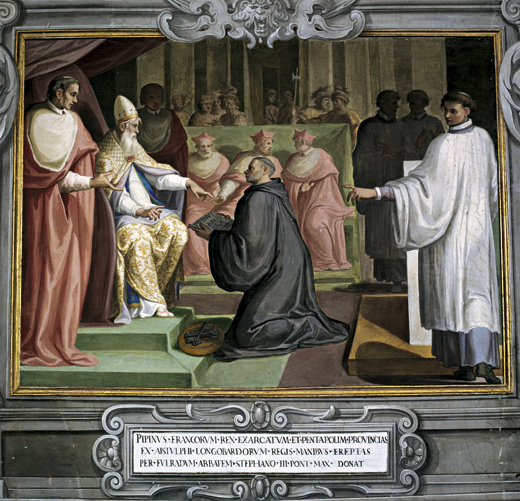
Carloman did not take the reverses in Rome lying down, sending envoys in an attempt to persuade the pope to reverse his decision. He threatened to invade Italy to break up the ‘unholy’ alliance. To counter Carloman’s attempts Desiderius marched his Lombard army on Rome. Stephen welcomed Desiderius’ men and informed Carloman’s faction in Rome that they did not have his support. Carloman’s agents were put to death on the pope’s orders.

The three way alliance of the papacy, Charles and Desiderius was thrown into disarray with the death of Carloman on 4th December 771. Carloman died at Samoussy; his death was recorded as being of natural causes.

Charles immediately travelled to Laon where his brother’s body lay. He wanted his brother’s men to swear allegiance to him. By Frankish law Carloman’s sons should have inherited their father’s domains, but the Frankish lords cannot have wanted two young infants as their kings.

Hildegarde
A number of Carloman’s liege men readily swore allegiance to Charles but others had to be bribed or wooed. There was little dissent at Charles’ takeover of his nephews’ lands, with the notable exception of Bertrada and Charles’ cousin Adalhard of Corbie[i].

Einhard records;

‘Upon the death of Carloman, his wife with her sons and some of the leading nobles fled to Italy, and, for no obvious reason[ii], passed over her husband’s brother, and placed herself and her children under the protection of Desiderius, King of the Lombards.’[iii]

Charles returned his wife to her father; Charles no longer needed the Lombard alliance. In Desiderata’s place Charles married Hildegard, daughter of Count Gerald of Vinzgau and granddaughter of the Duke of Alamannia. Hildegard was chosen to help win the allegiance of the nobles of Alamannia[iv].

 
Family Life


Charles at dinner (medieval manuscript)
Charles and Hildegarde’s first child Charles the Younger was born the following year. Like any woman of the time, Hildegard spent much of the twelve years of her marriage producing children, six of whom lived into adulthood. In 773 she gave birth to Carloman (later renamed Pepin) and in 774 a daughter Adalhaid, born while her parents were in Italy, she died the same year.

Hildegarde then had a break for three years after which she produced another four children in a row; Rotrude, Louis[v] and his twin Lothair who died two years later and Bertha in 779. Gisela was born in 781 and Hildegarde in 782.

By 773 Charles had a concubine named Gersuinda who bore him a daughter named Adaltrude in 774. The following year Charles added another concubine to his harem, Madelgard who bore a daughter in 775 named Ruodhaid[vi].

According to Einhard Charles did not neglect his children’s education’

‘In educating his children he determined to train them, both sons and daughters, in those liberal studies to which he himself paid great attention. Further, he made his sons, as soon as their age permitted it, learn to ride like true Franks, and practise the use of arms and hunting. He ordered his daughters to learn wool work and devote attention to the spindle and distaff, for the avoidance of idleness and lethargy, and to be trained to the adoption of high principles.’[vii]

War with the Saxons


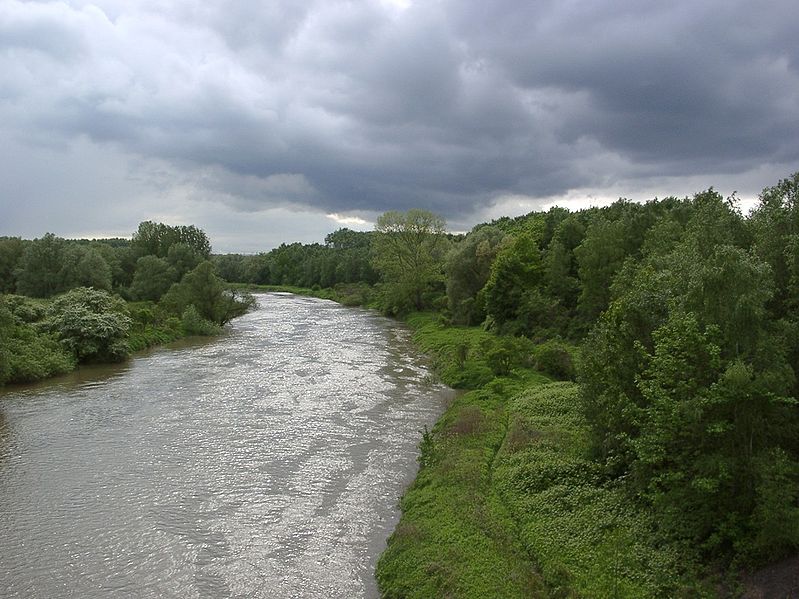
Lippe River
To the north of Charles’ new enlarged kingdom lay the lands of the Saxons, long regarded as barbarians by the Romans. The continual border clashes resulting from the Saxons desire for the more hospitable lands southwards and population pressures meant that any peace treaties did not last long. The religious divide exacerbated the problems; north of Francia the inhabitants adhered to the old gods; oaths made on them did not impress the Christian negotiators and vice versa.

‘For the Saxons, like most of the races that inhabit Germany, are by nature fierce, devoted to the worship of demons and hostile to our religion, and they think it no dishonour to confound and transgress the laws of God and man.’[viii]


Charles' men destroy the Irminsul (19th century)
In 772, following a Saxon incursion over the Lippe[ix], Charles launched an invasion across his northern border, the curtain raiser to two decades of war. In the spring Charles held a conclave of all his nobles at Worms[x], and it was from here that the army;

‘Marched first into Saxony. Capturing the castle of Eresburg, he proceeded as far as the Irminsul[xi], destroyed this idol, and carried away the gold and silver which he found.’[xii]

In this campaign Charles was acting as the spear man for the Christian fight against the pagans in northern Europe. Churchmen had long been associated with the throwing down of foreign idols and converting pagans to the way, the truth and the light, now a political leader was doing the same. This joining of safeguarding his borders, possible expansion in the north and the church was to be a focus of Charles’ early reign.

Charles’ people regarded Saxon practices of human sacrifice and the burning alive of criminals with loathing[xiii]. They felt that their culture was superior to the Saxons and that they were conducting a war blessed by God, their weapons being blessed by priests for God’s holy work. Following destruction of the Irminsul the Franks returned home. This was only the first shot in a bitter fight.

The Return of the Lombards


Charles meets Hadrian (medieval)
In early 772 Pope Stephen died and Hadrian was elected pontiff in his place. This change of pope led to a collapse of the alliance with the Lombards and once again Desiderius was well placed to threaten Rome. When he received the pope’s call for help in the Autumn of 773 Charles decided to attempt a crossing of the Alps before the winter snows made the passes impossible to travel.

The Frankish army’s successful passage through the Great St Bernard Pass meant that Desiderius had to fall back on Pavia which Charles then besieged. Desiderius assumed that winter would take its toll of Charles’ army and then Charles would retreat to Francia, his tail between his legs. Charles managed to maintain the unity of his army throughout the long winter months; it was the citizens of Pavia who suffered most from hunger and disease.

Einhard recorded that;

‘Charles….did not stop [fighting] until he had received the surrender of King Desiderius, whom he had worn down after a long siege; until he had forced his son Adalgis[xiv]….to fly not only from his kingdom but from Italy; until he had restored to the Romans all that had been taken from them’[xv]


The Iron Crown of Lombardy
Having expected that Charles would demand large amounts of loot and then march home Desiderius was shocked, when suing for peace at midsummer 774, to find himself a prisoner with his family while Charles placed the iron crown of Lombardy[xvi] on his own head.

During this Italian trip Charles took time out to visit Hadrian; he was rapturously received in Rome. Charles wanted to make clear to his subjects the closeness of his relationship with Hadrian as he needed the support of the church to enforce his control over his disparate peoples. Charles was determined not to be just the pope’s poster boy, but he intended to keep his own counsel and look out for his best interests. He would not put the needs of the church above those of Francia.

Hadrian on his part wanted Charles to curb the antics of Leone I, Archbishop of Ravenna, who refused to accept the pope’s authority. There were papal lands under the control of unauthorised persons and these included the Franks. Hadrian was concerned that he had exchanged the threat of Desiderius for Charles who for his part was not prepared to jump when Hadrian demanded it. He was unimpressed and determined to return home.

Bibliography

The Cambridge Illustrated History of the Middle Ages – Robert Fossier (ed), Cambridge University Press 1989
The Oxford History of Medieval Europe – George Holmes, Oxford University Press 2001
The Year 1000 – Robert Lacey & Danny Danziger, Abacus 2007
Absolute Monarchs – John Julius Norwich, Random House 2011
Emperor of the West – Hywel Williams, Quercus 2010
Charlemagne – The Great Adventure – Derek Wilson, Hutchinson 2005
www.wikipedia.en


[i] Adalhard later reconciled with his cousin and became a counsellor to Pepin of Italy when he reigned in Italy
[ii] Einhard was being more than disingenuous here
[iv] Hildegard’s brother Gerold was chosen to be Prefect of Bavaria when Bavaria was incorporated in Charles enlarged kingdom in 788
[v] Known as Louis the Pious
[vi] Later Abbess of Faremoutiers
[ix] A border fortified originally by the Romans
[x] A favoured residence of the Carolingian kings
[xi] An ancient tree trunk the Saxons believed was one of the pillars of the heavens
[xii] Charlemagne - Wilson
[xiii] There are some reports that the Saxons practised cannibalism; certainly the Franks believed this was so
[xiv] In joint kingship with his father
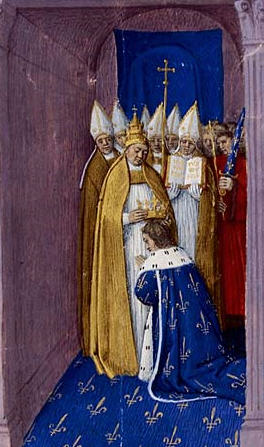
[xvi] The crown allegedly had a nail from the true cross worked into the golden circlet

Monday, 2 May 2016

Emperor of the West - Charlemagne


Pepin the Short
A Time of Consolidation

Pepin the Short was the son of the Frankish prince Charles Martel. When Charles died in October 741, Pepin was the Mayor of the Palace[i] of Neustria while his brother Carloman took the position of Mayor of the Palace at Austrasia[ii]. Pepin took Austrasia from his brother’s son Drogo a year after his brother retired to the monastery at Monte Cassino in August 747[iii]. Drogo resisted Pepin’s annexation of Austrasia until his capture in 753; he was then imprisoned.

In 750 an emissary from Francia travelled to Rome; it would appear that Pepin had decided to clear up what was clearly to him an analogous position; he wrote to Rome for clarification; should the Frankish throne belong to one who had no ‘kingly powers’? Abbot Fulrod and Bishop Burchard’s trip produced the required answer;

Pope Zacharias instructed Pippin that it was better to call him king that had power than him without royal power.’[iv]

By 751 King Childeric III[v] had been deposed and Pepin elected King Pepin III and annointed by Archbishop Boniface.

A Son and Heir
Einhard
Charles was Pepin’s son elder son by his then leman Bertrada of Laon. Records are divided about Charles[vi] exact date of birth[vii], but he was probably born in April 742. Pepin and Bertrada got married in 749, legitimising Charles’s position as his father’s heir. Their second child Carloman was born in 751 and their daughter Gisela[viii] was born in 757[ix].
There is very little record about Charles’s early years. Even Charles’s earliest biographer Einhard[x] was wary of writing about Charles’s infancy;

‘It would be foolish of me to say anything about his birth and infancy, or even about his boyhood, for I can find nothing about these matters in writing, nor does anyone survive who claims to have personal knowledge of them.’[xi]

The children were not sent away to the abbey school of St Denis in Paris as their father had been; possibly Pepin was afraid that Charles and Carloman might be kidnapped or murdered. Instead the boys stayed with Pepin’s peripatetic court as it made its way around Pepin’s territories.

Pepin had the boys educated along with the sons of his most trusted followers, learning to ride and fight. Military training began in earnest at the age of six and the children were taken on campaigns. Charles learned his letters but never learned to write, something he much regretted in later life. Both Charles and Gisela were imbued with a love of culture and learning, possibly from the circle of scholars that surrounded their mother.

Learning the Art of Kingship

I
Pope Stephen II
n 753 when
Pope Stephen II made his journey across the Alps at the end of 753 Pepin sent the eleven year old Charles as head of the welcoming party. Stephen’s mission was to gain allies to fight off the threats from the Lombards and from Al-Andalus[xii].

During his stay Stephen re-consecrated Pepin as king of Francia at St Denis; Charles and Carloman were both included in the ceremony. Two years later the boys both took part in another important ceremony in Auxerre; the transfer of the bones of St Germanus to a new shrine.

Pepin’s rule now stretched from the Atlantic coast to the Danube. When Charles was fifteen Pepin assigned his older son over-lordship of several duchies, including some whose loyalty was suspect. Pepin’s major problem was Aquitania where the local dukes, assisted by their neighbours the Vascones, resisted Frankish sovereignty. Pepin fought in the southwest year after year and Charles and Carloman took an increasingly prominent part in the expeditions.


In June 768 one of the main dissidents Duke Waiofar was assassinated by some of his own fighters. The end of the fighting in Aquitania found Pepin a sick man, who managed to wend his way to St Denis and made provision for his children before dying in September. The three provinces of Austrasia, Neustria and Aquitania were divided into half and Charles and Carloman each received their halves as required by Frankish law.

‘[Pepin] died at Paris of the dropsy, and left behind him two sons, Charles and Carloman, to whom by divine will the succession of the kingdom came. For the Franks called a solemn public assembly, and elected both of them to be kings.’[xiii]

Neither brother was pleased with the end result.

Ruling in Tandem

Francia at Pepin's death
Charles and Carloman were consecrated as kings of their respective domains at the Abbey of St Denis on St Denis’ saint’s day of 9th October 768. Charles was twenty-five and Carloman eighteen, neither of them ready to submit to the direction of others. Carloman’s lands included Paris and Soissons[xiv] cutting Charles’ lands from direct access to Rome. Charles’s resentment increased when, the following year, Aquitania rose in revolt; he called on Carloman to come to his assistance.

The two brothers met in Vienne and immediately started arguing. Carloman led his army home and Charles marched his to Aquitania and an easy victory over the rebels. The ease of his victory did not assuage Charles’s anger at Carloman.

In 770 both brothers became fathers for the first time. Carloman’s wife Gerberga gave birth to a boy that Carloman named Pepin after his father[xv]. A few months later Charles’s partner Himiltrud gave birth to a boy who was also named Pepin[xvi]. This increased the rivalry between the two brothers.

Pope Stephen was concerned about consolidating his position as the legitimate pope[xvii] and for that needed strong allies in the Frankish kings. Having Carloman and Charles at odds with each other did not serve his purposes. Stephen wrote to the two brothers urging them to ensure the observance of

‘The rights of the Prince of the Apostles.’[xviii]

The pope’s main supporter in Italy Desiderius King of the Lombards was refusing to honour a commitment[xix] to return five Italian coastal towns to papal rule and he had made Sergius, one of his supporters, Archbishop of Ravenna[xx] undermining Stephen’s rule.

Discord

Carloman had agents in the papal entourage; Christopher and his son Sergius were leading officials in the papal bureaucracy. Carloman’s contacts in Rome were more influential that Charles’. But Christopher and Sergius were hangovers from the previous pope[xxi] whom Stephen viewed with suspicion. Bertrada was concerned that the conflict between Charles and Carloman could endanger her husband’s legacy.

Bertrada emerged from the home[xxii] she had ensconced herself in and journeyed across the Alps. She first visited Carloman to urge him to stop intriguing against Charles, a thankless and unsuccessful task. Her next stop was the court of Duke Tassilo III, Duke of Bavaria, married to one of Desiderius’ daughters.

En route to Bavaria Bertrada conceived the plan of marrying Charles to another of Desiderius’s daughters. This would give Charles an alliance with both Bavaria and Lombardy and giving him the access to Rome that he needed. With the support of Tassilo Bertrada then travelled on to her final destination for a conference with the pope. Stephen was horrified by the idea, sending messages north warning Charles not to ally himself with;

‘The faithless and most vile Lombard people.’[xxiii]

Ignoring Stephen’s plea Charles put aside Himiltrude[xxiv] to marry Desiderata[xxv]. The new alliance resulted in an agreement over the vexed question of the five towns which were returned to papal control; Carloman’s contacts in the papal entourage lost their places and eventually their lives after being blinded by Desiderius’ men. Desiderius’ appointment of Archbishop of Ravenna was replaced by Leone I, a man of Stephen’s choosing.

Bibliography

The Cambridge Illustrated History of the Middle Ages – Robert Fossier (ed), Cambridge University Press 1989
The Oxford History of Medieval Europe – George Holmes, Oxford University Press 2001
Absolute Monarchs – John Julius Norwich, Random House 2011
Emperor of the West – Hywel Williams, Quercus 2010
Charlemagne – The Great Adventure – Derek Wilson, Hutchinson 2005
www.wikipedia.en


[i] Manager of the Frankish king’s household
[ii] The two brothers forced their half-brother Grifo into a monastery when he dared to demand a share in the hand-outs when Charles Martel died. Grifo escaped and caused trouble in Aquitania before dying in battle in 753
[iii] It is possible that Carloman and Pepin came to an agreement that Pepin, without legal heirs at the time, would name Drogo has his heir
[iv] Emperor of the West - Williams
[v] The last of the Merovingian dynasty
[vi] Or Karolus; known to posterity as Charlemagne
[vii] Anywhere from 742-8AD
[viii] Later Abbess at Chelles Abbey
[ix] Bertrada had five other children who died in infancy
[x] One of Charles’s courtiers
[xii] Islamic Spain
[xiv] The old capital
[xv] In doing so Carloman was laying claim to be his father’s successor
[xvi] He was called Pepin the Hunchback which may explain why Charles did not marry Pepin’s mother
[xvii] The death of Pope Paul I had led to vicious infighting and two rival nominations for pope who were removed by the rival groupings, one led by King Desiderius of Lombardy who had Pope Constantine II’s eyes put out and placed his candidate Philip on the papal throne
[xviii] Emperor of the West - Williams
[xix] Made to Pepin the Short when campaigning on behalf of the Holy See
[xx] One of the towns in question
[xxi] Pope Zachary
[xxiii] Charlemagne - Wilson
[xxiv] There is a possibility that Charles and Himiltrude were married
[xxv] Also known as Ermengarda