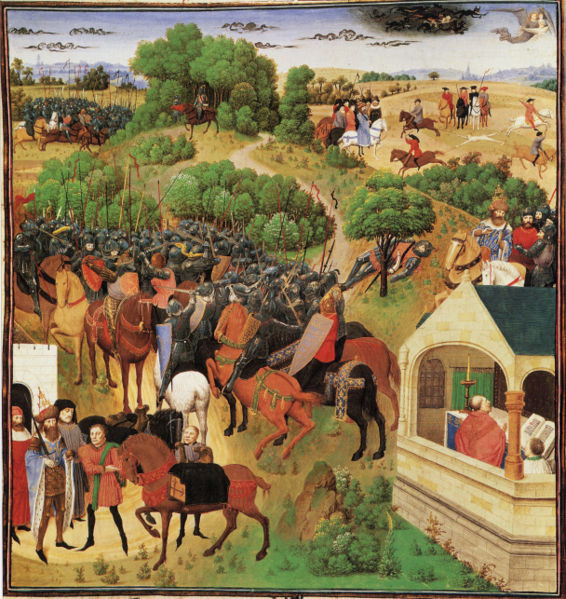
Tuesday, 24 May 2016

Emperor of the West – Charlemagne IV


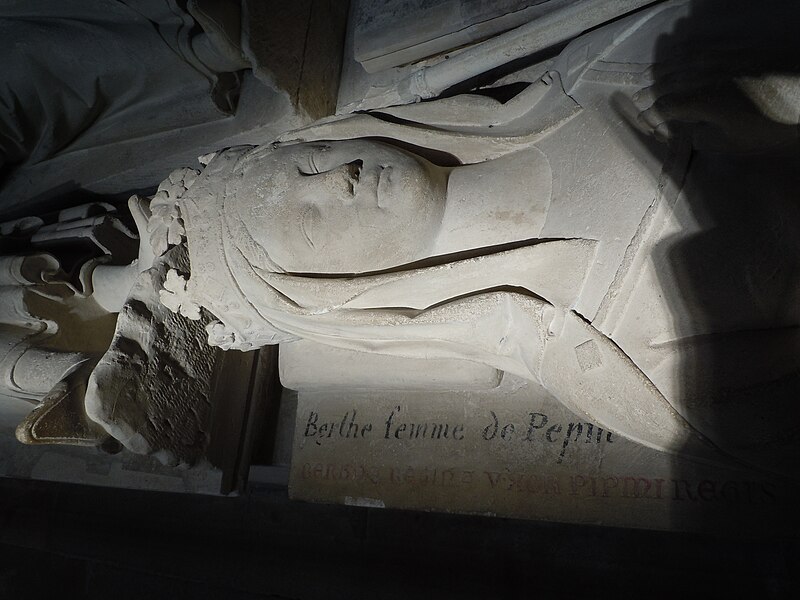
The tomb of Bertrada of Laon
Charles’ Family 

On 30th April 783 Hildegard died[i] at Thionville in the same year that her daughter Hildegarde died. Bertrada of Laon died in the summer and Charles buried his mother next to his father in the basilica of St Denis.

‘Bertrada died after the death of Hildigard, having lived to see three grandsons and as many granddaughters in her son’s house. Charles had his mother buried with great honour in the same great church of St Denys in which his father lay.’[ii]

Charles married his third wife Fastrada in 784 and she had a daughter Theodrada[iii]; her second child was Hiltrude born in 787.


Despite close chaperonage Charles’ daughter Rotrude had an affair with Rorgon[iv], and in 800 had a son named Louis. There was talk that Bertrada might be married off to King Offa of Mercia. Instead she had a long and passionate affair with one of her father’s closest friends, Angilbert[v], a courtier, warrior, poet, scholar and religious leader. There is dispute over whether the couple were married, but they had two sons, one of them Nithard, born in 795, became a historian. Once Angilbert, when he was away on official business, wrote a poem he sent to Bertrada, referring to the couple’s children;
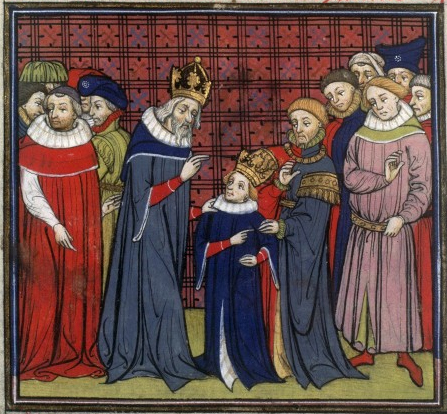

Charles with his son Louis
‘Tell the boys, poem of mine, to keep safe by God’s mercy within their walls from fire and thief and sickness.’[vi]

Charles did not approve marriages for any of his daughters[vii]; instead they were placed into positions of power within the church as Abbesses. Their illegitimate children were provided for in the same way.

In 781 Charles had his son Carloman (whom he had renamed Pepin) anointed "king of Italy" and crowned by Hadrian with the Iron Crown of Lombardy. Pepin’s younger brother Charles was anointed king of Aquitaine. Charles’ youngest son Louis, who was only 3-years old, was appointed sub-king of Italy and Aquitaine.

Educating Francia
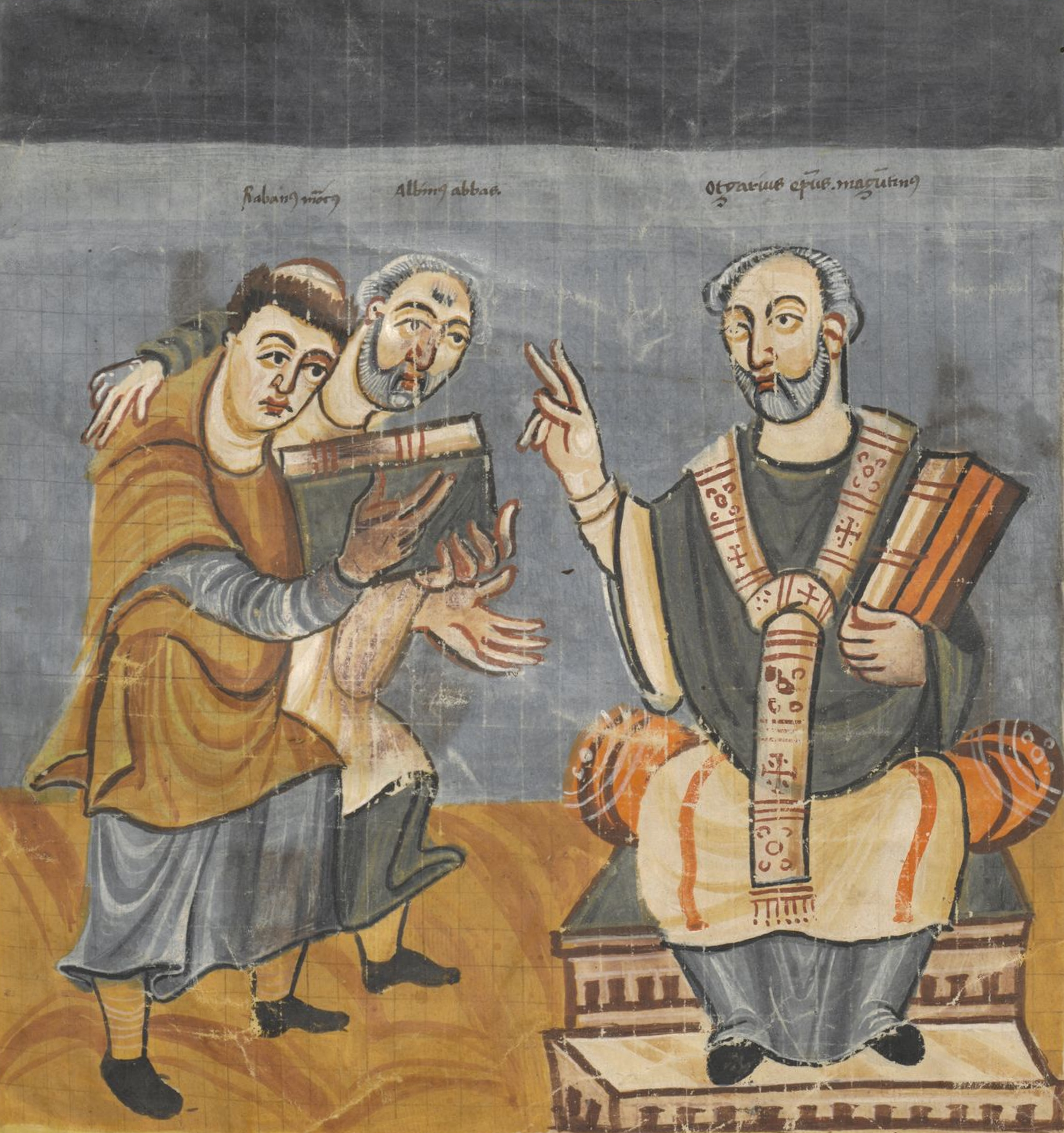

Alcuin of Northumberland 
From the very beginning of his reign Charles had plans for role of education in Francia. The French politician and historian Franรงois Guizot[viii] said of Charles;

‘His predominating idea was the design of civilising his people.’[ix]

Charles had grown up in his father’s sophisticated court where he met many of the premier prelates of the day.

Charles and his advisers were concerned to rule Francia in accordance with God’s will. And for that the clergy needed educating. A series of Capitularies decreed the restoration of strict canon law in the church, conformity of rule in monasteries and correct Christian living throughout the kingdom.

In 782 Charles invited Alcuin of Northumbria[x] to join his court. Charles’ sister Gisela was an active supporter of Alcuin’s work. Alcuin was to play an important role in Charles’ cultural and religious ambitions. He ran the palace school for 14 years, where the sons of kings and princes and the nobility came to be instructed in the trivium and the quadrivium[xi]. To provide the school with texts Charles had agents scouring libraries for interesting manuscripts which were copied in his ever busy scriptoriums.

Charles was fascinated by astrology almost as much as he was by the bible and the heads of the early church. According to Einhard;

‘[Charles] paid the greatest attention to the liberal arts….For his lessons in grammar he listened to the instruction of Deacon Peter of Pisa, an old man; but for all other subjects Albinus, called Alcuin, also a deacon, was his teacher…. the most learned man of his time. Charles spent much time and labour in learning rhetoric and dialectic, and especially astronomy, from Alcuin.’

Peter of Pisa not only taught Charles grammar, he also taught him Latin, the language of the church. Charles efforts to improve his reading and writing came to naught, despite keeping notebooks under his pillow to enable him to work in snatched moments of free time.

Bavarians
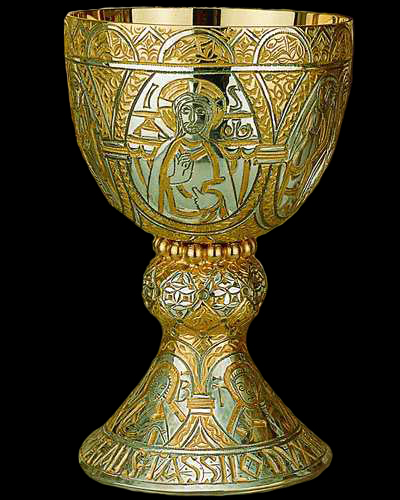

The Tassilo Cup
Duke Tassilo of Bavaria, a cousin of Charles and son-in-law of Desiderius, asserted his independence of the Franks. Both Pepin the Short and Charles took the view that Bavaria was a vassal state. Tassilo occasionally provided troops for Charles’ armies, but occasionally declined to attend the annual gatherings of Frankish nobles. In 781 Hadrian told Tassilo to;

‘Remember his former oaths and not to go back on his long-standing pledge to the Lord King Pepin, the great Lord King Charles and the Franks.’[xii]

Hadrian’s poking his nose into this squabble probably resulted from Tassilo’s interference in church affairs in Bavaria, deeply resented by the bishops there. In a separate decision, that doomed Tassilo, Charles decided that he needed direct control over the eastern Alpine passes and the Danube valley[xiii].

Hadrian assisted Charles in putting pressure on Tassilo and when Tassilo sent envoys to Rome in 787, he pronounced an anathema on Tassilo. Charles ordered Tassilo to present himself at Worms and ratify an oath of loyalty, a journey Tassilo was reluctant to undertake.
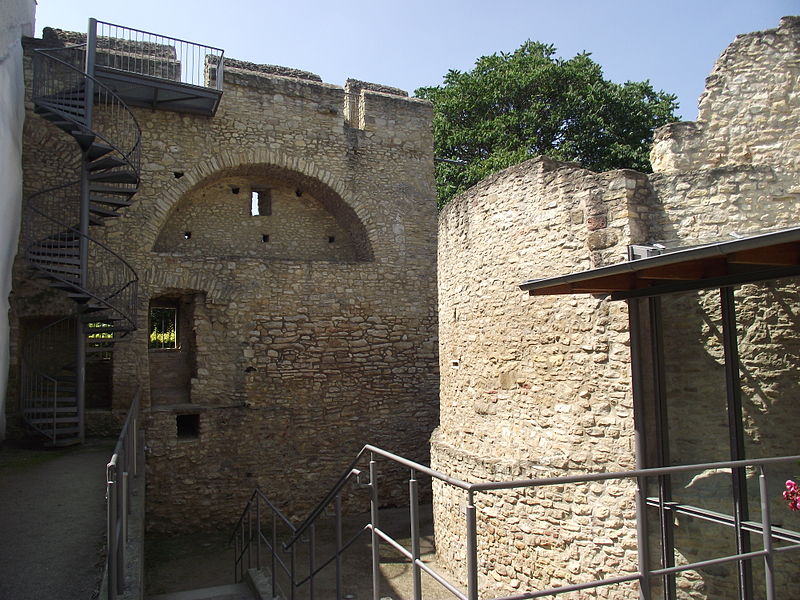

Charles' villa at Engelheim
Charles reacted by sending three armies into Bavaria; he led the army that crossed the Danube near Regensburg. Another army under Pepin’s titular leadership crossed the Alps from Italy. Tassilo had no choice but to surrender his lands to Charles. He was allowed to yield up his dukedom, but within months was charged with plotting rebellion with the Avars in the lands bordering Bavaria.

Tassilo, his family, treasure and household were taken to Charles’ villa at Engelheim and there was tried and convicted after he confessed. Tassilo and his sons were forcibly tonsured and sent to separate monasteries, while his wife was exiled.

For his part Hadrian’s problems in Italy were lessened when, on 26th August 787, Arechis II, Duke of Benevento, died. His son Grimoald III, was a hostage of the Franks. In 788 Charles’ son Charles the Younger made Grimoald a client of the Frankish kingdom.

And Barbarians

Abrodites' territory
In 789 Charlemagne marched an Austrasian-Saxon army across the Elbe into Abodrite territory. The Slavs ultimately submitted, led by their leader Witzin. Charles accepted the surrender of the Wiltzes under Dragovit demanding hostages. Charlemagne insisted on the right to send missionaries into the area and that they not be molested. The army marched to the Baltic before turning around and marching to the Rhine. The army returned home with a large amount of booty that had been easily won. The tributary Slavs became loyal allies.

Following the campaigns in the north Charles turned his attention to the Avars, a tribe centred in the Lower Danube basin. By early 7th century they dominated the area[xiv]. Their dominancy was threatened by the Bulgars who forced the Avars westwards towards Bavaria[xv]. In 791 the Avars raided into Bavaria and when they were repulsed offered hostages and conversions.


Charles decided to personally see off the Avar attack. At the head of a large army, before crossing into enemy territory, Charles ordered three days of prayer and fasting to ensure divine aid. The opposition crumbled; allowing the Franks to strike deep into Avar territory. The Avars had been weakened by the Bulgars and internal strife.
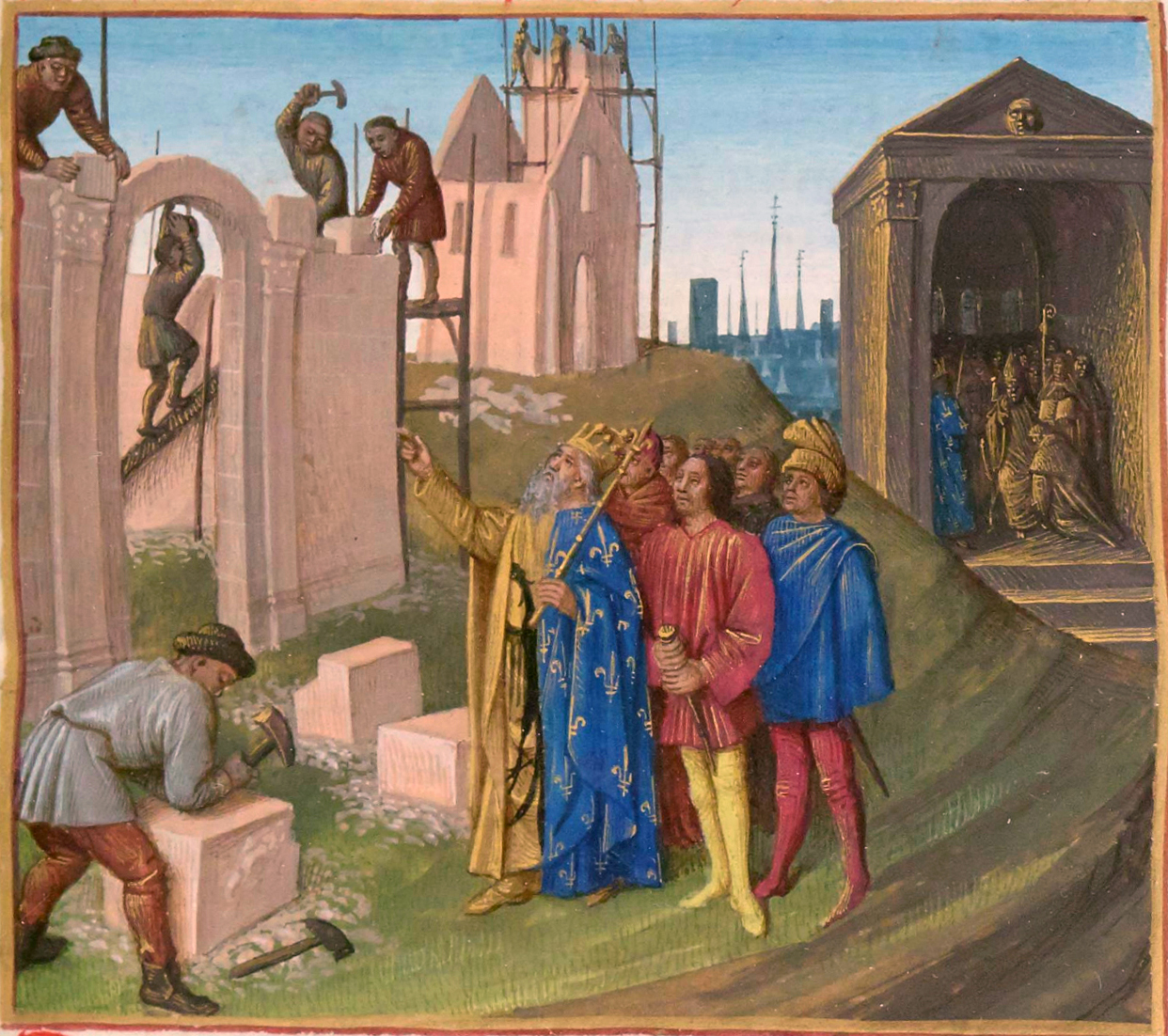
Charles inspecting the work on his palace at Aachen
The Royal Frankish Annals record that;

‘[Duke Erik] dispatched his men under the command of the Slav Wonomir into Pannonia and had them plunder the ring[xvi] of the Avars…..the duke sent the treasure of the ancient kings[xvii]….to the Lord King Charles at the palace at Aachen.’[xviii]

Charles donated part of the haul to the pope and gave rewards to his counts and dukes. But much of his prize was devoted to building himself a new capital city at Aachen[xix]. The architect whose job it was to create Charles’ vision was Odo of Metz, responsible for the palace Charles built there.

The expeditions against the Avars secured Charles’ eastern borders, although he made no effort to include the Avar territory in his kingdom. The marches of the Danube provided a buffer zone between Francia and the Balkans with whose tangled affairs Charles had no desire to involve himself in.

Bibliography

Celts and Saxons – Peter Berrisford Ellis, Constable and Company Ltd 1995
The Cambridge Illustrated History of the Middle Ages – Robert Fossier (ed), Cambridge University Press 1989

The Holy Roman Empire – Friedrich Heer, Phoenix 1999
The Oxford History of Medieval Europe – George Holmes, Oxford University Press 2001

The Year 1000 – Robert Lacey & Danny Danziger, Abacus 2007

Absolute Monarchs – John Julius Norwich, Random House 2011

Emperor of the West – Hywel Williams, Quercus 2010

Charlemagne – The Great Adventure – Derek Wilson, Hutchinson 2005

www.gutenberg.org

www.wikipedia.en


[i] Possibly worn out by birthing nine children
[iii] Date of birth possibly 785; later Abbess of the convent at Argenteuil
[iv] Later the Count of Maine
[v] Made a saint
[vi] Charlemagne - Wilson
[vii] It has been postulated that Charles was concerned about setting up potential rivals
[ix] Charlemagne - Wilson
[x] A disciple of the Venerable Bede and later Abbot of St Martin at Tours
[xi] Together these made up the seven liberal arts
[xii] Charlemagne - Wilson
[xiii] A trade route down to the Black Sea
[xiv] In 626 they even threatened Constantinople and only their lack of sophisticated siege weapons halted their attack
[xv] In turn the Bulgars were being ousted by the Byzantines who were reasserting control over former possessions.
[xvi] In Hungary; the central stronghold of the Avars; believed to have been sited in the plain between the Danube and the Tisza. It was defended by ten circular concentric earthworks.
[xvii] So much treasure was held in the ring that Charles sent a second expedition under Pepin to retrieve the remainder
[xviii] Charlemagne - Wilson
[xix] Popular with the Romans for it’s hot springs

Tuesday, 17 May 2016

Emperor of the West – Charlemagne III

Carolingian currency


Attack is the Best Form of Defence

Charles’ return to his kingdom was predicated by the need to deal with the Saxons who were once again causing problems. Charles was a ruler able to view events on a long term basis; he realised that in order to stabilise his northern borders the regions to the north needed pacifying. In 776 he began construction of a fortress at Paderborn[i], near the source of the river Pader, deep inside territory formerly belonging to the Saxons.

In 777 Charles held his spring review with his nobles amid the construction site that was Paderborn. His standing was increased by the attendance of an envoy from Al-Andalus seeking Charles’ assistance. Charles was becoming a personage, a counter to the power of Constantinople.

One of the most formidable of the Saxon warriors was a champion named Widukind. He was to be a thorn in the Frankish side for many years, conducting raids into Francia and then retreating into the marshes of his homeland or into Nordmannia or Frisia. While not very competent militarily Widukind was a hero to his people and helped stiffen resistance to the invading Franks.

Frisia
In 779 the campaigning season took the Franks to the Saxons’ northern border with the Slavs. The East Saxons put up little resistance and there were mass conversions to Christianity. According to Einhard;

‘Sometimes they were so cowed and broken that they promised to abandon the worship of devils and willingly to submit themselves to the Christian religion.’[ii]

Charles established churches and monasteries in the newly captured lands in an attempt to encourage the unconverted to see the light[iii]. The Saxons’ resolve and their ability to field armies season after season remained undiminished, an annual drain on Charles’ finances. Both sides lost thousands of fighting men and the line between the two territories was very fluid and varied from season to season.

Campaigning in Spain

Umayyad Caliphate in 750
Charles’ expedition into Islamic Spain in 778 was encouraged by Pope Hadrian who wanted to expand Christian influence throughout the peninsula and eliminate the Muslim presence[iv]. The Muslims in the western Mediterranean were in disarray following the overthrow of the Umayyad Caliphate by the Abbasids. In Spain Abd al-Rahman I[v] resisted the Abbasid revolution and instituted an independent caliphate with a capital in Cรณrdoba.

Abd al-Rahman was opposed by supporters of the Abbasids, religious dissidents and local leaders bidding for independence. Sulaiman ibn Yaqdhanu’l-A’rabi, the wali of Barcelona, headed the opposition which included a number of Muslim princelings holding sway over the lands between the Ebro and the Pyrenees. Those opposing Al-Rahman sent envoys to Paderborn, calling on Charles for assistance to rid them of this interloper.

Charles led an army into Islamic Spain where he was able to take Pamplona, a city damaged by earlier internecine wars. He then marched on to Zaragoza while a second army travelled to Barcelona. The garrisons of both cites refused to admit their nominal allies, the Franks. Sulaiman had been murdered by one of his colleagues and the anti-al-Rahman clique fell into disarray. Al-Rahman marched northwards sweeping the rebels before him and Charles had no option but to retreat homewards.

Einhard tells a different story. According to him;

‘Charles attacked Spain with the largest military expedition that he could collect. He crossed the Pyrenees, received the surrender of all the towns and fortresses that he attacked.’[vi]

Charles may have felt pressured into accepting the rebels’ invitation in order to match the reputation of his grandfather Charles Martel who, in 721, who pushed the Muslims out of Aquitaine and back over the Pyrenees[vii].


Battle of Roncevalles
It was at the end of this Spanish campaign that Charles suffered his greatest defeat, glorified in the Chanson du Rolande written in the 11th century. The original crossing into al-Andalus over the Pyrenees had made enemies of the Gascons living in the mountains, they objected to the taking of Pamplona. On the Frankish army’s return to Francia, circa 15th August, the Gascons attacked at Roncevalles.

Einhard records that the dastardly Gascons attacked the Frankish army marching enfilade through the narrow valleys, at the battle of Roncevaux Pass.

‘For while his army was marching in a long line….the Gascons placed an ambuscade on the top of the mountain….and then rushing down into the valley beneath threw into disorder the last part of the baggage train and also the rearguard which acted as a protection to those in advance. In the battle which followed the Gascons slew their opponents to the last man.’[viii]

One of Charles’ captains, Roland died during the battle, along with a number of Charles’ friends and leading nobles. The humiliation of this defeat did not lower Charles’ standing in Francia.

Charles’ southern frontier was safe from attack as successive caliphs were too involved in internal problems to worry about expanding the caliphate northwards. The Christian kingdoms of Asturias, Navarre, Leon, Castile and Aragon were a buffer zone between Charles’ lands and al-Andalus.

Massacre at Verden

Charles was caught in a fight to the death with his neighbours, having staked his reputation as a leader on the fight. His treatment of the Saxons, who would not give way, became ever more savage. Failing to conquer all of Saxony would deleteriously affect the cohesion of the Franks who were drawn on by the promise of riches.

In 782 the majority of Saxon leaders, bar Widukind, capitulated to the Franks. Charles then enforced a number of constraints on the Saxons; making it illegal to destroy or raid churches, kill priests or refuse baptism. He also imposed military service on the Saxons to take the fight to the Slavic tribes on the northern borders. In retaliation Widukind rallied his fellow Saxons and rose up against the Franks. By the spring of 783 the uprising was widespread.

River Aller
Three of Charles’ captains precipitately led the Frankish army into the battle of Sรผntel and lost most of their men including two of the three captains and two Counts. From his base in Auxerre Charles led a second army into Saxony and summonsed the Saxon leaders to resubmit themselves to his authority. Widukind fled yet again and his fellow leaders surrendered the warriors who fought in the battle. Charles authorised the massacre of the 4,500 Saxons[ix] at Verden, beheaded near the river Aller. The Royal Frankish Annals comments;

‘The Lord King Charles rushed to the place with all the Franks that he could gather on short notice and advanced to where the Aller flows into the Weser. Then all the Saxons….surrendered the evildoers who were chiefly responsible for this revolt to be put to death—four thousand and five hundred of them. This sentence was carried out. Widukind was not among them since he had fled to Nordmannia.[x]

Trouble Abroad

Ardennes
Even the massacre did not stop the fighting; Charles had to campaign in 783 and 784 and beyond. Charles was aware that Widukind was a voice that needed silencing. In 785 Charles offered Widukind safe passage to his villa[xi] at Attigny in the Ardennes. The two men met there in the autumn where Charles showered his visitor with gifts and a pardon in return for which Widukind was baptised on 25th December with Charles standing as his godfather.

The conversion of this renegade did not mean an end to the fighting which continued sporadically until 805. Charles arranged the government of Saxony, less as a colony, more an integral part of his kingdom leaving him free to concentrate his attention elsewhere.

Alongside the later campaigns against the Saxons Charles was having problems ruling his lands in Italy. The distances between his capital and Lombardy meant that Charles could not provide speedy decisions for problems emanating from Italy. The independence of Spoleto and Benevento were thorns in the side of the papacy while Benevento remained good relations with Byzantium[xii] which regarded it as a client state in the west.

Joining East and West

Constantine VI with his father Leo IV
The eastern empire was undergoing its own woes with the Iconoclastic Controversy[xiii]. In both east and west there were Islamic states pressing for further victories, while only Charles was extending Christianity in the north. This role increased Charles kudos as a counter-balance to Byzantium, making his support ever more attractive to the pope.

In 781 the Byzantine Empress Regent Irene began negotiations with Charles for Rotrude to marry her son Constantine VI. Irene went as far as to send an official to instruct Rotrude in Greek; but in 787 Irene broke off the engagement against her son's wishes[xiv]. Irene demanded that Rotrude be sent to Constantinople and Charles refused, breaking the agreements between the two empires.

Irene had looked for Charles support for the restoration of the practise of venerating icons, but events conspired against her. Constantinople had provided a safe harbour for Desiderius’ son Adelchis and Irene refused to return him. And Hadrian had no desire to see a rapprochement between the major powers in the west the east; he preferred to be a pivot between the two.

In retaliation to the breakdown of the agreement in 788 Irene sent an army into Italy, headed by John the Military Logothete, The army was aided by the Byzantine Governor of Sicily, Theodore. The Byzantines aimed to occupy Benevento, but the citizens, aided by the Lombards, fought off the invaders who retreated ignominiously.

Bibliography

Celts and Saxons – Peter Berrisford Ellis, Constable and Company Ltd 1995
The Cambridge Illustrated History of the Middle Ages – Robert Fossier (ed), Cambridge University Press 1989
The Oxford History of Medieval Europe – George Holmes, Oxford University Press 2001
The Year 1000 – Robert Lacey & Danny Danziger, Abacus 2007
Absolute Monarchs – John Julius Norwich, Random House 2011
Emperor of the West – Hywel Williams, Quercus 2010
Charlemagne – The Great Adventure – Derek Wilson, Hutchinson 2005
www.wikipedia.en


[i] He may have intended Paderborn to be his new capital
[iii] There may very well have been many instances of forced conversions
[v] His family had been ejected from Damascus in 750
[ix] The figure is disputed
[xi] Built by Clovis II
[xii] Byzantium also owned lands in southern Italy
[xiii] The first of two disputes in part over whether religious pictures should be shown in churches
[xiv] Increasing enmity between mother and son