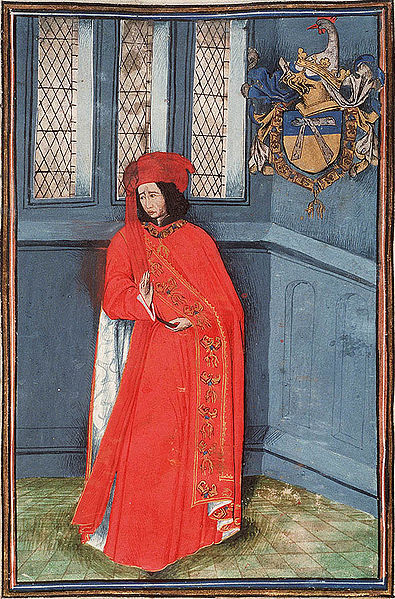
Sunday, 10 September 2017

Philip the Good VIII


Margaret of Anjou
Tumult In England

As a result of the Anglo-French agreement the English, now on the losing side of the war, were looking to ally themselves closer to Charles VII, in the hope that this might at the very least slow the rate of attrition. The death of the Duke of Somerset in May 1444 and Cardinal Beaufort’s retirement to his see of Winchester, meant that The Earl of Suffolk was able to step in to fill the power vacuum. His mishandling of the Truce of Tours;

‘Set the seal on the recovery of the Valois [Charles VII] and confirmed his conquests.’[i]

As part of the truce Suffolk promised to return the County of Maine to the French, but kept his promise secret for fear of a popular uprising.


Duke of York
Suffolk proposed a marriage between the twenty-three year old Henry VI and Margaret of Anjou, daughter of René of Anjou. Margaret’s marriage to Henry in April 1445 and her dominance of her biddable husband meant that an inveterate enemy of Philip’s was now, in alliance with Suffolk, in the driving seat in England.

In 1447 Suffolk’s power increased with the deaths of Cardinal Beaufort and Duke Humphrey of Gloucester[ii], six weeks apart. Henry VI’s other uncle the Duke of York was sent to Ireland as Lieutenant there[iii]. Suffolk made himself a duke and made his ally the new Duke of Somerset Lieutenant of France in York’s place.

Somerset was not a natural soldier and found himself facing a reinvigorated Charles VII who returned to the fight when Suffolk failed to make good on his promise to return Maine. Optimistically Suffolk had been reducing his forces while Charles increased his military capabilities.

France Resurgent
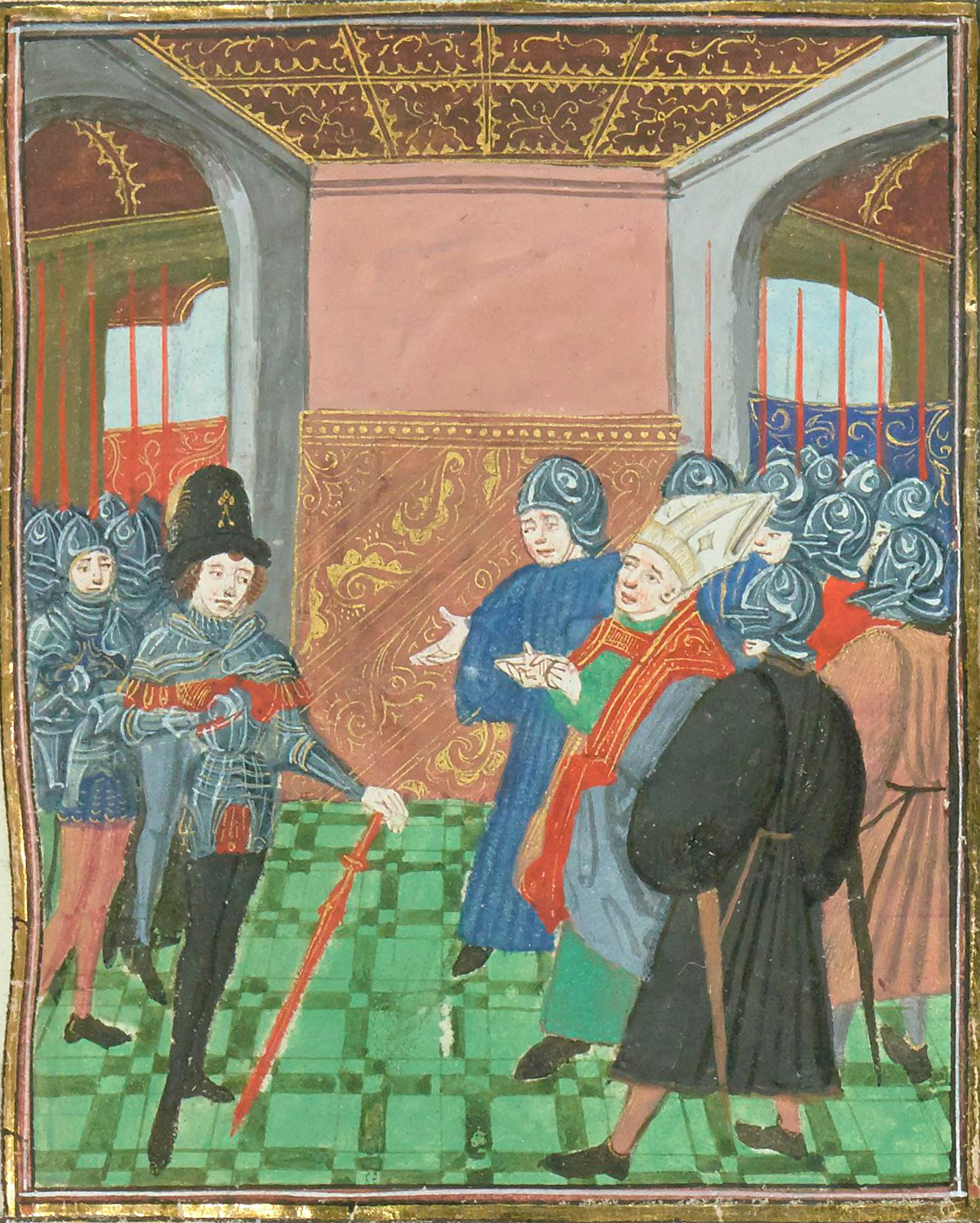
Duke of Somerset in Rouen
Early in July 1449 Charles asked Philip whether he should wage war against the English; he did not wait for a reply before placing his four armies on the borders of lower Normandy. The invasion converged on the duchy from north, east and west. The eastern army found itself outside Rouen in October.

Holed up in Rouen, Somerset was helpless to fend off the French onslaught and was only saved by the arrival of John Talbot, Earl of Shrewsbury. Talbot’s presence was not sufficient to assuage the fears of the English living in the town and Somerset weakly asked the Archbishop of Rouen to negotiate a surrender. Charles VII rode into the city on 10th November 1449;

‘The king of France rode into his said city….to meet the king there came on horseback into the fields the archbishop of the said city, accompanied by many bishops, abbots and other churchmen.’[iv]

This aroused the fury of the folks back home when the news arrived in England. The war was still popular with the populace who felt little effect from its terrors.

Fortress at Caen 
It took seven months for Charles VII to take Caen where the Duke of Somerset was hiding out after fleeing Rouen[v]. This last English stronghold in Normandy held out as Suffolk lost favour with the English for his role in the loss of English holdings in France. Isabella returned to Brussels in the spring of 1450 to the news that Suffolk, enemy to all her hopes of an English alliance, had been arrested for treason.

Henry VI exiled Suffolk but he was picked up crossing the channel by one of the king’s ships and Suffolk was decapitated by the sailors[vi]. Queen Margaret was viewed as supporting French interests over the English who viewed her as partly responsible for the English defeats. On the other side of the channel, to bolster his own legitimacy as king[vii] Charles VII decided to resuscitate the reputation of Joan of Arc. The legality of her trial was questioned by Guillaume Bouille, one of Charles’ councillors  and head of the College of Beauvais.


Besancon
Trouble was rife throughout Philip’s realm. Apart from the troubles in Ghent, Bruges was also a trouble spot as was Rotterdam, Amsterdam and Leiden. In 1451 revolt flared up in Besançon; taxes were not paid and citizens plotted to seize control of the city government.

Philip sent the Marshall of Burgundy Thibauld de Neuchâtel to negotiate with the town. When the negotiations failed Neuchâtel was attacked as he made a clandestine departure from the town. Philip authorised the use of force and Neuchâtel returned in October with 1,600 men. He found the town in the grip of the plague and the ringleaders of the plot were given up for execution.

During early 1450 Philip was embroiled in another financial dispute with the burghers of Ghent who had refused his demand for an increase in taxes[viii]. During this period many medieval towns were discontented with their rulers[ix] and Ghent was no exception. Burgundian hegemony had been won at the expense of thousands of Ghent dead in the previous century[x] and it was to remain a thorn in the side of all of the Burgundian dukes. Ghent was;

‘The most powerful town in the duke’s territories, extremely wealthy in all respects, incredibly large, and with an exceptionally numerous population[xi].’[xii]

Ghent was part of France and held from Charles and the city appealed to Charles for help staving off any revenge Philip took against the town for refusal of his demands. Charles was eager to involve himself in the Ghent debacle to undermine Philip and weaken his authority. .

Philip attempted to interfere with the annual elections in Ghent to place his own men on the town council. In this he failed. In January 1450, at a meeting of the three Estates of Flanders, attempting to negotiate Philip complained;

‘About the aggressions which the Ghenters have committed and are still committing against the duke and his government.’[xiii]

Ghent agreed to hold new elections. In August Philip moved from negotiation, legislating a change in the status of non-resident burgesses[xiv] making them subject to the rule of law.

A Turn of the Screw

Termonde
The following year an attempt was made to seize power in the city on Philip’s behalf, organised by two of his secretaries, Pieter Baudins and Jooris de Bul. The coup failed and when Philip ordered the town to give up the three leaders of the rebellion his demand was refused on the grounds that it infringed Ghent’s civil liberties. The three finally appeared before Philip at Termonde on the promise of a pardon.

In the winter of 1451-2 the common people of the town rose up, revolting against the burgesses, Philip and his officials and anyone else who courted their disfavour by not agreeing to their demands. In October two of Philip’s supporters in Ghent were executed for their parts in the attempted coup of the previous summer.

A general strike was proclaimed when Philip withdrew his bailiff and other officials in protest against the executions. On 16th November the town chose a rechter ende justiciar to fill in for the bailiff until such time as Philip agreed to allow his return. The Justiciar

‘Will swear to look after your rights, prerogatives and privileges, to receive your fines and dues and keep account of them in good time, just as your bailiff has been doing.’[xv]

Ghent
This did not suit the townspeople who chose their own representatives and overturned the civic constitution and elected government of Ghent, replacing it with rule by three hoofdmannen or captains.

Several of Philip’s partisans were executed in the market place. The new representatives of Ghent wrote to Charles VII, Bruges, Liège and Brussels for aid and support in their rebellion. The executions of opponents of the new rulers of Ghent continued as a lengthy dossier of misdeeds and peculations of the old rulers was drawn up.

The discovery that Philip had prohibited the supply of corn to Ghent and set up a blockade around the town, did not go down well with the townspeople. The appeals to other towns were extended to Termonde, Courtrai, Oudenaarde, Aalst and Ninove. Bruges refused assistance and only Tournai[xvi] offered support. Most of Flanders supported their duke.

Bibliography

The Hundred Years War – Alfred Burne, Folio Society 2005

The Reign of Henry VI – RA Griffiths, Sutton Publishing Ltd 1998

Europe: Hierarchy and Revolt 1320-1450 – George Holmes, Fontana 1984

The Fifteenth Century – EF Jacob, Oxford University Press 1997

Margaret of Anjou – Helen E Maurer, Boydell Press 2003

Isabel of Burgundy – Aline S Taylor, Madison Books 2001

Philip the Good – Richard Vaughan, Boydell Press 2014

www.wikipedia.en

[i] The Hundred Years War - Burne
[ii] After an arrest of trumped up charges laid by Suffolk – he was possibly murdered with a slow poison
[iii] Formerly Lieutenant of France 
[iv] Henry VI - Griffiths
[v] His handing over of Rouen to the French was a blow to the prestige of the Duke of York who was captain of Rouen and responsible for its safety; York and Somerset were never to see eye to eye again
[vi] Whose captain Henry Holland was the Duke of York’s son-in-law
[vii] His mother Isabeau had disavowed Charles’ claim to the throne of France in favour of her grandson Henry VI
[viii] Philip promised to abolish all other taxes in return for 24 Flemish groats on all sacks of salt sold in Flanders
[ix] There was a burgeoning middle-class of artisans and Guild members who opposed Philip’s desire to wipe out the gains proffered the townspeople of Ghent following the Battle of the Golden Spurs
[x] At the battle of Roosebeke in 1382
[xi] Circa 200,000
[xii] Philip the Good - Vaughan
[xiii] Ibid
[xiv] Who were almost immune from justice, as were resident burgesses as part of liberties granted in 1297
[xv] Philip the Good - Vaughan
[xvi] A French town

Monday, 4 September 2017

Philip the Good VII


Bruges Market Square
Trouble in Bruges

Philip spent Christmas 1436 in Bruges without serious incident, although his seven hundred strong bodyguard were called out one night when news arrived that some of the crafts guilds were assembling in the market place. The news was false, but showed how on edge Philip was. The discontent in his lands had not died down.

In April one of the Burgomasters of Bruges and his brother were murdered because;

‘He worked with the prince to keep down the common people of Bruges.’[i]

Jehan de Villiers de L'isle Adam
Many of Bruges wealthy citizens fled and Ghent too saw riots in April 1437. Philip decided to frighten his subjects into obedience by marching his army through Bruges. The attempt to overawe failed and on 22nd May Philip escaped death by a hairs-breath when his troops fired on the townspeople in the Fridaymarket.

‘The prince stationed himself on the higher ground of the Fridaymarket….there he was with his nobles, armed, holding a drawn sword in his hand, sitting up on his horse while his men either shot at the common people of Bruges or laid about them with their swords and wounded many.’[ii]

Philip’s most trusted captain, Jehan de Villiers de L’isle Adam was not so fortunate and died on the streets of Bruges. The people turned on Philip’s troops killing seventy-two of them. Philip escaped the town and left for Lille. Twenty-two of Philip’s men were captured and were executed by the citizens of Bruges.

The Aftermath

Sluys
Philip was now at war with his own people. He attempted to starve Bruges into submission. The Zwin[iii] was staked meaning that no ships could travel up to Bruges and the town’s mercantile privileges were given to Sluys. Bruges responded in July by besieging Sluys; Philip raised the siege before the end of the month. Ghent was drawn into the maelstrom with its attempts to mediate which almost resulted in a war between Bruges and Ghent.

Flanders was riven by rebellion, warfare and civil chaos and it was not until February 1438 that agreement was reached at Arras. Bruges agreed to peace terms with her duke that were humiliating in the extreme. The civic authorities were to meet Philip outside the town, bare-headed and bare-foot and kneel in apology to him.

The gates that had been barred against Philip were to be torn down and in its place a chapel was to be erected to hear a perpetual mass for those killed in the fighting. Bruges was also fined among many other penalties. Philip required forty citizens to be nominated for execution before he could bring himself to forgive Bruges. Ten of the citizens suffered the ultimate penalty and their heads adorned the city gates.

Things were no better as famine stalked the land elsewhere. Rotterdam rioted in 1439, the riots linked to a shortage of corn. Holland found itself fighting the Hanseatic League and the Duke of Holstein in a mercantile war.

‘[We] have consented and agreed on behalf of our gracious lord Burgundy, count of Holland, that the Duke of Holstein’s subjects and those of the six Wendish towns[iv] may be damages, seized and injured in lives and goods wherever they can be found.’[v]

The war lasted nearly three years as the Hollanders attacked all Hanseatic shipping. The war was inconclusive and netted no gains whatsoever, bar a few attacks on neutral shipping.

Allies and Enemies

Nuits St Georges
Meanwhile Philip’s southern lands were increasingly attacked by écorcheurs or flayers, so-called because they stripped their victims of everything. Encouraged by Charles VII, the écorcheurs ensconced themselves in the heart of Philip’s duchy, concentrating around Nuits St Georges and Beaune.

The governor of Burgundy Jehan de Fribourg levied troops to defend the duchy. These troops were as much a menace to the local population as the écorcheurs and the local population rose up in revolt in the winter of 1437-8. Towns throughout the duchy refused aid to the troops which were ostensibly meant to protect them. In September 1438 Charles VII ordered the écorcheurs out of southern Burgundian lands; he was ignored and the écorcheurs stayed until the mid-1440s[vi] creating havoc throughout Philip’s southern domains.

In May 1438 Hue de Lannoy, in his role as Stadtholder of Holland, led a Burgundian embassy to England to discuss mercantile matters. By August Flemish economic interests were also under discussion. A conference in Gravelines in December 1438, headed by Isabella for Burgundy and her uncle, Cardinal Henry Beaufort, for the English and a follow-up the next year led to an Anglo-Burgundian trade treaty[vii] in September 1439[viii]. From now on Philip was to remain neutral between the English and the French.

James II of Scotland
Philip was careful to arrange treaties with his neighbours and this included Scotland. The Burgundians had been treating with the Scots since 1426 when Philip sent his first embassy which resulted in a commercial treaty signed the following year. In 1449 the daughter[ix] of the Duke of Guelders was sent as the bride of the young King James II. James wanted grooms for his sisters and, lacking in legitimate daughters Philip made use of the daughters of his nobility or of nobles indebted to him.

Relations between France and Burgundy were not as friendly and Philip frequently had cause to complain to Charles VII about anti-Burgundian actions by the French. Even after Philip requested and obtained a French princess as bride for his son Charles, matters were still often fraught. The Paris Parlement had directions from the king to ignore Burgundian cases brought before them. There was little or no attempt to deal with the écorcheurs who were referred to by the Burgundians as ‘les gens du roi’[x].

Early in 1441 Isabella was sent to Paris on Philip’s behalf to present a series of complaints to Charles, none of which were accepted. She returned back to Burgundy to report on her failure; from now on Philip and his councillors were seldom without worries about possible invasion from France.

Dealings With France

Jehan de Burgoyne
There was a noisy group of courtiers at the French court who proselytised for war with Burgundy; they included Philip’s brother-in-law Arthur de Richemont. The causes of complaint ranged from fishermen’s attacks on Flemish commerce to claims on the county of Étampes which Philip had granted to his cousin Jehan de Burgoyne[xi].

From 1442 onwards the Dauphin Louis led troops into his cousin’s lands. In 1442 he attacked the countryside around Dieppe, in 1443 it was the area around Montbéliard that suffered his depredations. His father besieged Metz while Louis attacked the Swiss with the assistance of the écorcheurs. The French had been freed up to attack Burgundy by the Anglo-French truce signed in Tours on 28th May 1444.

In March 1445 Isabella met with Charles VII at Rheims and produced a list of thirty-two complaints. In May a further set of complaints were presented. Charles and his son meanwhile were attacking Burgundy and the Marshal of Burgundy Thibaud de Neuchâtel reported to Isabella that;

Rene of Anjou
‘The king and my lord the dauphin had secretly ordered these troops to live off Burgundian territory until the conference at Rheims…..and to act in such a way as to ensure that complaints were made about them.’[xii]

The ravages continued after the end of the conference at Châlons in July 1445. A French captain attacked Mâcon and Charolais. Philip was forced onto the defensive and found himself making concessions to the French crown, concessions supported by his French leaning councillors, in particular the de Croys who like many others were on the French payroll.

The major concession Philip made was the release of René of Anjou from all his obligations towards Philip, including the ransom of 400,000 gold crowns[xiii] which he could not afford to pay. The treaty was signed on 6th July but Philip got nothing in return for his virtual surrender to Charles VII bar Charles agreeing to evacuate his troops from Montbéliard.

Bibliography

The Hundred Years War – Alfred Burne, Folio Society 2005

The Reign of Henry VI – RA Griffiths, Sutton Publishing Ltd 1998

Europe: Hierarchy and Revolt 1320-1450 – George Holmes, Fontana 1984

The Fifteenth Century – EF Jacob, Oxford University Press 1997

Louis XI – Paul Murray Kendall, Sphere Books Ltd 1974

Isabel of Burgundy – Aline S Taylor, Madison Books 2001

Philip the Good – Richard Vaughan, Boydell Press 2014

Charles the Bold – Richard Vaughan, Boydell Press 2002

www.wikipedia.en


[i] Philip the Good - Vaughan
[ii] Ibid
[iii] A tidal inlet connecting Bruges to the sea
[v] Philip the Good - Vaughan
[vi] When the Dauphin led them against the Swiss
[vii] The Anglo-Dutch treaty took until 1445 to settle outstanding issues and the Dutch had to pay reparations.
[ix] Philip’s great niece
[x] The king’s people
[xi] For his part Charles VII confirmed the Duke of Brittany as Count of Étampes
[xii] Philip the Good - Vaughan
[xiii] In 2015 the relative: historic standard of living value of that income or wealth is £321,200,000.00 labour earnings of that income or wealth is £2,360,000,000.00 economic status value of that income or wealth is £11,310,000,000.00 economic power value of that income or wealth is £210,000,000,000.00 www.measuringworth.com