|
| Fortifications at Lille |
Marlborough
could not allow himself to be distracted by his wife’s antics back home. The Siege of Lille continued apace and an Allied
assault on 9th September proved bloody and inconclusive. Heavy
shelling of Dutch and English troops based at Entriers gave rise to the
suspicion that the Duc de Vendôme intended to offer battle. But on the 15th
the French decamped to Bruges, cutting off the Allied army from supplies coming
from the coast.
Lille
surrendered on 22nd October, the governor hanging out the white
ensign. 1,700 French horse were conducted to Douai, the rest of the garrison of
6,000 retired into the citadel and the siege continued. Four days before the
surrender Field Marshall Ouwerkerke died.
One day
while Christian was foraging for food and booty she was picked up by some
soldiers of the French army. Christian, dressed in man’s clothing, appealed to
their officer, claiming to be the son of an Irish officer fighting for the
French. She was released. 
Duke of Argyle
Christian immediately made her way to the Duke of Argyle’s quarters, where she found the Duke
and Lord Mark Kerr[i]
playing chess.
‘I asked them with some
warmth, in a language which only became a soldier, and a freedom allowed my sex,
what they meant by having no better intelligence, and idling their time at
chess while the French were on the point of cannonading us.’[ii]
Kerr assumed
that Christian was drunk, but Argyle knew Christian and cross questioned her.
While doing so, confirmation that the French were positioning themselves for an
attack came in and two regiments were sent to clear the French out. The Duke’s
quarters were demolished in the fighting, so Christian made him up a bed of
straw.
Meanwhile the
Duke of Bavaria had laid siege to Brussels, and the Duke of Marlborough marched
to the town’s relief. Hearing of the march, the Duke raised the siege and
retreated to Namur, leaving behind
‘Their wounded, to the
number of eight hundred men, sixteen pieces of cannon, four mortars, and a
great deal of baggage.’[iii]
The siege
works at Lille, suffering from a want of powder, were sapping the walls of the
citadel. The governor beat the chamade[iv] on the 8th
December and the capitulation was signed the following day. The Lille garrison
surrendered on 10th December.
The Siege of Ghent

Eighteenth Century Ghent
Unable to leave the French in possession of Ghent, Marlborough decided to besiege the town. By the 18th December the Allies were ready to fire the town with bombs and cannonades. The French sent the Duc d’Enghien[v] to parlay with Marlborough, who allowed the French to depart the town with all signs of honour.

Duc d'Enghien
‘The place where he rashly
exposed himself, was so very dangerous, that not a man would venture to go to
his assistance. I ran, therefore, and carried him off to a surgeon, under whose
care he was in a fair way of doing well, but a cold he got killed him.’[vi]
When the
siege was lifted Christian was able to enter the town to sell root vegetables
from a garden she had commandeered. The townspeople, having had their supplies
taken by the Allied soldiers, were forced to pay whatever price Christian
demanded.
As happily
as they made their submission to the French, the burghers now presented the
keys to Ghent, in a gold basin, to the Duke of Marlborough,. This pragmatic
approach was eyed with disfavour by Christian.
‘The burghers, who had received the French with open arms, changed sides
with their fortune, and made public rejoicings with thanksgivings in the
churches for their departure.’[vii]

Bruges
In Bruges too, the magistrates sent
to the Duke of Marlborough to submit once the French had quit their town.
Richard’s regiment was quartered in Ghent for what remained of the winter.
Christian made money by cooking for the soldiers and selling them beer. Her
income was supplemented after she and Richard fell in with a local gin seller,
Christian then took to smuggling gin, or geneva, into the town[viii].
Christian
during this period was pregnant again and stricken with a desire for eels. The
man who was to become her second husband, one Hugh Jones; risked stealing eels
from the nets in the town’s moat to appease her cravings. Even before Richard’s
death Hugh attempted to seduce Christian on a number of occasions.
The Nadir of French Fortunes
The winter
of 1708-9 was severe and people froze to death[ix]. The cost of provisions
rose through the roof and in France the vines were killed off. Louis XIV had
expended so much monies on his ambitious European policies that the French
Treasury was almost empty and French trade was impeded by the Dutch and British
navies.
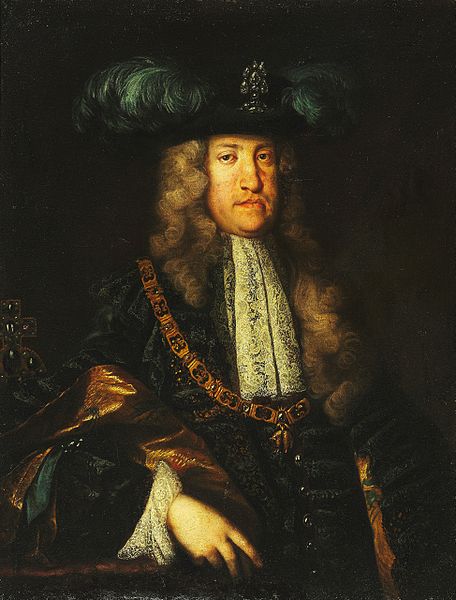
Charles as Holy Roman Emperor
Louis sent
an embassy to the Netherlands to set peace talks in train; he was even prepared
to concede the throne of Spain to the alternate candidate, Archduke Charles[x], despite opposition from his
grandson Philip. The Allies, feeling that their enemy was at their mercy, set
such onerous conditions to any proposed peace that Louis was able to galvanise
the French and the proposals were rejected with loathing. Amidst a general
feeling that the honour of France was at stake, volunteers for the army poured
in.
The 1709 Campaign
Tournai
The peace
proposals had not stopped preparations to continue the war. So when Louis
refused the harsh Allied terms, the Allies turned to Tournai[xi], the French being
positioned in strength before Arras. The town was invested on 23rd
June; the earthworks included the cutting of a new canal to deepen the River
Scheldl; the river’s low water level delaying the arrival of the artillery.

Lord Cobham
The town
capitulated on the 29th and the garrison withdrew into the citadel. The
governor agreed to capitulate by the 5th September, if he was not
relieved beforehand. Richard’s regiment was one of those attacking the citadel
and Lord Cobham[xii] offered a guinea to anyone bringing
down a windmill that stood between the artillery and the citadel.
‘I immediately snatched the
match out of the man’s hand who was going to fire, clapped it to the touchhole,
and down came the windmill. Major Petit, before I fired, bid me take care the cannon
did not recoil upon me…..I was in too much haste to get the guinea, and not
minding the caution, I was beat backwards……the officers could not refrain from
laughing to see me set on my backside.’[xiii]
The town was
not relieved and, after a reassurance that no quarter would be given if the
garrison continued to resist, the French surrendered.
Christian
spent much of her time with her husband and his regiment. When she could
Christian would go treasure hunting, armed with a sword and grappling iron, to
go poking about in wells, walls and searching for buried chests. She had
learned the tricks of the trade, as a young girl, from the habits of Dutch
soldiers, whom William III had taken to Ireland to quell the uprising in
support of James II.

Mons
Before the
fall of Tournai the Prince of Hesse-Kassel, with a force of 16,000 marched to
invest Mons; the remainder of
the army followed after the capitulation. Christian elected to travel to Mons
with the advance party, despite the danger, as there was more chance of rich
pickings.
Christian
found a number of farm animals and birds, trussed ready for travel, and she
appropriated these amongst other items. Then, arriving at the spot designated
for the overnight halt, Christian made depredations from the inn where a
Colonel Hamilton was to be quartered. On his arrival Hamilton found Christian
camped outside admiring the provisions she had set in for herself and Richard.
Christian lied to him;
‘Asked where I had got my
barrel of strong beer. I told him, that falling in with some boors, I drove
them before me, and made them bring me what I wanted; to which he civilly
replied, ‘D—n you, you are a lying devil.’[xiv]
Nonetheless
Colonel Hamilton dined off the shoulder of one of Christian’s sheep that night.
Mother Ross
The French
were already camped before the town and on 11th September the two
armies fought at the battle of Malplaquet, near the village of Taisnieres. The
French were led by the Ducs de Boufflers and Villars, who were unable to prevail against
the generalship of Marlborough and Prince Eugene. The French withdrew from the
field, their army left relatively intact and a continuing danger to the Allies.
Richard
Welsh was killed during the battle; according to Christian she had a
premonition of his death. Taking some small beer[xv] to him in the wood where
his regiment were fighting, Christian was disturbed when, unusually, her dog
started howling.
‘A man near me, who was
easing nature, said. ‘Poor creature, he would fain tell you that his master is
dead’.’[xvi]
Christian
searched through the bodies, uncovering many of her friends before finding
Richard’s body in the process of being stripped by a man. Christian’s grief was
assuaged by a Captain Ross, who sympathised with her[xvii].
‘This compassion from the
captain gave me the nickname of Mother Ross; by which I became better known
than by that of my husband.’[xviii]
Christian
dug Richard’s grave herself and says that she was stopped from throwing herself
in after him by his colleagues.
Mons was now
invested; but the French had managed to get provisions, ammunition, money and
1,000 men into the town. The weather did not cooperate and the Allied trenches
flooded. By the 20th October the besiegers were ready to invest the town,
but were forestalled by the beating of the chamade. The following day the town
and garrison surrendered, ending the Flanders campaign for that season.
Bibliography
Mother Ross
– Daniel Defoe, Oakpast Ltd 2011
Queen Anne –
Edward Gregg, Routledge and Kegan Paul 1980
The
Marlboroughs – Christopher Hibbert, Penguin Books 2002
Marlborough
– Richard Holmes, Harper Perennial 2009
Marlborough
– JR Jones, Cambridge University Press 1993
[i]
British general, Governor of Sheerness 1729-45 and Edinburgh Castle 1745-52
[ii]
Mother Ross- Defoe
[iii]
Ibid
[iv]
A beat of the drum or trumpet sound to inform the enemy that a proposal is
about to be made.
[v]
Son of the Prince de Condé and a Prince of the Blood
[vi]
Mother Ross - Defoe
[vii]
Ibid
[viii]
Duty was payable on goods transported into a fortified town; Christian’s
supplier was attempting to evade the tax, payable to the customs officers at the
gate.
[ix]
There was a mini-ice age at this period
[x]
Brother of the Holy Roman Emperor; Charles succeeded to his brother’s throne in
1711
[xi]
Handed to the Austrians at the end of the war
[xiii]
Mother Ross - Defoe
[xiv]
Ibid
[xv]
Low alcohol beer, as opposed to strong beer, was used instead of water which
was usually not drinkable. Small beer was also produced in households for
consumption by children and servants
[xvi]
Mother Ross - Defoe
[xvii]
There are intimations that Christian had an affair with Captain Ross
[xviii]
Mother Ross - Defoe