Wednesday, 11 December 2013

100 Years War - Bluebeard III


The Siege at Orléans
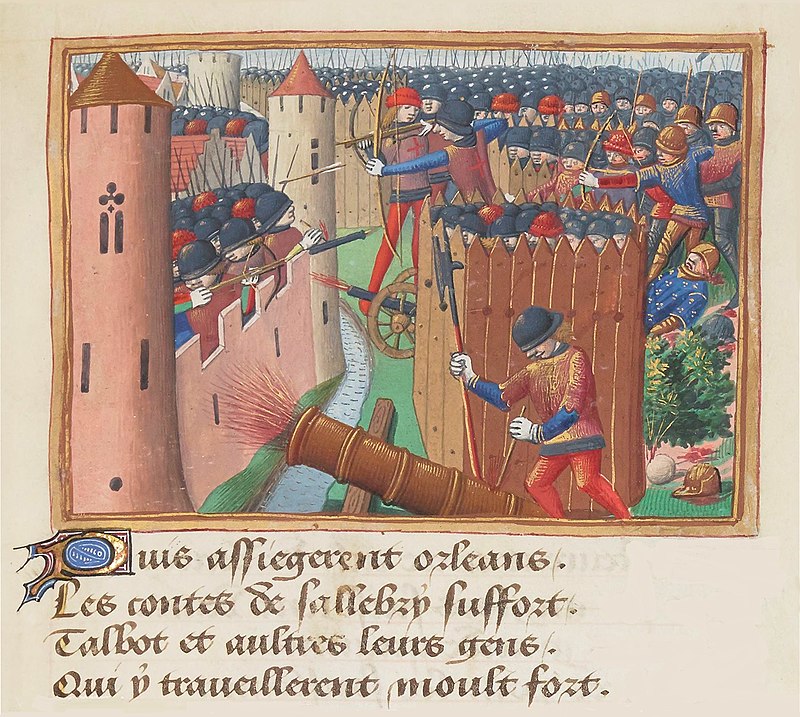
The siege of Orléans was to be one of the defining moments of Gilles’ life. How much he was influenced by Joan is debatable. It is alleged that as early as 1426, well before the death of his grandfather, Gilles was attempting to raise the devil. Strangely, in view of these proclivities, Gilles was a devout man, who lavished money on his chapel and maintained a choir of children, who followed him around as he moved from one of his properties to another. This choir was also to form a pool of victims.
Joan was hedged about by those she was theoretically commanding. Her squire, Jean d’Aulon[i], was one of la Trémoille’s men, as was Gilles the commander of her army. La Trémoille was able to influence Jean Pasquerel, an Augustinian monk who travelled with Joan, and her two brothers.

Xaintrailled coat of arms
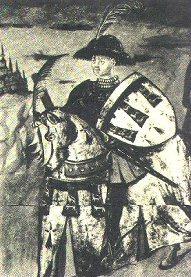
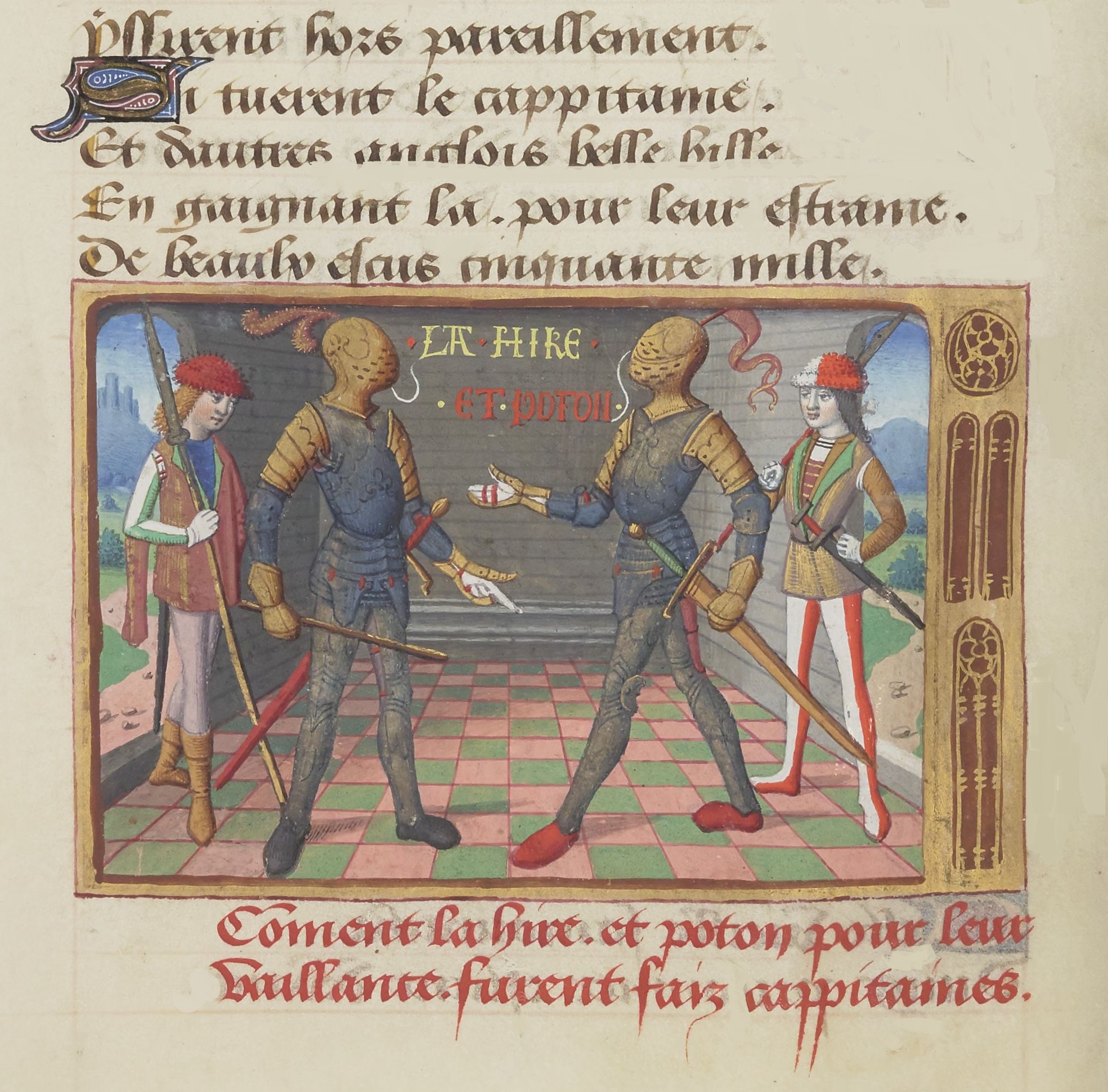
Gilles and the army, along with la Hire and Poton de Xaintrailles caught up with Joan, at Blois. Joan was on a processional tour with Jean de Brosse[ii] in an attempt to capture hearts and minds and reinvigorate the French people for a return to the fight against the English; that had already cost so many lives.
‘In the town of Blois many carts, great and small, were laden with wheat and also a large number of cattle, sheep, cows, swine and other victuals were taken, and Joan the Maid set out, as did the other Captains for Orléans.’[iii]
Yolande had organised the supplies, but was unable to pay for them. Charles sold off his last remaining jewels and borrowed large sums from la Trémoille[iv].

The bridge protecting the southern approach to the town[v] had been taken by the English early on. As a consequence Dunois had ordered the destruction of the bridge, leaving the town isolated from the south. The English army, numbering about 3,500, planned to starve Orléans into submission. Joan and Dunois were able to meet and the pair clashed over tactics; Dunois was taking orders from la Trémoille.
The Rescue
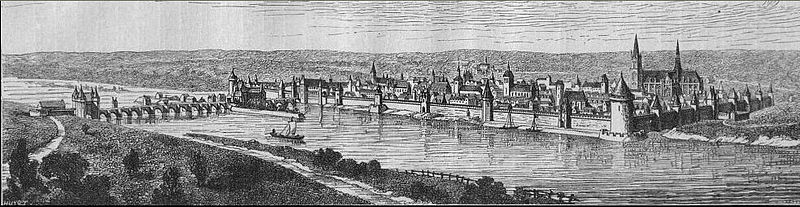
Orleans in 1428
Joan wanted an immediate attack, but there was insufficient food to feed the townspeople and the army and Gilles and Ambroise de Loré were to return to Blois to collect more supplies. Joan and Dunois were to enter the city. At eight in the evening on 29th April Joan entered Orléans in a torchlight parade, while Gilles and de Loré returned to Blois where Gilles was able to organise the fresh supplies and was back at Orléans on 4th May.
‘The Maid sallied forth into the fields…..and went to meet the Bastard of Orléans[vi], the Marshal de Rais…..and many other knights and squires….who bought foodstuffs that the people of Bourges, Angers. Tours and Blois sent to the people of Orléans.’[vii]
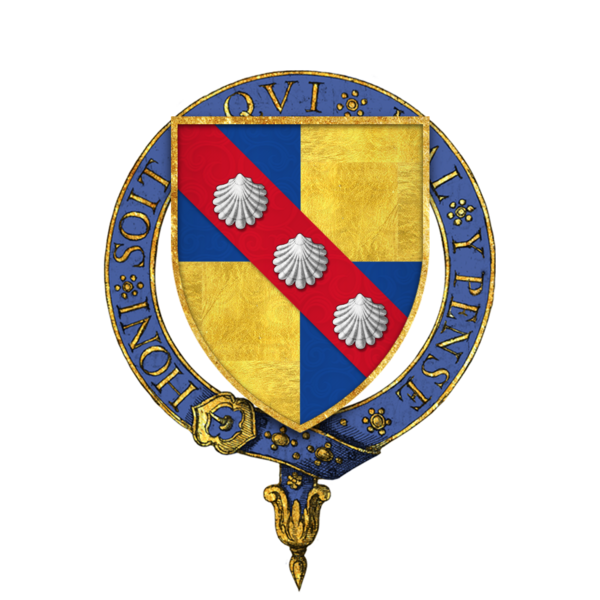
Arms of Sir John Fastolf
That same afternoon Sir John Fastolf[viii] arrived bringing reinforcements for the besiegers. The townspeople, inspired by Joan’s presence, had made a sortie against the English and were being slaughtered. Joan went to their rescue and in turn had to be rescued by Gilles and la Hire, who attacked the English from the rear. The combined French forces then attacked the English fortifications at St-Loup[ix] and took possession.
The Siege Continues

On the 5th May Gilles and Dunois held a council of war from which Joan was specifically excluded. Action on the following day was decided against; a ruling which Joan ignored when she was informed about it. She rode out with a handful of followers against the fortress of les Augustins[x].
‘The Maid placed her standard before the fortress of Les Augustins, where came straightway the Sire de Rais.’[xi]
Despite the decision of the previous day Joan and Gilles were joined by numerous others and les Augustins was taken. The next step was to remove the English from les Tourelles. Against advice Joan joined in the attack, which was faltering in the evening of 7th May. She led a frontal assault, forcing the English into the last redoubt of les Tourelles. Their captain drowned, with many of his men, when the drawbridge gave way and the French took control of this vital gateway to Orléans.

Joan leads an attack on English fortifications
Joan was wounded by an arrow in the attack on les Tourelles. On the Sunday the English took up battle formation and the French drew up against them; but after an hour the English retreated in an orderly fashion towards Melun; this despite some harrying of the rearguard by le Hire’s men. The siege was over. In the evening there were celebrations in the town, continuing into the Monday when, with the clergy at the head, the army paraded from church to church, with Gilles prominent among the commanders.
The Loire Campaign
A friendship between Joan and Gilles was starting to develop; they shared a recklessness in battle and a penchant for the dramatic, they were both drawn to simple solutions to any problem and a fondness for fine clothes.

Gilles was among those who went with Joan to talk to Charles. Joan was determined to have Charles crowned at Rheims, to validate his claim to be King of France[xii]. La Trémoille was determined that Joan should not have things all her own way and a number of alternative next moves were proposed. However Joan was adamant and in the end her proposals prevailed, although Charles insisted on a campaign in the Loire valley.
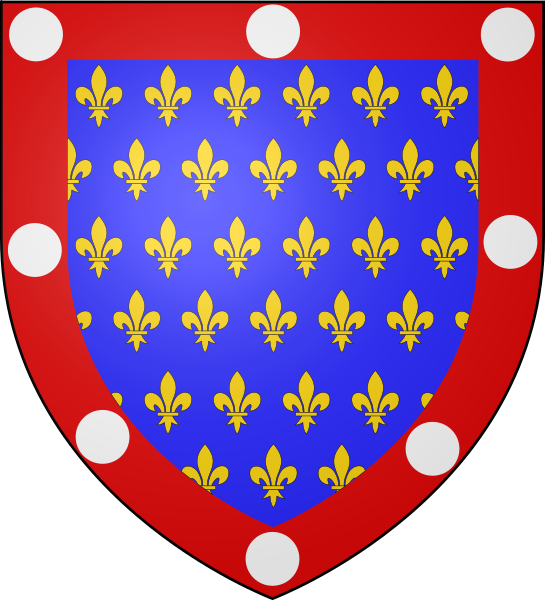
Alencon coat of arms
It was during this period of negotiations that Gilles’ star was eclipsed with the return to court of the Duke of Alençon, who had been in English hands since 1425. He was created Lieutenant-General of the French army.

Battle of Jargeau
It may be assumed[xiii] that Gilles fought at the battle of Jargeau, where the English were defeated and on 12th June the walls of the town were scaled. The Earl de la Pole[xiv] and his brother John were captured. On the 15th the army marched towards Beaugency, taking the bridge at Meung by a frontal attack. The following day they entered Beaugency, the English having withdrawn into the castle. The army was now joined by de Richemont and his men. The English agreed to leave the castle and to restrain from fighting the French for a period of ten days.

Joan on campaign
The English were sending relief under the command of Fastolf and Talbot; their attempt to retake the bridge at Meung was forestalled and the English made camp at Patay. On the 18th June the French defeated the English in a battle that was the turning point in the war. In just over a month Joan had turned around French fortunes.
Charles did not meet with his victorious army until 24th June, possibly held back by the jealous la Trémoille. After negotiations Charles left Gien on 29th en route for Rheims. They arrived at Auxerre on 1st July, where la Trémoille persuaded the town to surrender, thus enhancing his own reputation.
On the 4th July Joan wrote to Troyes demanding that the town surrender; they refused and the army, despite low morale, prepared to besiege it. Joan insisted that the town would fall in two days. A pro-French monk, Brother Richard, in the town had been promoting surrender, but was concerned that Joan was a witch. At her trial Joan said of the meeting;

‘It seemed to me that the people of Troyes, fearing that this was something that did not come from God, sent him to me. And when he came to me, approaching, he made the sign of the cross, and I said to him:

‘Approach boldly – I will not fly away.’[xv]
The siege lasted five days; when Joan had the assault sounded the Bishop and townspeople came out to treat with Charles. The English garrison was to depart and the citizens would receive a pardon. The English demanded to be allowed to take their prisoners with them but Joan would not allow this.

The Coronation
Following the surrender of Châlons, on 16th July a delegation of the townspeople of Rheims met with Charles and handed him the keys of the city. Given the exposed position of Rheims it was decided that Charles must be crowned the following day, a Sunday[xvi]. Much of the royal regalia was in English hands in Paris.

Basilica St-Remy
Gilles was one of the four nobles selected to collect the Holy ampulla from the Abbey de St-Rémy and carry it to the Notre Dame, where the coronation took place.
‘The Marshal de Boussac, my lords de Rais and Oraville and the Admiral (Culan) with their four banners, which each carried in his hand, armed at all points and on horseback and with a fitting retinue.’[xvii]

Notre Dame de Rheims
Gilles was made a Marshal of France the same day. It was on this day too that Joan wrote to the Duke of Burgundy demanding that he make peace with his suzerain.
Bibliography

The Hundred Years War – Alfred Burne, Folio Society 2005
The Real Bluebeard – Jean Benedetti – Sutton Publishing 2003

The Reign of King Henry VI – RA Griffiths, Alan Sutton 1998
Joan of Arc – Edward Lucie-Smith, Penguin 2000


[i] Later to become Chamberlain
[ii] Later a Marshal of France
[iii] The Real Bluebeard – Benedetti
[iv] Presumably money he had already given the favourite
[v] Built on the north bank of the Loire
[vi] Dunois
[vii] The Real Bluebeard - Benedetti
[viii] Given immortality by Shakespeare as Sir John Falstaff
[ix] To the east of the town
[x] To the south of les Tourelles guarding the bridge
[xi] The Real Bluebeard - Benedetti
[xii] The young Henry VI had yet to be crowned King of France and when he was, it was in Paris rather than Rheims where all coronations took place.
[xiii] After his fall from grace reference to Gilles was removed from many official records
[xiv] He was married to the granddaughter of Geoffrey Chaucer
[xv] Joan of Arc – Lucie-Smith
[xvi] The traditional day for coronations
[xvii] The Real Bluebeard – Benedetti

Wednesday, 4 December 2013

100 Years War - Bluebeard II


The Court
Charles VII & Yolande d'Aragon
In October 1422 Charles VII claimed the throne left vacant by the death of his father Charles VI. By the terms of the Treaty of Troyes, following the battle of Agincourt, Henry V of England was to become king upon the death of his father-in-law. But Henry had died in August 1422 and his infant son, Henry VI, was proclaimed king of France with his uncle the Duke of Bedford, acting as his Regent.

Charles established his capital at Bourges[i], but by 1424 his base of operations had been moved to Poitiers. Charles’ seemingly ineffectual nature was overwhelmed by the ambitions of his mother-in-law, Yolande d’Aragon.
Yolande identified Jean VI[ii], the Duke of Brittany, as a key man to win over to Charles’ side. Jean was a weathervane, changing the direction of his support with alarming frequency[iii]. In 1423 Jean had signed the Treaty of Sablé along with English and Burgundians.

Yolande’s plan was to enmesh the Duke of Brittany by wedding her son, Louis III of Anjou, to Jean’s daughter Isabel. The English played into her hands when, in June, the Duke of Bedford stripped two of Jean’s castles to give to one of his nobles. The marriage contract was signed on 7th October 1425 and Charles VII, Jean de Craon and Gilles de Rais were among those present at Saumur for the occasion. It was the first time that Gilles met Charles.
Arthur de Richemont
The Duke of Brittany’s brother Arthur, Duke de Richemont[iv] was made Constable of France. De Richemont was indebted to de Craon for arranging his ransom from the English and for setting up the negotiations leading to his becoming Constable. De Richemont was also determined to find a place for his cousin Georges de la Trémoille[v] at court.

The Favourites
De Richemont, whose crude manners made him no friends at court, attacked the English at St James de Beuvron[vi] in February 1426. There is no evidence that Gilles was at the battle, but it is highly possible that this violent young man was part of the French attack. Despite outnumbering the English 20-1 the French failed to take the town. De Richemont was hampered by his detractors at the courts of France and Brittany and his demoralised troops were not fed or paid.

In the early part of 1427 Yolande d’Aragon appointed the seventy year old de Craon Lieutenant-General of Anjou[vii]. The task of raising five companies, to join in the raids harassing the English, was given to Gilles.
La Tremoille arms
The king’s former favourite, Pierre de Giac, had been murdered at de Richemont’s behest[viii]. The new favourite Camus de Beaulieu[ix] was determined to stop anyone influencing the king. This intransigence led to de Beaulieu being cut down by one of the Constable’s friends and his men. De Richemont proposed that Charles take de la Trémoille as a friend, painting a picture of his cousin’s devotion to the king, who was unimpressed;
‘A pretty story, cousin. But you’ll live to regret it. I know him better than you do.’[x]
The Soldier

In the summer of 1427 Gilles was serving in the campaigns, under the mentorship of an experienced soldier, Guillaime de la Jumellière[xi], appointed by his grandfather. The five companies were part of an army under the leadership of the veteran Ambroise de Loré. Gilles took a huge retinue and his soldiers were well-paid; he also had a large number of spies under retainer keeping him well informed.

La Hire (left)
St Jean de Mortier, Ramefort and the castle of Malicorne were taken and then Gilles and his companies went to Montargis, joining forces with de Richemont and la Hire[xii] to take the town. Gilles and his men then travelled to Lude, where the castle[xiii] was commanded by an Englishman named Blackburn, who had sworn to defend the castle to death.
Lord Talbot
Gilles displayed considerable bravado in the attack, climbing over the top of the castle wall he came face to face with Captain Blackburn and killed him. As the hero of the day Gilles’ decision seems to have been taken as final with regard to the prisoners[xiv]. The French then moved on to Le Mans, where they took the town, but the garrison was relieved by the arrival of Lord Talbot[xv].

The Chamberlain
La Trémoille had himself made Chamberlain and ensured that anyone he considered a danger to his position of favourite was kept away from Charles. As Chamberlain he was able to engineer the fall of de Richemont, who had few supporters at court[xvi]. His position had been weakened by his brother Jean V’s return to the English fold in the spring of 1426. La Trémoille decided to take an interest in his naïve, rich cousin, who was the victor of the hour.

Gilles quickly became popular at court; he was rich, witty, handsome and more to the point, schooled by his grandfather, unscrupulous. La Trémoille knew that Gilles was only interested in his own pleasure. La Trémoille did not particularly care for his cousin saying in 1435, after Gilles’ arrest;
‘It is good to advance him in being bad.’[xvii]
Gilles had just taken a handsome ten year old boy, Etienne Corillaut known as Poitou, into his service[xviii].

In early summer 1428 de Richemont made his long awaited attempt at a comeback. At Bourges, which Charles had made his capital, de Richemont and his men invited the townspeople to hand over the administration to himself. His men marched in and seized Charles’ treasury and began levying taxes.
La Trémoille raised an army and marched on Bourges; no fighting took place and on 17th July a settlement was negotiated; an agreement that la Trémoille had no intention of keeping.

The Earl of Salisbury
In the meantime the English had gone onto the offensive, meaning to end the war between the two countries permanently. Charles controlled the lands south of the Loire, while the English held those from its north bank upwards. The plan was to take Orléans[xix] and then on southwards. The Earl of Salisbury landed in Calais on 24th June with fresh troops. The fighting between de Richemont and la Trémoille allowed the English unimpeded access to Orléans.
Soldiering Again

Jean de Dunois
The siege of Orléans began in October and there was a failed attempt to raise the siege in February 1429. The majority of the French commanders deserted the city, leaving only Jean de Dunois[xx] to organise the defence. It was now that word of a visionary shepherdess began to circulate. Joan of Arc was en route to meet with Charles, under the protection of Robert de Baudricourt[xxi]. She was examined by members of the court, including Yolande[xxii]; she was then examined by members of the clergy and finally she was given permission to proceed in March 1429.
On 8th April 1429 Gilles de Rais agreed to serve de la Trémoille[xxiii],

‘Until death and with his life.’[xxiv]
for the honours given him by his cousin. It was la Trémoille who had Gilles made a Marshall of France at the tender age of 23 and he was placed in charge of the army that accompanied Joan to Orléans.

‘About the end of April my Lord of Rais, Marshal of France, and many other captains, as well as common soldiers, were assigned to the Maid.’[xxv]
During the campaign Gilles role was to represent la Trémoille and to pass information back to him.

Bibliography
The Hundred Years War – Alfred Burne, Folio Society 2005

The Real Bluebeard – Jean Benedetti – Sutton Publishing 2003
The Reign of King Henry VI – RA Griffiths, Alan Sutton 1998

Joan of Arc – Edward Lucie-Smith, Penguin 2000
John Talbot and the War in France – AJ Pollard, Pen and Sword Military 2005


[i] In the province of Berry, now in the Department de Cher
[ii] A man with close connections to the English court, his mother Joan of Navarre having become Henry IV’s second wife
[iii] His troops had been prevented from coming to the aid of the English at Agincourt
[iv] Later became Duke of Brittany after the death of his nephew Peter II. Arthur supported Charles VII after his request for an army command with the English had been turned down by Bedford.
[v] De la Trémoille had been part of the court of the Duke of Burgundy, a prominent ally of the English. He had fought for the French at Agincourt at been ransomed, unlike the premier noble of France, the Duke of Orléans
[vi] Near Avranches
[vii] Involving the levying and command of troops
[viii] With the connivance of Yolande and Charles d’Albret
[ix] Commander of one of the companies of the royal guard and a protégé of de Richemont
[x] The Real Bluebeard - Benedetti
[xi] Shown in Gilles’ accounts as Monseigneur de Martigné
[xii] Étienne de Vignolles, one of the French army commanders
[xiii] Built as part of the defences for Anjou
[xiv] The English were freed, but the French collaborators put to death, although many of his co-fighters were dismayed at the loss of ransom possibilities
[xv] The English Constable of France and Earl of Shrewsbury; by June 1428 Maine was back under English control
[xvi] De la Trémoille also appears to have helped destroy Joan of Arc, both actions of jealousy, crippling the French by ridding the army of their best commanders
[xvii] Ibid
[xviii] Poitou was to go to the stake with Gilles
[xix] Whose duke was a prisoner in England
[xx] Half brother of the imprisoned duke; also known as the Bastard of Orléans
[xxi] Captain of the royal garrison at Vaucouleurs
[xxii] Who tested her virginity
[xxiii] One of his distant cousins, first met during the Brittany-Dauphin feud
[xxiv] Joan of Arc – Lucie-Smith
[xxv] The Real Bluebeard - Benedetti